No party is free of blame for weakening federalism
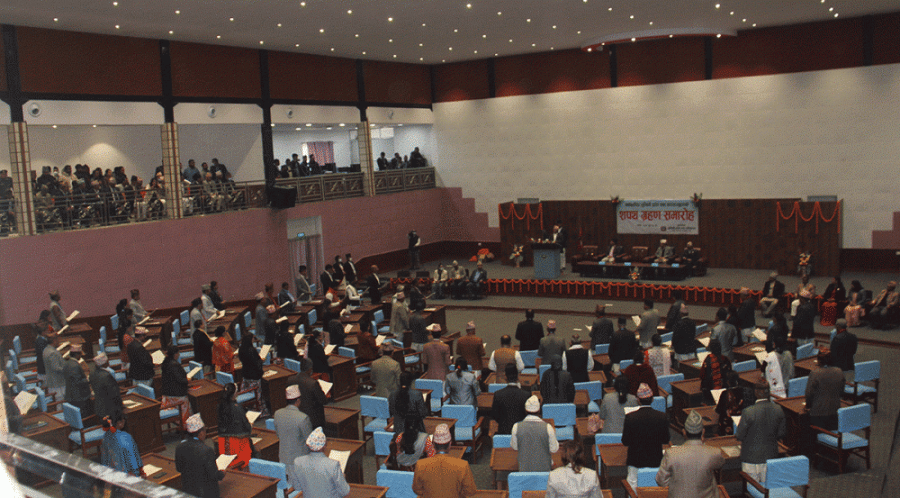
The legacy parties’ criticism of the RSP is hollow given their own record of unstable provincial governments, delayed laws and centralisation. Post File Photo
The ‘legacy parties’ appear apprehensive following the Rastriya Swatantra Party’s proposal to scrap the provincial assemblies and to make the National Assembly and local units partyless. They have accused the ruling parties of trying to weaken federalism under the guise of rewriting the constitution. As a result, the Nepali Congress, the main opposition, along with the CPN-UML, has withdrawn from the panel led by Ashim Shah, political advisor to Prime Minister Balendra Shah, which was formed to draft a discussion paper on constitutional amendment. Also, withdrawing from the panel are Nepali Communist Party, the Loktantrik Samajbadi Party, the Janata Samajbadi Party and the Rastriya Janamorcha. While the opposition’s concerns over the future of federalism carry some weight, they have little moral authority to criticise the RSP on this issue. Their own actions over the years have done more to weaken federalism than to strengthen it and they continue to do so even today.
Only on Wednesday, four Congress ministers in Karnali’s UML-led government resigned in retaliation for the UML’s refusal to hand over the chief ministership. Hours later, Sudurpaschim Chief Minister Kamal Bahadur Shah of the Congress dismissed four UML ministers from his Cabinet. In Sudurpaschim, the UML had been obstructing the passage of the budget over the same dispute—the Congress’s refusal to hand over the government leadership to the UML. These two incidents are indicative of how the older parties continue to play the cheap game of power even after the debacle of the March 5 elections just four months back. Their moves have only contributed to subverting the federal structure.
There is a long list of ways in which the parties now crying foul over the RSP’s proposal have done little to strengthen federalism while they had the power to do so. The provincial governments formed after the 2017 general elections proved to be unstable. In the decade since the promulgation of the Constitution of Nepal in 2015, which institutionalised federalism, the Nepali Congress, the CPN-UML and the CPN (Maoist Centre)—now the NCP—have led governments with comfortable majorities in Parliament. Madhesh-based parties, too, have been part of successive governments. Yet they failed to take concrete steps to equip the provinces with the laws and institutions necessary to function effectively. On the one hand, the failure to enact essential laws weakened the provinces. On the other hand, provincial governments repeatedly became casualties of changes in coalition politics at the federal level.
Following the 2017 elections, the government changed eight times in Koshi Province, four times in Madhesh, six times each in Bagmati, Gandaki and Lumbini, four times in Karnali, and five times in Sudurpaschim. Only the governments in Madhesh and Sudurpaschim completed their full five-year terms after the 2017 polls. In the other provinces, governments were reshuffled in tandem with shifts in the ruling coalition in Kathmandu. Today, the Congress-UML coalition governs six provinces, while Madhesh Province has a three-party coalition government. Having failed to grasp the message voters delivered through the ballot box, the traditional parties continue to control the provinces from Kathmandu, limiting their autonomy.
The RSP, for its part, has shown little initiative to strengthen the federal system either. As the leading force in government, it could at least have initiated the integration of the Nepal Police into provincial police forces and introduced the legislation required for the full implementation of federalism. The legacy parties must mend their ways. The ruling party, too, needs to align its actions with its election promise of strengthening federalism.




 24.79°C Kathmandu