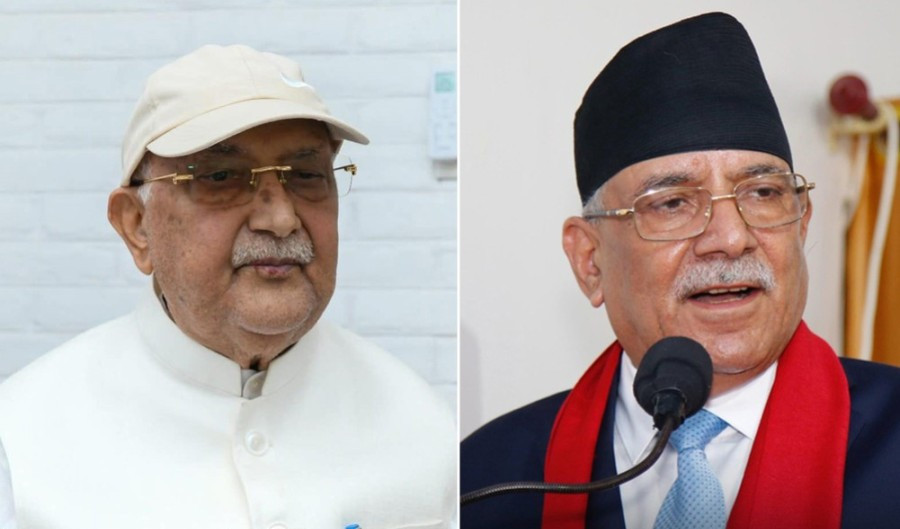
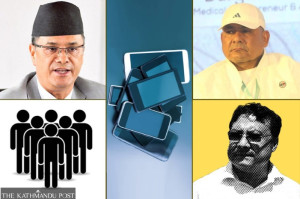
There is nothing new about Nepali political parties, particularly the communist forces, forming alliances and merging. Adding a new episode to this recurring trend, the KP Sharma Oli-led CPN-UML and Pushpa Kamal Dahal’s Nepali Communist Party are in intense discussions about forming an alliance, with the larger goal of merging the two parties. If Dahal’s statement in Janakpur is to be believed, a conducive environment for this merger has already been created. He has asked provincial leaders to collaborate with the UML to form governments. Leaders from both parties have realised the need to come together for the national interest.
However, it is clear that the renewed push for an alliance is largely the result of the debacle in the March elections and the need to prepare for the forthcoming provincial and local elections. Both parties suffered a historic defeat in the polls. Barring Nepal’s first general election in 1959, never have the communist parties been reduced to such a weak position.
Nepal has a large number of registered political parties—135 in total—which is quite high for a country with less than 30 million people. Except for the recent election that reduced the number of parties in the House of Representatives to six, Nepal’s Parliament has often had a large number of parties—sometimes dozens. So, an alliance among parties with a common ideology is a welcome development, provided it is long-lasting. More importantly, it should do more good to society than harm. Political stability and policy continuity are possible only when parties come together with a clear purpose that goes beyond electoral calculations and short-term power sharing.
However, past experience shows that such alliances or mergers have done more harm than good to the state machinery. The UML and then CPN (Maoist Centre) jointly contested the 2017 elections before merging in May 2018 to form the Nepal Communist Party. After securing a thumping majority in the parliamentary elections, people expected the unified party to ensure a stable government capable of delivering on its promises. Instead, the party became more engaged in internal disputes than in governance. The prolonged tussle resulted in Oli dissolving the House of Representatives twice, pushing the country into a political crisis. The huge public mandate went to waste.
Now, as they once again move closer, the leadership of both parties should be clear about what the alliance is meant to achieve. This is the right opportunity for them to establish a stable, consolidated party representing communities inclined towards left politics. But if their sole purpose is to form provincial governments or improve their electoral results, they are seriously mistaken. Recent elections have shown that people are increasingly able to distinguish lofty promises from actual delivery and to judge parties by how closely they remain connected to their voters.
Therefore, the two parties face a daunting task in convincing the public that the present attempt at left unity is different from the last one. If they keep repeating past mistakes, no matter what initiative they take, it will not stop further erosion of their political strength or restore the trust they are steadily losing.




 14.4°C Kathmandu