In the election build-up, RSP faces increased scrutiny
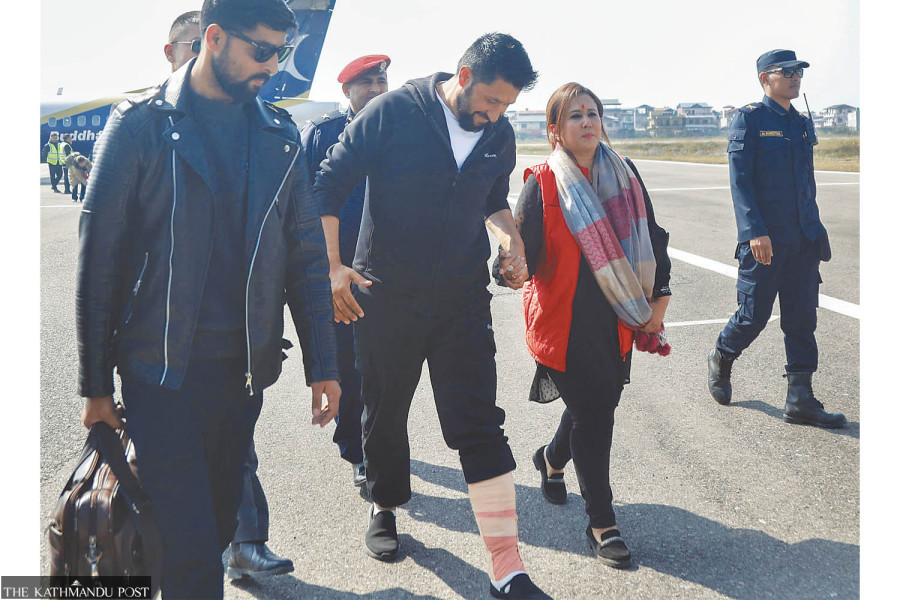
Opponents and party insiders point to problems, some even charging new force with code of conduct violations. RSP chief Rabi Lamichhane, with a bandaged leg, arrives at Bharatpur airport on Thursday. Post Photo
The Rastriya Swatantra Party (RSP), which emerged as the country’s fourth-largest political force in the 2022 elections by criticising the flawed political culture of older parties, is itself being criticised for its recent un-political activities.
From the closed list it submitted to the Election Commission under the proportional representation (PR) system to the anomalies seen in its election campaign, the party’s missteps mirror those of the established parties it once challenged.
In violation of election rules, the party replaced the highest number—38—of candidates among all the parties in its closed PR list. In the closed list, a party can include only new candidates in place of those who opt out. However, even as only two candidates withdrew from the closed list, the party replaced an additional 36 candidates.
It also violated its own rules in selecting the first-past-the-post (FPTP) candidates. The selection of candidates through primary elections was a key differentiator for the party. However, it failed to implement the primary ruleeven after raising thousands of rupees from the aspirants.
It charged Rs25,000 from each aspirant for the FPTP. However, shortly before the Election Commission’s January 20 deadline for candidate registration, the party said it was still in the process of unification and ultimately did not conduct the primaries.
The party argued that holding primaries at that stage would have been unfair on new members who had entered the party through recent mergers, and cited lack of time as another reason for not following the plan. Even so, the party faced criticism for not refunding the Rs25,000 each collected from those who had expressed interest in participating in the primaries.
Pranay Rana, an aspiring candidate from Kathmandu constituency-5, has demanded that the party return the Rs25,000 it collected in the name of holding primary elections. After the party collected the fee for the primaries but eventually nominated Sasmit Pokharel as the candidate from the constituency without internal contest, Rana posted a video on social media on February 3 and demanded that his money be refunded.
However, the party’s co-spokesperson, Pratibha Rawal, disagrees with Rana’s claim. “The fee collected from those wishing to run as first-past-the-post candidates was not meant for holding primaries, but rather a charge for expressing interest in being a party candidate,” Rawal said. She added that Rana is making accusations only because he was not picked as a candidate.
The party has previously been accused of failing to make public the results of the primary elections it conducted. A few months ago, the party held a primary for the by-polls that were supposed to be held in November for the House seat in Rupandehi-3. Although the by-election was postponed following the Gen Z protests in September, the party never disclosed how many votes each contender received.
The RSP candidates have made more mistakes on the campaign trail.
A few days ago, the Election Commission sought clarification for the second time from RSP candidate Balendra (Balen) Shah who is challenging four-time prime minister KP Sharma Oli in Jhapa-5 constituency.
According to the commission, the clarification related to an audio-visual material related to Shah’s election campaign. The commission said a complaint had been lodged alleging that plainclothes police asked voters to support Shah.
The commission had also expressed concern over the reported deployment of plainclothes police alongside Shah’s wife during the campaign. Asking what exactly happened in the incident, the commission has instructed Shah to submit a written clarification.
The commission warned that if a candidate or individuals acting on their behalf are found to be involved in activities that violate the Election Code of Conduct, action will be taken in accordance with prevailing election laws.
Earlier, the commission had also sought clarification from Shah over a comment he made on UML chair Oli’s Facebook post.
Analysts say mistakes during campaigning are not limited to RSP candidates; others have also taken such missteps. However, they argue that criticism is natural when a party that rose to prominence by criticising older parties and their corrupt political culture ends up emulating them.
“Politics in any country is a reflection of the society, and the RSP is no different, as it is a product of Nepali society,” said Pitambar Bhandari, head of Conflict, Peace, and Development Studies at the Tribhuvan University. “But while the party presents itself as fundamentally different from others, its actions do not fully support that claim.”
But the party’s joint general secretary, Bipin Acharya, maintains that the RSP is still evolving. Yet, when partial information about its activities comes to light, it faces criticism.
“We understand that there are no excuses for flouting election laws and election code of conduct. So the RSP is complying with them,” said Acharya. “However, being a highly visible and much admired party, even minor mistakes are being amplified.”
The party is also accused of using children in its election campaign. Speaking at a press conference organised by the Nepali Congress central office in Lalitpur on Thursday, party spokesperson Devaraj Chalise said they were preparing to file a written complaint with the Election Commission over the issue.
“The use of children in election campaigning is objectionable. We will lodge a complaint on this matter,” Chalise said, without naming a party.
Before that, the party had conducted a primary election to select the RSP’s candidate for the proportional representation (PR) list. However, when the people who did poorly in internal evaluation were placed higher when the party submitted its PR list to the election commission, RSP was criticised for placing individuals close to party leaders ahead of others. Amid such allegations, however, the party claimed that the primary election conducted for the proportional category was incomplete.
The party maintained that the primary election would carry a weight of 50 in determining PR candidates, while the remaining 50 marks would be decided through an internal evaluation. Acharya, the RSP joint general secretary, claims that the party is still playing by the rules.
At the time, the provision requiring individuals interested in participating in the proportional primary to pay a fee of Rs50,000 also drew criticism.
Some leaders in the party opposed the rule, arguing that proportional representation is meant to include minorities and communities that have struggled to enter mainstream politics. Requiring a Rs50,000 payment simply to compete in the primary, they said, undermined that objective. Their concerns, however, went largely unaddressed.
However, party co-spokesperson Rawal claims that the amount was intended for those who could afford it, while 25 individuals who could not pay still contested the primary for PR.




 14.7°C Kathmandu