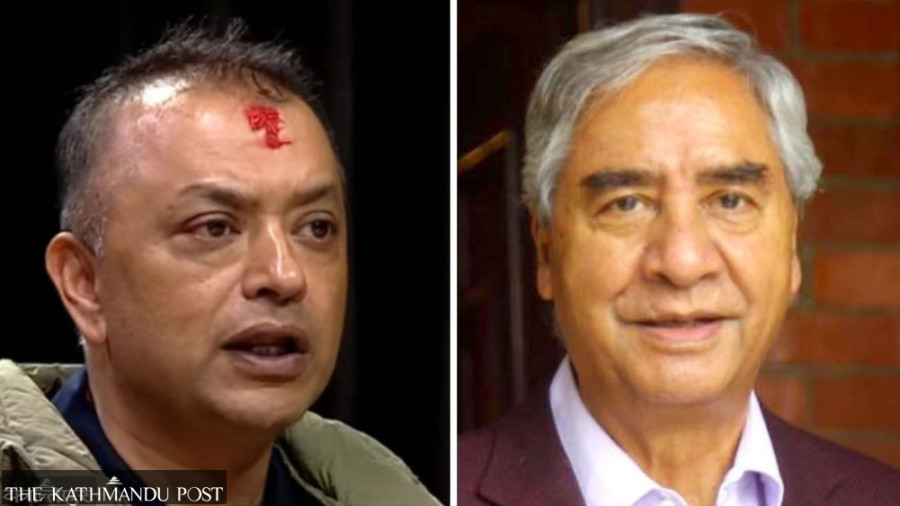
Under newly elected party president Gagan Thapa, the Nepali Congress entered the election race with renewed energy and confidence. Several leaders close to former party president Sher Bahadur Deuba and senior leader Shekhar Koirala, who strongly opposed the special convention, are contesting the March 5 elections.
However, the absence of several influential leaders, both as candidates and in the electioneering, could impact the party’s electoral showing, party leaders and cadres say.
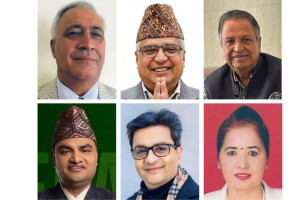
Several influential leaders who won the previous elections have been denied tickets, including vice-presidents Purna Bahadur Khadka and Dhan Raj Gurung, former general secretaries Prakash Man Singh and Shasanka Koirala, and leaders such as Ramesh Lekhak and Ramhari Khatiwada.
Leaders close to Thapa are concerned that staunch opponents of the convention could resort to non-cooperation during the polls.
“Some leaders close to Deuba who vehemently stood against both the regular and special general convention are not positive towards the new leadership,” a leader close to Thapa said on the condition of anonymity. “We fear there could be non-cooperation from their side, which will affect the election results.”
Amid a prolonged dispute and intense internal power struggles, the Congress held its second special general convention in mid-January. It elected Thapa as party president and formed a new central working committee under his leadership. However, the Deuba camp refused to accept the convention’s process or its outcome.
As a result, the legitimacy of the second special general convention was first challenged at the Election Commission and later taken to the Supreme Court. The commission upheld the convention, citing the participation of more than 56 percent of the general convention delegates. The court also didn’t immediately overturn that decision, though a writ petition lodged by those close to Deuba is still sub judice.
The fear of non-cooperation by the dissident faction is not limited to leaders close to Thapa. It has trickled down to the grassroots. Anuj Regmi of West Nawalparasi is among those spooked.
“If leaders like Deuba in Dadeldhura, former vice-president Khadka in Surkhet, or Singh in Kathmandu do not actively support the party during the election, it will inevitably hurt us,” Regmi said at an event held in the Capital on Monday. “If leaders like Deuba, who had won past elections from their strongholds, remain silent, the election results will not be in our favour.”
But Devi Prasad Acharya, a party activist from Morang-2, believes the leadership change ahead of the House of Representatives election, which came on the back of the Gen Z uprising, will benefit the party despite the absence of some leaders.
Top leaders from Thapa’s team are also hopeful the Deuba camp will support the party.
“Though some of the party leaders are not actively participating in the election, we believe they would not refuse to support the party during the election,” said party General Secretary Gururaj Ghimire.
Addressing an event in Janakpur on January 30, Thapa said he remains in constant touch with senior leaders, including Deuba.
“I am in regular communication with our former party president, the respected leader Sher Bahadur Deuba, as well as other senior leaders,” Thapa said. “I urge everyone not to hold on to past grievances or misunderstandings.”
Puranjan Acharya, a political analyst close to the Congress who is currently touring several districts of Koshi Province, said he has seen many senior party workers become inactive. Analysing the reasons behind this, Acharya notes that while the party did not formally split after the special convention, it has endured some damage as leaders who have long shaped the party’s identity have stayed inactive during the election period.
“The impact of that is now being felt at the district level,” Acharya told the Post.
However, some Congress leaders argue that the claim of non-cooperation doesn’t apply to every leader. Ramhari Khatiwada of Okhaldhunga is among the leaders who initially received a party ticket but was denied later. Khatiwada said he will do everything possible to strengthen the party, even though he didn’t get a ticket.
Khatiwada added that the country is going through a difficult phase and questions about who got a ticket and who did not can be assessed after the election. “This is the moment to support the party and its candidates,” he said. “I will extend that support from my side.”




 14.81°C Kathmandu