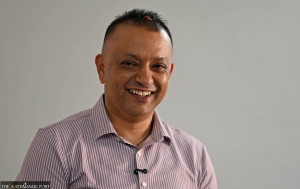
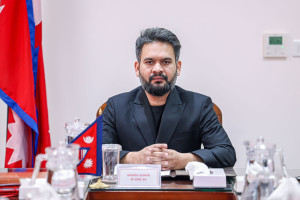
Gagan Thapa is a familiar name in Nepali politics. On Wednesday, as Thapa became the sole official candidate for party president at the special convention, he took another momentous step towards establishing a lasting political legacy.
Thapa was born in Kathmandu on July 16, 1976 as the second son of Mahendra Kumar Thapa and Rameshwori Thapa.
Thapa, 49, a one-time host of religious programmes and news shows on radio, now has a broader audience, waiting to see the kind of guidance he can provide to the country’s oldest political party and a potential leadership for a politically fractured country, especially after the September Gen Z uprising that saw dozens of youths dead and edifices of major state organs burnt down.
The party faction led by Thapa and Bishwa Prakash Sharma locked his unopposed election as party president at the special general convention held at Bhrikutimandap, Kathmandu on Wednesday.
At Sanepa in Lalitpur, a parallel meeting of the party’s Central Working Committee, convened by the faction led by Congress chief Sher Bahadur Deuba, decided to expel both Thapa and Sharma from the party for five years.
Both Thapa and Sharma were elected general secretaries of the Congress through the 14th general convention that reelected Deuba the party president.
Thapa’s grandfather, Bhim Raj, was a resident of Solukhumbu district. The family later settled in Kathmandu after his father moved there for education, and later a job.
As Gagan Thapa has shared in various media interviews, his father worked as an engineer at the Nepal Electricity Authority. Gagan spent part of his childhood in Sindhupalchok. His formal schooling then began in Kathmandu, where he got his School Leaving Certificate (SLC) from Siddhartha Banastali High School.
When Nepal’s first People’s Movement for the restoration of democracy erupted in 1990, Gagan Thapa was just 15, studying in the ninth grade. His active participation in that movement marked the beginning of his political awakening, a formative moment that would go on to shape his future political life.
After enrolling at Tri-Chandra Campus for higher education, Thapa became active in student politics. In 1994, he was elected a member of the Tri-Chandra Free Students’ Union, a development that marked his decision to pursue politics as a lifelong commitment, according to his close aides.
Thapa subsequently rose through the ranks of the union, serving first as secretary and then as president. During his tenure as campus union president from 1998 to 2000, his engagement in the central politics of the Nepal Students Union (NSU), student wing of Congress, intensified. As a result, he went on to serve as central general secretary of the NSU from 2002 to 2004.
During King Gyanendra’s direct rule, Gagan Thapa was repeatedly imprisoned on charges related to treason, as he took up resistance to royal authority.
Having been trained in student politics, Thapa emerged most prominently on the national stage during the second People’s Movement of 2006. As his political appeal grew, in the 2008 Constituent Assembly election, the party placed him on its proportional representation list. At a time when the Congress won only 37 seats in the first-past-the-post system in then CPN-Maoist dominated election, Thapa entered the Constituent Assembly as a proportional representative.
Since the second Constituent Assembly election in 2013, he has each time contested elections from Kathmandu-4 and won for three consecutive terms, cementing his position as a key figure in national politics. Despite his age, Thapa forever retained the tag of a youth leader.
Political analysts credit Thapa with playing an influential role as the chair of the Agriculture and Water Resources Committee during the second CA. Besides, his tenure as health minister in 2016 is notable for the introduction of the national health insurance programme, a policy widely acknowledged for its tangible benefits to the public.
Although he was defeated when he first contested the post of general secretary at the party’s 13th general convention, Thapa ran again for the same position at the 14th convention, and this time won.
Following the 2022 general election, Thapa challenged party president Sher Bahadur Deuba for the leadership of the parliamentary party but was defeated. Analysts note that the period that followed saw him harbour bigger political ambitions.
Soon after the Gen Z movement in September, Thapa argued that the party could no longer be run along outdated lines. Teaming up with Bishwa Prakash Sharma, fellow general secretary, he pushed for a transformation of the Congress. On October 15, the duo registered a proposal at the party’s Central Committee to call a special general convention, in line with the demand of 54 percent of the delegates to the 14th convention.
After the special general convention decided to dissolve the central working committee elected by the 14th convention, the faction opposed to the special convention moved to take disciplinary action against Thapa and Sharma. The latter argues that the action lacked legitimacy, stating that both of them had already resigned from their posts as general secretaries when the decision was made.
Speaking to journalists at the convention venue after his unopposed election on Wednesday, Thapa said: “This is the place leadership is being chosen through due process and in accordance with the party statute. This is the Congress.”
Thapa’s challenges
Political analyst Shreekrishna Aniruddh Gautam says Gagan Thapa faces two principal challenges—political and legal.
If the special general convention ultimately secures legal and institutional legitimacy, it would amount to a political victory for Thapa, Gautam argues. “If it does not, however, the central question will be how he acts in the face of a new political reality, one that could involve leading or shaping a new party.”
This uncertainty, Gautam notes, would itself become Gagan’s most formidable challenge.
Senior advocate and constitutional law expert Bipin Adhikari holds a different view. Adhikari argues that because the special general convention was held in accordance with the party statute, it is unlikely to face any legal complications.
“Decisions taken by a special general convention attended by a majority of elected delegates are legally binding,” Adhikari told the Post. “And the Election Commission would be obliged to recognise and endorse them as the official Nepali Congress.”
To begin with, Thapa faces the challenge of establishing his authority over a party that stands deeply divided, as some political experts see it. A parallel leadership structure and competing claims to organisational control threaten to prolong instability.
“One of his foremost tasks will be to reunify the Congress by bringing dissenting factions back into a single organisational framework,” Geja Sharma Wagle, a longtime Congress observer and political analyst, said. “This will require political accommodation, careful negotiation, and a willingness to balance reformist ambition with institutional continuity.”
Thapa must also show that his leadership represents more than procedural victory, should both the factions decide to continue under a single umbrella. Translating the promise of generational change into credible policy direction, organisational reform, and electoral strategy will be essential if he is to convince both party cadres and the wider public of his capacity to lead.
Externally, the challenge is no less formidable. With public frustration towards traditional political parties running high, Thapa will be under pressure to articulate a clear alternative vision, one that addresses governance, service delivery, and accountability, while competing against both established rivals and emerging political forces, Wagle said.




 18.3°C Kathmandu