Women election candidates in Nepal face abuse and vitriol
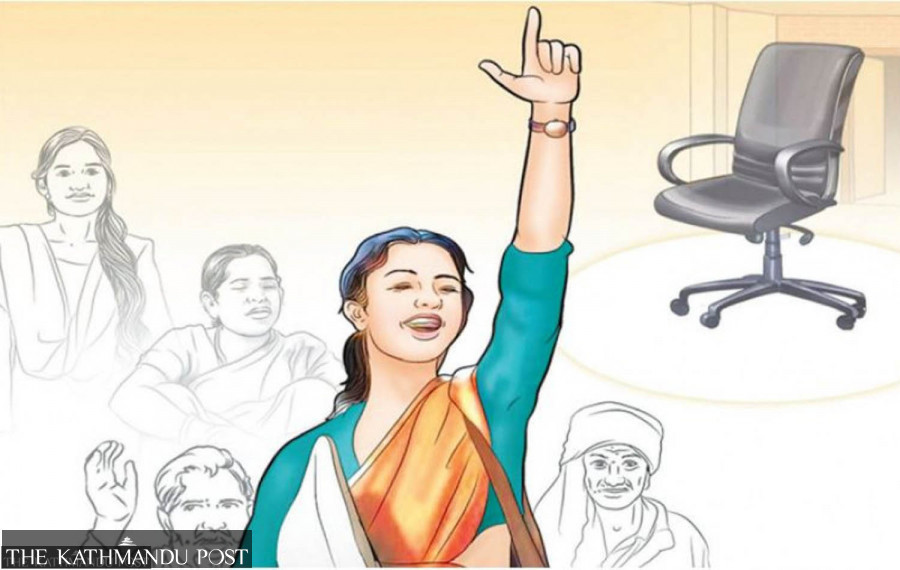
The few women politicians who were given tickets to contest direct election are dealing with scrutiny over their bodies and identities. Post file illustration
Late in December, a Facebook user uploaded a photo showing Ranju Darshana, a leader of the Rastriya Swatantra Party, placing her hand on her pregnant belly. The caption read, ‘‘I decided to stay in the proportional representation list due to my health condition: Ranju Darshana.’’ The comments the post received were far from encouraging. “If she is pregnant, I don't think she will be able to work,” one user declared. “It would have been better if she stayed at home rather than on the PR list,” another wrote. A majority of the over 500 comments under the post were critical about Darshana’s decision, with some of them verging on the abusive.
The implication was that a pregnant woman cannot take up leadership roles and that she is unsuited for public life. Darshana was later given a ticket to contest the election in the first-past-the-post category from Kathmandu constituency-1 in the March 5 election.
The comments Darshana’s post received are representative of how women politicians are looked down upon in the Nepali society. They are part of a larger pattern, one of seeing women’s bodies as political liabilities.
Like in previous elections, political parties have fielded a minimal number of women for the upcoming polls, reducing women’s candidacy to tokenism.
And even for those who secured candidacy tickets, the society is hardly receptive.
Despite the constitutional guarantee of equal rights, women have always been regarded as electoral liabilities rather than as legitimate political actors. That they have fielded only 11 percent women in the first-past-the-post elections and it hasn’t reflected well on the predominantly male-led parties, exposing their entrenched gender bias.
Now that the women are out campaigning, the exclusion continues through insults, hostility, and hatred on social media.
Feminist writer Sabitri Gautam sees this as part of a broader social tendency. “The practice of viewing women less as minds and more as bodies is common in Nepal,” Gautam said. Women who enter public life are not assessed primarily on their ideas but on their age, appearance, health, and reproductive status.
This is not new. Gautam notes that feminist writers and activists have long faced abuse for daring to challenge dominant narratives. The nature of the abuse differs sharply by gender. “Men who hold alternative thoughts are never trolled with sexual abuse,” Gautam explained. “Their bodies are not targeted.”
With women, however, political disagreement quickly turns into corporeal humiliation and ad hominem attacks.
In Darshana’s case, Gautam argues, the attack crossed into direct violence. “Making fun of her physical condition, targeting her body, is violence,” she said. Darshana’s pregnancy became a tool to delegitimise her candidacy.
“Even when faced with such a difficult and special physical condition, Ranju is busy with her political campaign,” Gautam added. “She does not want to miss out on this rare political opportunity… It is the responsibility of all of us, including social media users, to make her feel safe and healthy, not just physically, but emotionally.”
Instead, the insistence that she should withdraw her candidacy, rest, or remain invisible reveals outright misogyny and cyber violence, Gautam argues. “This line of thought is aimed at enforcing women’s absence from political life.”
Managing this hostility has become part of the election campaigns. Anjal Adhikari, a volunteer with Darshana’s social media team, described how responding to abuse is now routine. “We go through all her social media pages,” he said. The team counters negative comments by flooding threads with promotional material, while also circulating posters highlighting Darshana’s past work. This has helped generate more supportive responses, but it also reveals how women candidates must defend their right even to participate in elections campaigns.
This logic, where women’s bodies become grounds for political disqualification, extends well beyond pregnancy.
Prime Minister Sushila Karki has repeatedly been subjected to online abuse rooted not in her policies or decisions, but in her age and gender.
Commenters have asked why she does not go on tirtha yatra, telling her that hers is the “age for pilgrimage.” Others have written that she should stay at home and rest, suggesting she is not capable of leading the country.
The message mirrors what pregnant candidates hear: that there is a narrow window in which women are considered acceptable in politics, and outside of it, they need to disappear.
Whether a woman is pregnant, ageing, or perceived as physically slowing down, her body becomes the justification for exclusion.
This burden is familiar to almost all women with political ambitions. Tashi Lhazom, a climate activist who is contesting the election on a RSP ticket from Humla, speaks of a constant need to justify her presence in the race. “As women candidates, we have to defend our candidacy, whereas men don’t have to defend theirs,” she said. For women from minority backgrounds like Lhazom, scrutiny is even more heightened. “They use your gender and identity against you.”
In the early phase of her campaign, Tashi was told to “go back to where you came from.” Questions were raised about her Nepali identity when she was reportedly considered as a minister in the interim government. The hostility was relentless. To protect her mental health, she stopped reading hateful comments altogether, Tashi says. Some public sympathy came later, but the damage had already been done.
Research and media reports have consistently shown that online violence against women in Nepali politics increases during elections. Social media enables this kind of violence, as it rewards outrage and abuse hurled digitally has no real repercussions. Women have to contend with what Gautam calls “iron gates”—standards of perfection, endurance, and respectability that men are never asked to meet.
The question is not whether women can endure this pressure. Many already do. The question, as rights activists say, is whether a country that repeatedly tells politicians of one gender to go home, to rest, to pray, or to give birth, can be called a true democracy.
Aarya Chand is a reporter at The Kathmandu Post covering social issues. Before moving to the social beat, Chand was an intern covering culture and lifestyle for the Post.




 19.64°C Kathmandu