Parties fail to streamline campaign agendas as March 5 polls near
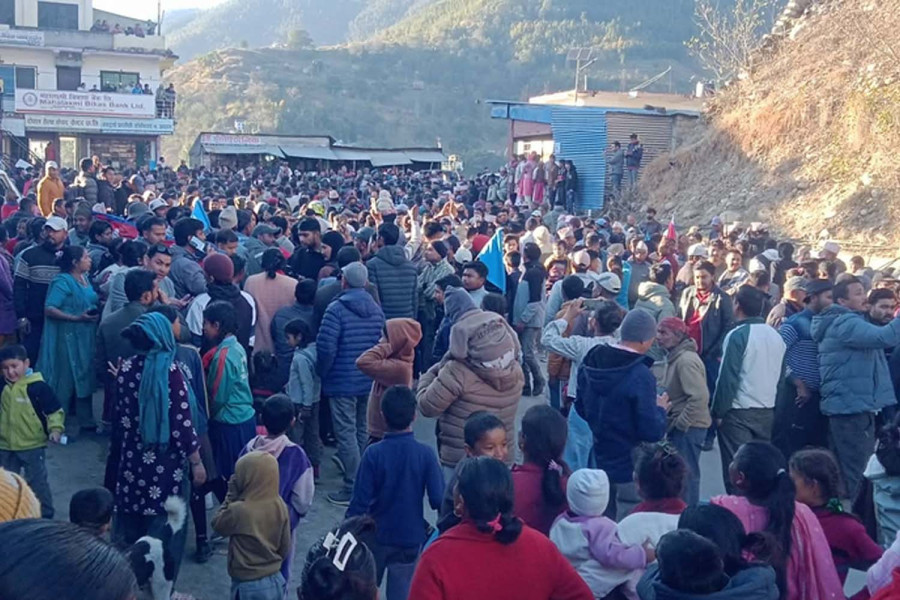
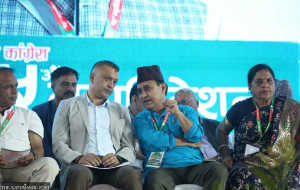
Public opinion is divided over Sept 8 killings and Sept 9 destruction, but parties are unable to show their clear standing. People gather at a political event in Sanphebagar, Accham on Thursday. Photo: Courtesy of Bhagwati Kunwar
As political parties ramp up their preparations for the March elections, there have been glaring gaps between their approaches and public expectations set by the September revolt last year.
The House of Representatives election is being held two years in advance—on March 5—due to the Gen Z uprising of September 8-9. Regular parliamentary elections were due in 2027.
The uprising against the political parties and governments led by ageing leadership that failed to deliver good governance, curb corruption, or improve basic services was not just targeted at the CPN-UML and the Nepali Congress that were in power but also at the Nepali Communist Party (NCP), an alliance of several smaller communist parties and groups. It exposed broader public disenchantment with traditional forces across the political spectrum.
Yet they don’t seem to have learned. At least their tendencies in the election campaigns suggest so. The Rastriya Swatantra Party (RSP), which rose to power by blaming the three traditional parties for the country’s ills, also has little to offer in terms of concrete or promising alternatives.
Economist and former governor of Nepal Rastra Bank, Dipendra Bahadur Chhetri, says no political party appears to have focussed its campaign on the country’s fundamental problems. This is not merely a weakness of individual parties but a challenge confronting the nation as a whole, he added.
Despite the many political changes the country has undergone, and even though parties have been forced into an early election, Chhetri notes that they still lack a clear and concrete vision for addressing Nepal’s core economic and structural challenges. According to him, none of the political parties has put forward a credible roadmap to solve the problems facing the country.
He warns that Nepal can no longer afford to be run on an ad hoc basis. By failing to grasp this reality, both old and new political parties risk repeating the same governance failures, leaving the country to bear the consequences once again.
Even as political parties head to the polls without a clear roadmap, they have not faced the kind of tough questioning one would expect from the public, Chhetri says.
No political party has come up with their manifesto for the March elections. The Election Commission has asked political parties to make their manifestos public before they can start campaigning on February 19.
The realities that the old and new parties face are different. While established parties continue to be questioned about their past failures, their long history of political engagement has left them with extensive organisational networks that reach deep into villages across the country. These structures still provide them with repeated opportunities to deliver their message directly to voters, which is a key advantage.
By contrast, this organisational hold remains a major lack of newer parties. Without the same level of grassroots reach and trusted networks, they often struggle to consistently engage voters beyond urban centres, making it harder for them to translate popular sentiment into sustained electoral support, analysts say.
They point out that although newer parties are drawing large crowds at their campaign events, it remains uncertain whether this enthusiasm will translate into votes. The visible turnout, they say, reflects curiosity and momentary excitement, but there is no clear indication yet that such crowds will convert into votes in the ballot box.
Political analyst Arun Kumar Subedi, who served as a foreign affairs adviser to then-prime minister Sher Bahadur Deuba until 2022, argues that growing public fatigue with the established parties and the widespread use of political defamation as a tool have created a clear opportunity for the relatively new forces.
He argues that this environment of political defamation is amplified by alternative media and reinforced by algorithms, which tend to reward sensational and polarising content. This dynamic, he says, has given newer parties a favourable ground to challenge traditional political forces, turning digital momentum into a potent weapon in the electoral contest and creating an opportunity for them.
However, Subedi also cautions that any political party must possess at least a basic sense of statesmanship, something he believes is lacking among new parties, especially the RSP. “Their attempts to introduce a culture of celebrity politics have become a liability rather than a strength,” Subedi says.
In the run-up to the election, people from different walks of life, particularly from the arts and entertainment world, are entering politics, with the RSP leading the trend. According to Subedi, this approach is not yielding positive results and instead poses a serious challenge for the party as it seeks to present itself as a credible governing alternative.
As the election approaches, a section of the public holds the sharpest division over its views of the first day of the Gen Z movement, September 8; and the second day, September 9.
One camp argues that the Gen Z uprising on September 8, in which 19 people were killed on a single day, symbolises the brutality of the then Congress–UML government. For this, they contend that the old parties should not be endorsed through the upcoming vote.
Another camp trains its focus on September 9, when incidents of arson were reported across key locations nationwide. Citing alleged involvement of the so-called new forces in these acts, they argue that endorsing them through elections would legitimise anarchy. Such groups should be rejected at the polls in the interest of restoring stability and ending disorder, according to the second public category.
In essence, there is a growing view that the legacy of the Gen Z movement could emerge as a shared challenge for both old and new political forces at the ballot box. While the established parties struggle to cast off the baggage of September 8, the newer forces are equally unable to distance themselves from the events of September 9.
The Gen Z movement is likely to dominate campaign debates and public discourse, not as a narrative that benefits one side alone, but as a reminder of unresolved questions and competing interpretations that pose electoral risks for both the traditional parties and their newer challengers, says a political analyst.
However, economic and political analyst Dambar Khatiwada argues that categorising parties simply as ‘old’ or ‘new’ is misleading. He points out that the RSP, which entered the previous parliament, can no longer be considered a new party.
Khatiwada also highlights that the party’s leader, Rabi Lamichhane, faces criminal charges, ranging from cooperatives scams to accusations of lying about his citizenship certificate and passport, further complicating its claim to be a fresh alternative in Nepali politics.
“The real concern is whether the election could see the rise of a leader driven by heroic impulses, lacking political prudence, whose primary aim is to unseat the so-called corrupt old parties and their leaders, without offering a thoughtful plan for governance,” Khatiwada told the Post.




 14.69°C Kathmandu