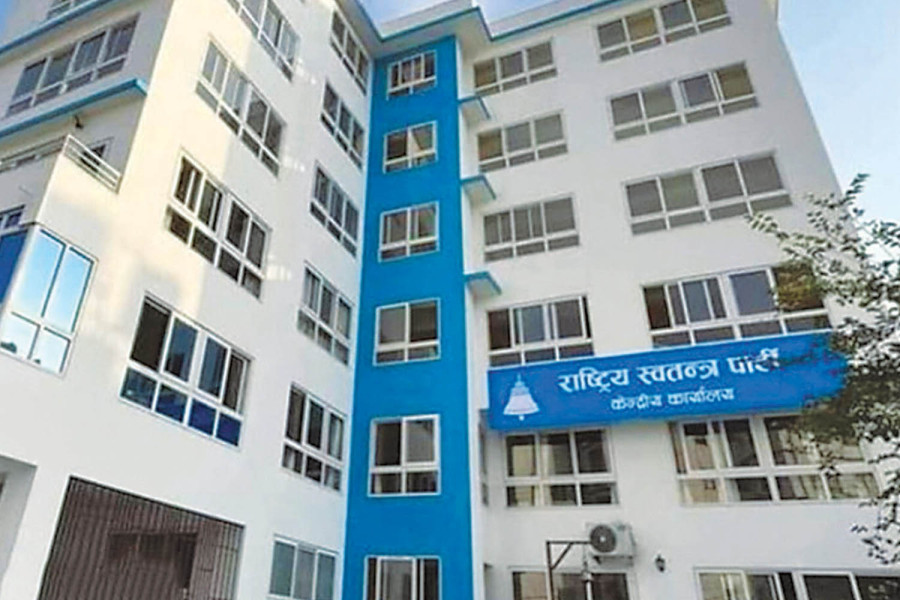
Riding on a strong anti-incumbency slogan, the Rastriya Swatantra Party (RSP), formed barely five months before the November 2022 House of Representatives election, emerged as the fourth-largest force in the 275-member House of Representatives.
The party then secured seven seats under the first-past-the-post (FPTP) system and 13 under proportional representation, for a total of 20 seats. Three months after the election, the Supreme Court annulled party chair Rabi Lamichhane’s lawmaker status after the citizenship certificate he produced to contest the election was found to be invalid.
While he retained his seat from Chitwan-2 in the April 2023 by-election, the party also managed to add one seat, registering a win in Tanahun-1. Former National Planning Commission vice-chair Swarnim Wagle won the seat vacated by Ramchandra Paudel after being elected as President.
The bypolls extended its strength to 21 in the House. Of these, eight were FPTP seats. Notably, most of these candidates made their ways into Parliament from the constituencies that had traditionally been communist strongholds.
Six of the eight seats came from constituencies that were known to be communist bastions. Until the September Gen Z movement, RSP leaders often complained that they were cutting into the communist vote bank, and the Nepali Congress was unnecessarily suspicious of them.
In the changed political landscape following the September movement that ousted the Congress-UML coalition government, the Lamichhane-led party is again in the limelight after inducting former Kathmandu Metropolitan City mayor Balendra Shah, popularly known as Balen, and his team in the run-up to the March 5 election. Shah, who is the party’s prime ministerial face, is already in a full election campaign mode, from the country’s east to the far west.
Will the rise in the party’s popularity after Shah’s entry help RSP expand beyond the communist strongholds into constituencies long dominated by the Congress?
Biraj Bhakta Shrestha, an RSP leader, says his party did well in the communist strongholds in the last election “as the communist government formed after the 2017 election failed to deliver on its promises”. The two largest communist parties of the time, the UML and the CPN (Maoist Centre), entered into an alliance for the 2017 election and later merged to form the Nepal Communist Party (NCP).
But the NCP government failed to live up to its promises despite an excellent performance in the election, which was contested on the agenda of stability, delivery, and good governance. The subsequent internal feud led to its split and the revival of the original parties—the UML and the Maoist Centre.
The Congress emerged as the largest party in the 2022 periodic elections, followed by the UML, while the Maoist Centre ended up in a distant third place. A powerful Congress-UML coalition was governing the country when the Gen Z movement happened.
“The two-day Gen Z revolt against corruption, and for good governance and transparency toppled the Congress-UML government, which symbolised a regressive force,” said Shrestha. “As our party was formed by championing these agendas, and as the party that embraces the spirit of the Gen Z movement, we expect to cash in during the elections, allowing us to expand even into Congress strongholds.”
Not everyone agrees. Those with sound knowledge of the Congress claim it will retain its traditional support while also getting the support of new voters.
“With the change in the Congress guard, the party will do well in the elections,” Geja Sharma Wagle, a political analyst close to the Congress, argues. “Besides, the RSP’s electoral campaigns continue to focus on UML-dominated constituencies, so it will have less impact on the Congress.”
Gagan Kumar Thapa has been elected the new Congress president from a special general convention and has been projected as the party’s prime ministerial candidate. In Wagle’s view, the drastic yet largely unexpected move has rejuvenated the Congress rank and file.
Bhim Bhurtel, a left-leaning political analyst, says something similar, though he frames it differently.
Cadres who are loyal to another party are unlikely to vote for the RSP but swing voters who chose the UML could opt for the RSP, he said. “Also, voters aged 45 and above who voted for the RSP in the last election may not vote for them this time,” he said.
In the previous election, RSP won Kathmandu-2, Kathmandu-7, Lalitpur-3, Chitwan-1, and Chitwan-2, which are widely regarded as traditional strongholds of the communist parties, according to electoral data. Similarly, Kathmandu-6, another seat secured by the party, has been regarded as a partial communist bastion. Only two constituencies—Kathmandu-8 and Tanahun-1—that went to the RSP were seen as traditional Congress strongholds.
In Lalitpur-3, RSP’s Toshima Karki won in 2022. Pampha Bhusal, then a Maoist leader, had won in 2008 and 2017 from this constituency. Before that, Raghuji Panta, who is currently a vice-chair of the UML, had won the 1994 mid-term election from the same place.




 14.69°C Kathmandu