Congress leaders in hectic parleys to avert party split
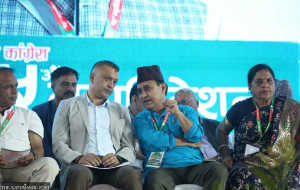
Thapa, Sharma demand recognition of convention, election ticket overhaul, and Deuba’s withdrawal from party control. Congress leaders at the closed-door session of the party’s special general convention at Bhrikutimandap, Kathmandu, on Monday morning. Angad Dhakal/TKP
As supporters of the Nepali Congress’s special general convention pressed ahead with proceedings, party president Sher Bahadur Deuba and his camp, who opposed the convention, were struggling to formulate a clear strategy to find a middle ground and keep the party intact.
After the closed-door session progressed in line with the procedures endorsed by the special convention, as of 11pm on Monday, fear loomed that the situation could escalate to the point of a party split.
By Monday evening, multiple rounds of talks were underway among Congress leaders to defuse the tension after the closed door session of the special general convention endorsed a proposal to elect a new party leadership, including the central working committee.
Interlocutors appeared determined to find a solution by the time of Tuesday’s central working committee meeting scheduled for 11 am, according to party leaders.
A four-member talks team was formed late Monday from the special general convention side.
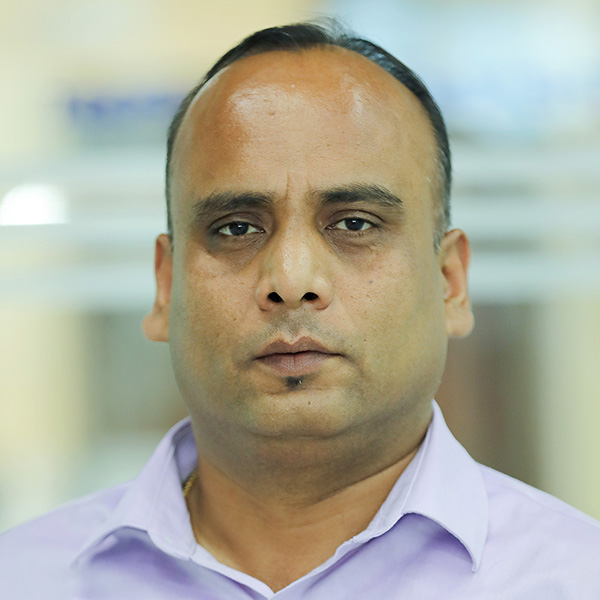
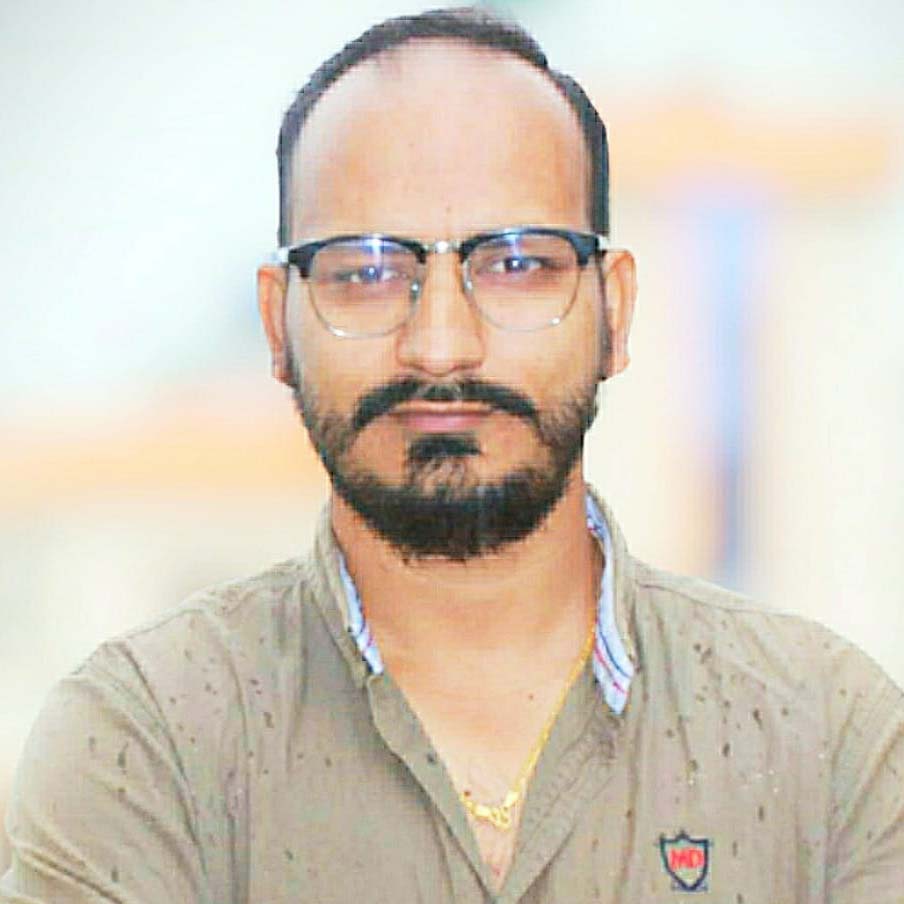
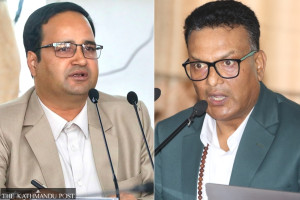
Congress General Secretaries Thapa and Sharma were in touch with Deuba confidants Purna Bahadur Khadka, Ramesh Lekhak and Bal Krishna Khand, according to Ramhari Khatiwada, who is also mediating to defuse the tension in the party.
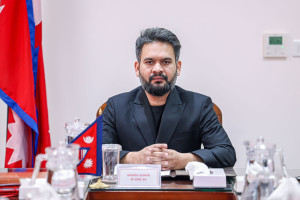
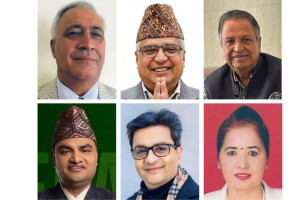
Khadka, Lekhak and Khand were representing the establishment faction while Pradip Poudel, Guru Raj Ghimire, Devraj Chalise and Madhu Acharya represented the Thapa-Sharma faction.
“We also believe Deuba should not contest the upcoming election even from Dadheldura, he should be relieved of party responsibilities,” said Subas Pokharel, a leader close to Thapa–Sharma faction. “He should rather take ownership of the special convention.”
Talking to the Post, Ramhari Khatiwada said that party president Deuba is prepared to engage in a more conciliatory dialogue with the special convention camp.
Khatiwada added that they had advised either party president Deuba, acting president Khadka, or Shekhar Koirala to address the special convention in a way that helps preserve party unity.
Guru Raj Ghimire, a member of the dialogue committee from the special general convention team, was also optimistic about the dialogue reaching a meaningful conclusion.
“We believe the ongoing talks will reach a positive conclusion. Otherwise, the dialogue team will sit again tomorrow before the central committee meeting for final discussions,” Ghimire told the Post.
The special general convention drew the support from 56 percent of elected representatives at the opening ceremony on Sunday, which its conveners claimed had reached 63 percent by Monday, clearly pushing Deuba into the minority.
“It will reach 70 percent,” said Subas Pokharel. “We don’t know what will happen on Tuesday. The party president should take responsibility for the party’s split, if a new committee is formed.”
An interlocutor told the Post that negotiations were taking place so as to address the problem in four ways.
One, Deuba should take ownership of the special convention by attending it; two, he should take ownership of the policy papers presented by two general secretaries on Monday at the closed-door session; three, he should declare Thapa as next Nepali Congress prime minister candidate; and four, the ticket distribution for March election should be revised.
With this Deuba’s dominance in the party and election process would come to an end, the interlocutor said.
“But if there is no deal by the time of Tuesday’s central working committee meeting, the party will split,” another interlocutor said.
A split ahead of elections would plunge the party into deeper trouble.
If talks break down, the Thapa-Sharma faction plans to go to the Election Commission, seeking recognition as the legitimate establishment faction.
The Election Commission would then have to decide and those unhappy with the decision may knock on the door of the Supreme Court. This would also disrupt the party’s entire schedule for the March 5 elections.
Both sides have consulted legal experts in anticipation of such a scenario.
Thapa on Monday stated that the Election Commission should grant legitimacy to a new Congress if a majority of elected representatives decide to constitute new office bearers and a central committee. In that case, Thapa would become party president.
Some leaders in Deuba camp continue to insist that there is no need for a special general convention. They argue that the current situation has risen as party president Deuba failed to act decisively.
While the special convention faction claims that a majority of general convention delegates have taken part in the event, these leaders say the claim itself is open to question, as there is no authorised body to formally validate it.
Speaking on condition of anonymity, a leader close to the Deuba faction said that a possible party split and the question of the legitimacy of the special convention are two separate issues.
“The Election Commission’s regulations stipulate that once an electoral process has begun, decisions taken by a majority of the central committee are recognised,” said the leader. “Therefore, even if the special convention faction were to decide on a party split, such a move would not be legally valid.”
Had the party strictly followed its statute, the Congress would be required to hold a general convention every four years. As the 14th General Convention was held in December 2021, the 15th General Convention should have taken place in December 2025.However, before the Gen Z uprising of September, there was an informal agreement to delay it by a year.
Senior Congress leader Shekhar Koirala, who had been demanding a special general convention due to the failure to hold the regular one on time, appeared hesitant to clearly define his position when the special convention became a reality.
Nevertheless, as fears of a possible party split began to grow within Congress ranks following the special convention, Koirala issued a video statement on Sunday, assuring that he would not allow the party to break apart.
On Monday, he went a step further by meeting party president Deuba, accompanied by Vice-President Dhanraj Gurung and two joint general secretaries, Badri Pandey and Jeevan Pariyar, along with central committee member Minendra Rizal from his faction. In the meeting, Koirala urged Deuba to take steps to prevent party division.
“During the meeting with the party president, they discussed ways to prevent the party from splitting,” said a leader close to Koirala, who was present in the meeting.
Although Deuba held day-long discussions on Monday with leaders from his own camp, as well as leaders from the Koirala faction, and legal experts close to him, there was no decision on how to move the party forward in a united manner.
Special general convention organisers invoked Article 17(2) of the party legislation, while leaders aligned with Deuba have countered this by invoking Article 26.
Article 17(2) states that if 40 percent of the party’s general convention delegates formally call for a special convention, it must be convened within three months of the date of the call. Citing this provision, the special general convention has been taking place since Sunday at Bhrikutimandap in Kathmandu.
OnOctober 15, leaders advocating a special general convention of the Congress submitted a proposal to the party’s Central Committee with the signature of 54 percent of general convention delegates, formally calling for the convention to be held on January 11 and 12.
As the special convention prepares a proposal to dissolve the executive committee elected by the 14th General Convention and select new leadership, the Deuba faction has put forward a different statute interpretation. Referring to Article 26, it argues that if the party president resigns and the resignation is accepted by the Central Committee, the vice-president assumes the role of acting president.
Furthermore, Article 26(2) envisions that an acting president must organise a party general convention within six months to elect a new president.
The procedures proposed for the special convention state that the term of the existing central executive committee elected by the party’s 14th General Convention in 2021 has already expired. On this basis, the proposal calls for the dissolution of the current executive committee and the election of a new central committee that would remain in place until the completion of the party’s 15th General Convention.
When the procedures to dissolve the current executive committee were proposed, the party called its central committee meeting at the party office in Senapa on Tuesday.
Leaders close to Deuba maintain that since the president elected by the 14th General Convention has not resigned, the special convention does not have the authority to dissolve the existing executive committee or elect new leadership. They insist that any attempt to do so would be illegal.
Ramesh Lekhak, a Deuba confidant, said that a party’s central committee elected by a general convention cannot be dissolved by a special convention.
“An elected party president cannot be removed by convention delegates unless there is at least a two-thirds majority,” Lekhak told the Post. If the special convention organisers are to be believed, they are close to that threshold.
Lekhak also said that if the closed session of the special convention decides to dissolve the party’s executive committee elected by the 14th general convention, it would amount to a formal split in the party.
The special general convention of the party, which was supposed to conclude on Monday, has been prolonged.
Key demands of the Thapa–Sharma camp:
1) The political ownership of the special general convention should be taken by the Nepali Congress Central Committee.
2) The Nepali Congress Central Committee should accept the proposals and suggestions for party reform that are presented at the special general convention and collected from the participants.
3) The party should not form an alliance with any other political party in the upcoming House of Representatives elections.
4) A parliamentary board should be formed according to the party's constitution to select the party’s candidates. Such a board must have the respectable presence of supporters of the Special General Convention.
5) In the upcoming House of Representatives election, the distribution of tickets must be fair and respectful.
6) In the House of Representatives election, the tickets distributed to candidates should bear the signature of the Acting President Purna Bahadur Khadka instead of President Sher Bahadur Deuba.
7) At the closing session of the Special General Convention, the Acting President Purna Bahadur Khadka and Leader Dr Shekhar Koirala must be present and take ownership of the agreement.
8) Deuba should not contest the elections and he should separate himself from party responsibility.
Anil Giri is a Chief Sub Editor covering diplomacy, international relations and national politics for The Kathmandu Post. Giri has been working as a journalist for more than two decades, contributing to numerous national and international media outlets.




 14.81°C Kathmandu