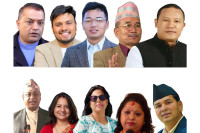
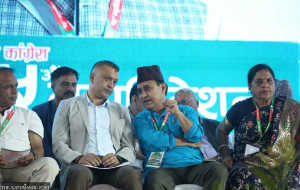
Less than two weeks after their unification, the Ujyalo Nepal Party (UNP) formally split from the Rastriya Swatantra Party (RSP) on Saturday.
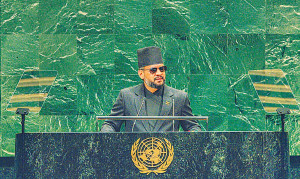
RSP chair Rabi Lamichhane and UNP chief Anup Kumar Upadhyay had announced party unity on December 29 under a seven-point agreement. But the partnership was short-lived.
This comes just three days after UNP patron Kulman Ghising resigned as a minister in the Sushila Karki government to take a plunge into politics.
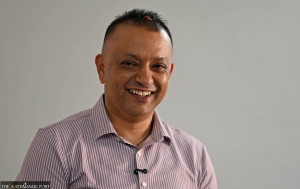
Though the UNP is widely considered as a brainchild of Ghising, he had presented himself only as its patron of the party while picking former government secretary Anup Kumar Upadhyay as its chair.
But just hours after the failure of the talks with RSP chair Lamichhane, the party held a meeting and announced Ghising as the new chair.
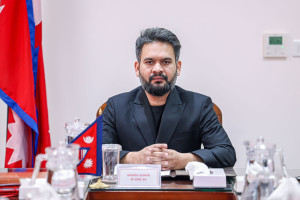
UNP had reached an agreement with Lamichhane on December 29, a day after Kathmandu Metropolitan City Mayor Balendra Shah joined the RSP.
The unity was projected as the three sides coming together to develop a powerful alternative political force ahead of the House of Representatives election scheduled for March 5.
In the agreement, they agreed to retain the unified party’s name as the Rastriya Swatantra Party, and use the RSP’s existing banner and its election symbol, the bell, in the upcoming polls. However, the growing rift between the RSP and UNP leaders has now undone the merger.
Even before the UNP was formally registered with the Election Commission in November, there had been repeated discussions between the RSP and Ghising about working under a single party.
As those talks failed to make a breakthrough, the UNP was registered in the second week of November. At that time, Ghising was its patron and a minister in the interim government formed in the wake of the September Gen Z uprising. Prime Minister Sushila Karki had pledged not to include any politically affiliated individual in her non-partisan election government.
Even after the UNP’s registration, dialogue with the RSP continued. Eventually, amid growing pressure for alternative political forces to come together and following Mayor Shah’s entry into the RSP, the UNP agreed to merge with the Lamichhane-led party.
On the day the unification was announced in the presence of Mayor Shah, the RSP submitted a closed list of proportional representation (PR) candidates to the Election Commission, incorporating candidates from all three sides.
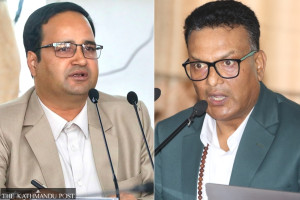
Within days, UNP president Upadhyay had visited the Election Commission to inquire whether his party could submit a separate list of candidates, an early sign that the two parties were unlikely to stay united for long.
UNP leaders say the agreement with the RSP could not last as the latter showed no willingness to implement the commitments made in the seven-point deal. The agreement had clearly stated that Ghising would be given the second position after party chair Lamichhane. However, according to them, the understanding began to unravel when the RSP appeared inclined to place Shah ahead of Ghising in the party hierarchy, immediately after chair Lamichhane.
Raju Thapa, a member of the dialogue committee formed by the UNP, says this shift in intent, among other reasons, was a key reason for the agreement’s failure.
RSP insiders claimed that Ghising had been pressing some key demands such as inclusion of at least 26 members from his side in the RSP’s central committee, a general secretary position in the party, and the placement of at least six of his nominees on top of the PR candidates’ list.
It had been agreed that the UNP would be given one joint general secretary and one joint spokesperson. A day earlier, the RSP had agreed to allocate one general secretary, one joint general secretary and one joint spokesperson to Mayor Shah’s team.
The UNP had also insisted on including 18 candidates from its side in the PR closed list, but only 14 of its nominees were ultimately included.
After resigning his ministerial position, Ghising met RSP chair Rabi Lamichhane on Friday for what was described as a final round of talks on these issues. However, as the meeting failed to yield a positive outcome, the UNP decided to part ways on Saturday.
Ghising, who formally took charge of the UNP on Saturday, claimed that the two sides were unable to move in sync as efforts to reach a supplementary agreement with the RSP on issues such as federalism and inclusivity failed. Ghising made these remarks in a press conference held on Saturday to announce the end of cooperation with the RSP.
“The core issues were inclusivity and federalism. We proposed a supplementary agreement to address the fundamental principles laid out in the constitution,” Ghising said.
Ghising also claimed that, alongside the formal agreement with the RSP, there had been an unwritten understanding between the two sides. He rejected allegations that he had bargained for senior positions.
Thapa of the UNP’s dialogue committee said during negotiations Ghising had been put under undue pressure to give up some of his agenda.
“Besdies, Ghising faced pressure from various indigenous groups to move forward independently, rather than aligning with the RSP,” he said.
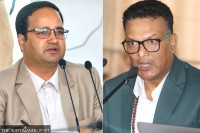
RSP leader Shishir Khanal, who was involved in negotiations with Ghising’s team, accused Ghising of disregarding the original agreement.
“The sole reason the UNP walked away from the agreement was that it could not agree on distribution of portfolios,” Khanal told the Post.
A person familiar with various rounds of talks between the RSP, Mayor Shah and the UNP right from the start says the UNP’s exit is meaningful. “It is a setback to Mayor Shah’s longstanding effort to bring alternative political forces under a single platform,” he said.
Sasmit Pokhrel of Shah’s team, who was picked joint spokesperson for the RSP, said the mayor would continue his association with the RSP despite Ghising’s ouster.




 16.49°C Kathmandu