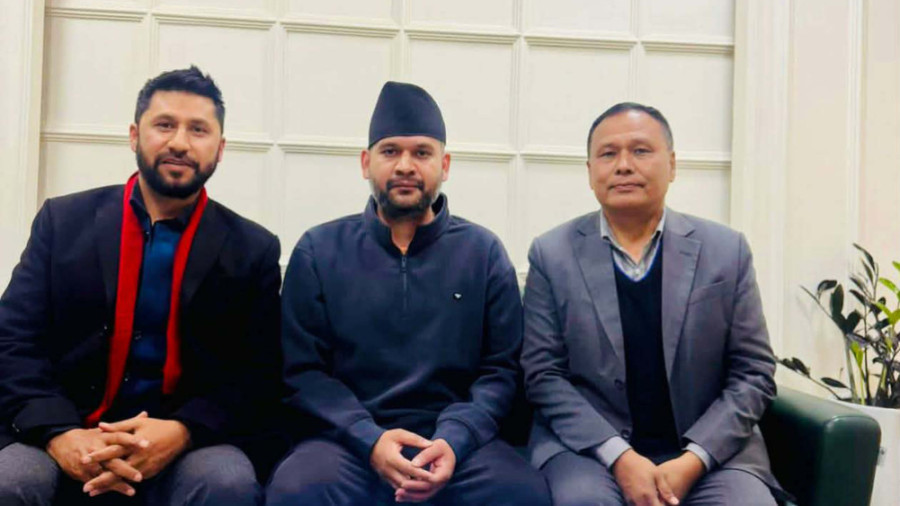
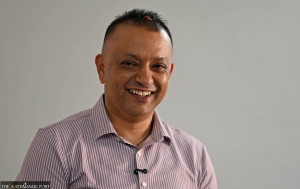
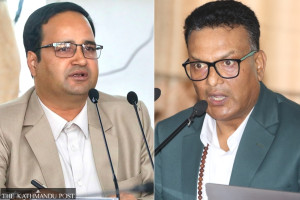
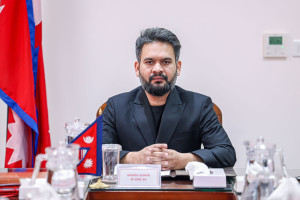
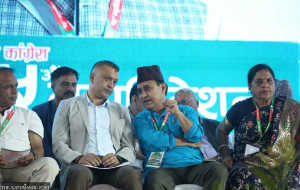
After resigning as minister on Wednesday, Ghising indicates being active in the RSP. (From left) Rastriya Swatantra Party (RSP) chief Rabi Lamichhane, Kathmandu Mayor Balendra Shah, and Ujyalo Nepal Party patron Kulman Ghising on December 29 after the three forged an electoral alliance for March 5 elections, as Ujyalo Nepal merged into the RSP. Photo obtained from Shah’s Facebook
Lengthy closed-door meetings held in the name of consensus, cooperation and unity among the so-called old political parties no longer inspire hope in the public.
Leaders often emerge from such meetings claiming an agreement has been reached but their “deal” barely lasts a few days. When closed-door meetings aren’t transparent, the truth of what actually was discussed, how consensus was reached, and why accusations of backtracking followed are unclear. This not only confuses the public, but also frustrates the rank and file of the relevant party.
After the rise of the Gen Z-driven political uprising, there was widespread expectation that newer parties would avoid repeating the old mistakes. Yet there are growing signs that these habits refuse to go.
Political analysts say the expectation that new parties would avoid repeating the mistakes of the old has not been met, as the newer forces too have struggled to live up to that promise.
Sociologist and political analyst Uddhab Pyakurel says it is a mistake to expect genuine political change from Rastriya Swatantra Party president Rabi Lamichhane, who has faced allegation of irregularities during his time out of the country and also while at home, and Kulman Ghising, who entered politics carrying a legacy of the discredited bureaucracy, even as they are often projected as new political actors.
“When any political party is labelled as ‘new’, one might expect a corresponding freshness in political integrity as well. At present, the so-called new parties do not meet that standard, and expecting novelty from them is a path that leads from frustration to depression,” Pyakurel told the Post.
In a fresh polarisation between the old and new forces, the RSP and the Ujyalo Nepal Party (UNP), in which Ghising is the patron, forged unity based on a seven-point agreement signed in the presence of Kathmandu mayor Balendra (Balen) Shah on December 29.
On December 28, the RSP and the group led by Mayor Shah had reached a separate seven-point unity agreement. However, a week into the merger between the RSP and the UNP, the developments on the ground are far from encouraging.
In particular, UNP patron Ghising, who led the negotiations with the RSP, has reportedly grown dissatisfied, alleging that individuals from his side have not been given “dignified and meaningful roles” in the unified RSP. Leaders close to Ghising say he has increasingly been unhappy over what he sees as a breach of the spirit of the agreement.
Under the agreements reached on December 28 and 29, it was decided that Mayor Shah’s side would be given one general secretary and one joint general secretary within the RSP, while a new position of senior leader was to be created for Shah himself.
Similarly, UNP patron Ghising was to be appointed first vice-chair of the RSP, along with one joint general secretary and one joint spokesperson from the UNP side.
In line with this understanding, the general secretary and joint general secretary from Mayor Shah’s camp have already assumed their responsibilities in the unified RSP.
However, representatives from the UNP side have yet to take up their agreed roles. Although the RSP has formally decided to appoint Ghising first vice-chair, Ghising at a press meet on Wednesday said: “Though my name is mentioned in the agreement with the RSP, it has not yet been implemented. I have not taken membership yet,” he added. “Once I formally join the party, I will take membership.”
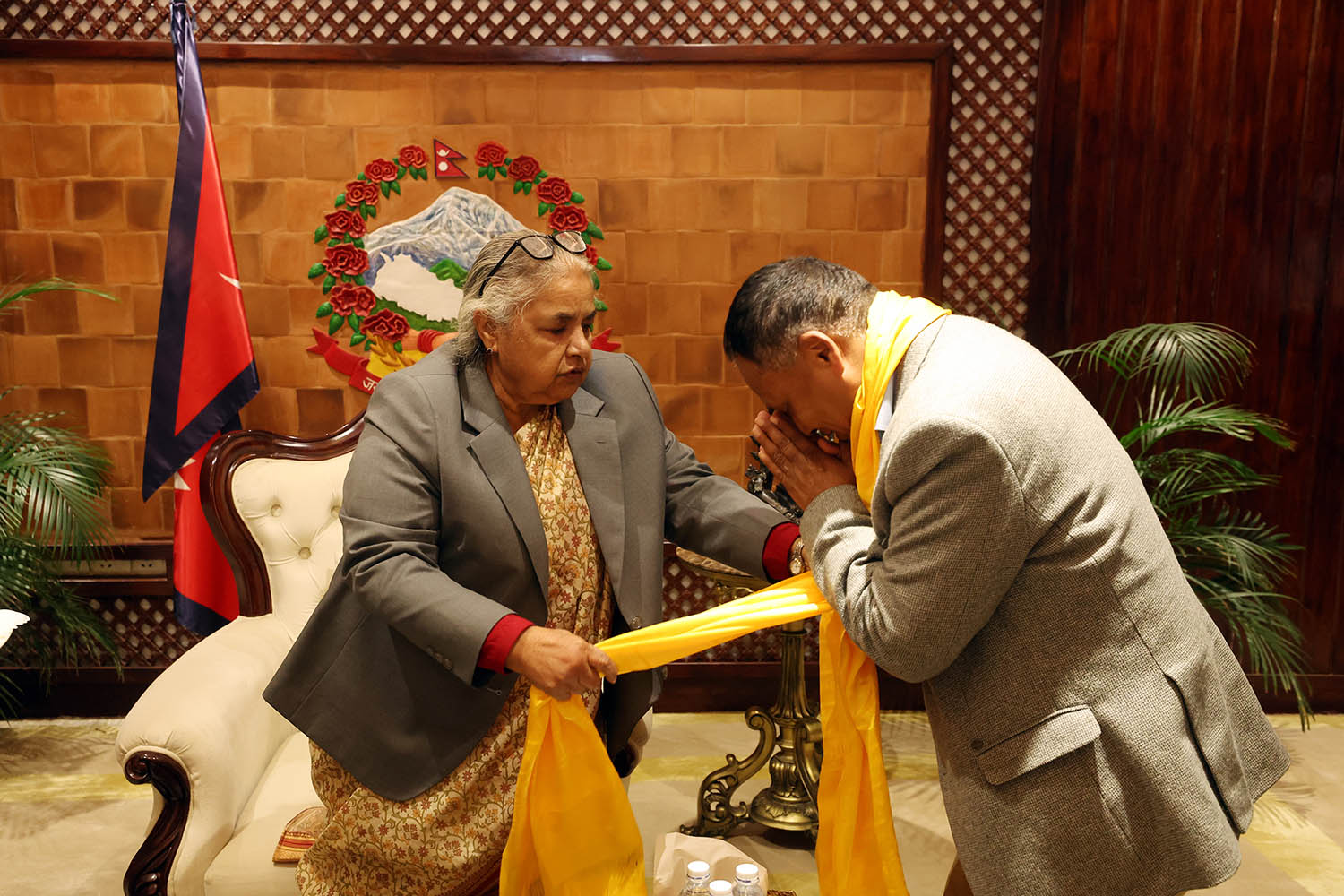
Ghising on Wednesday evening resigned his ministerial position after Prime Minister Sushila Karki, at a Cabinet meeting on Monday, urged some ministers to resign if they consider joining politics with the March 5 elections in mind.
Prime Minister Sushila Karki bids farewell to Energy Minister Kulman Ghising after his resignation, at Baluwatar on Wednesday. Photo: Prime Minister’s Secretariat
Ghising has demanded at least the general secretary for his side in the RSP, according to a leader close to Ghising.
Another key reason cited for the growing rift between the RSP and the UNP, despite the agreement, relates to the proportional representation (PR) list submitted to the Election Commission for the March 5 House of Representatives elections.
According to a leader from Ghising’s panel, the RSP failed to allocate the agreed number of PR candidates to them. According to him, even those on the list were placed lower in priority. Those figuring high on the list have higher chances of election after the votes are counted.
As per the agreement, the RSP was supposed to allocate 18 candidates to the Ghising group out of the total 110 names on the list. However, the Ghising side alleges that when the list was finally submitted, only 14 from their team were included.
However, RSP leaders argue that despite lingering disagreements on some issues, the UNP no longer has the option of walking away from the merger, insisting that the unification has already been completed.
Anup Kumar Upadhyay, who chaired the UNP prior to the merger, categorically denies any possibility of the party withdrawing from its unification with the RSP.
“Some of the party leaders whose political prospects could be diminished in the unified party might have tried to foil the unification,” said Upadhyay. “However I believe our relation with the RSP is intact.”
Upadhyay, who was secretary at the ministry of energy, is on the PR list from the unified RSP.
Upadhyay also acknowledged that there are strong views in the group, especially among indigenous community members, that the party should go to the election on its own, rather than in unity with the RSP.
There is also a section of people within the group who believe that an electoral alliance with Harka Sampang’s Shram Shaskriti Party would yield better electoral results for the party, Upadhyay said.
“It was due to the interests of different groups within the party that our unification with the RSP was delayed. Otherwise we were supposed to sign an agreement the same day [December 28] the RSP and Mayor Balen united,” Upadhyay told the Post. “But I see no indications on Ghising’s side of any decision that could reverse the unification with RSP.”
Dharan mayor Sampang, who chairs the Shram Shaskriti Party, has been actively engaged in campaigning. On Wednesday, he announced on social media that he will contest the election from the Dharan municipal area itself. “I will contest the House of Representatives election from Sunsari-1,” Sampang wrote.
While indigenous groups close to Ghising argue that the party would benefit more from an electoral alliance with Sampang than with the RSP, people close to Sampang say their party has no intention of having electoral arrangements with others.
Rasik Thebe, who works at Sampang’s secretariat, claims that although they have received suggestions to work with Ghising, Sampang remains firm in his decision to contest the election on their own.




 14.81°C Kathmandu