



 14.69°C Kathmandu

Sat, Oct 24, 2026
Money
Global oil shock tests Nepal, but electric cooking cushions blow
Nepal is better prepared than before as West Asia tensions push up fuel prices.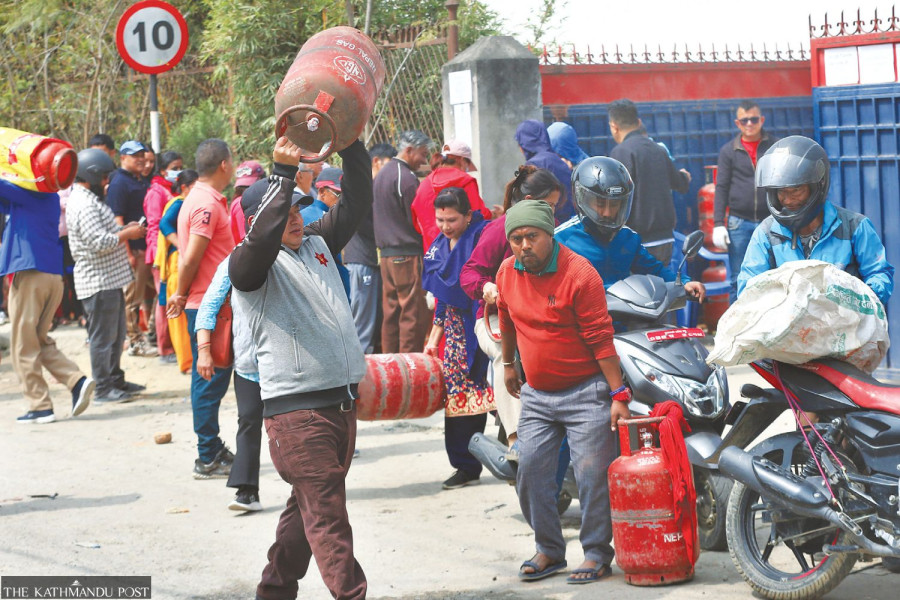
bookmark
Sangam Prasain & Krishana Prasain
Published at : March 20, 2026
Updated at : March 20, 2026 07:25
Kathmandu
Raghu Basnet and his wife arrived at the Nepal Gas plant in Balaju Industrial Area with two empty cylinders of liquefied petroleum gas (LPG) on Thursday afternoon. As there was no queue, they dropped their two cylinders, paid for two half refills, loaded them onto their scooter and left.
“We were really afraid of a shortage due to news coming from West Asia,” said Basnet.
But he was not as worried as in the past. He now owns an electric cooking stove.
In earlier years, every news about cooking gas shortages would trigger panic. The situation was most severe in 2015, when India imposed a blockade, halting fuel supplies to Nepal. People even brought wood to cook food.
Separately, Rudra BK arrived at the Salt Trading Corporation in Kalimati carrying a cylinder on his bike.
He knows induction stoves can be an alternative, but says the upfront cost is too high.
Nearly a month ago, BK had planned on buying an electric stove to avoid the hassle of refilling gas cylinders.
“I heard it costs Rs5,000 to Rs6,000 to buy an electric stove. It’s too expensive for me,” said BK, who runs a stationery shop in Kalanki. The induction stove may be expensive for BK, but he is at least aware that using electricity produced in Nepal would save money to buy fuel from abroad.
Nepal’s domestic LPG supply remains highly vulnerable to geopolitical shocks, as the country depends entirely on imports from India, itself a net oil importer. Rising costs are affecting everyone—from households to restaurants and small businesses. Many eateries and cloud kitchens are struggling to maintain margins.
For Raju Rajthala, a pustakari [hard molasses candy] maker in Suryabinayak, Bhaktapur, securing LPG is a constant challenge.
“I cook my meals on induction [stove], but for making sweets, electric stoves are not large enough for my cooking vessels,” he said.
Nepal’s LPG demand stands at around 45,000 to 46,000 tonnes per month. Around a third of this demand comes from the commercial sector, including hotels and restaurants, according to Nepal Oil Corporation.
“We are major LPG users,” said Binayak Shah, president of the Hotel Association Nepal. “Due to policy constraints, we haven’t been able to fully switch to electricity, though many have started adopting it.”
“The shortage of LPG has affected hotels and restaurants for years. With reliable electricity now available, a policy shift could reduce imports and lead to significant savings,” he added.
Shah said the current fiscal budget has recognised the hospitality sector as a priority industry, raising expectations for concessional electricity tariffs.
“We expect electricity at Rs6-7 per unit, similar to industrial rates. Currently, hotels pay around Rs15 per unit, which discourages switching,” he said.
According to him, a proposal to extend lower tariffs to the hospitality sector has yet to be tabled at the Nepal Electricity Authority board.
“We hope the upcoming government will pass it,” he said.
Globally, net oil-importing countries such as India, Bangladesh, Myanmar, Thailand and the Philippines are being hit hard by the ongoing conflict in West Asia.
Around a fifth of the world’s oil passes through the Strait of Hormuz, making it a critical chokepoint. Nearly 70 percent of that oil flows to Asian economies including India, Japan, China and South Korea.
As supplies tighten, consumers and businesses across Asia are feeling the strain. Governments are scrambling to cushion the impact.
A surge in global oil prices is now affecting India’s domestic energy market, disrupting cooking gas supplies and accelerating a shift to electric alternatives.
In Nepal, however, the impact has been less severe compared to past crises like the 2015 blockade, when people paid as much as Rs8,000 for a single cylinder to keep fire burning in their kitchens.
The growing availability of electricity has played a key role. Electric cooking is gradually gaining acceptance in urban households.
According to a 2019 Post article by Saroj Koirala, LPG has a calorific value of 46.1 megajoules per kg. A standard 14.2 kg cylinder provides about 181.9 kilowatt-hours of energy.
At current rates, that volume of electricity would cost around Rs1,800, while a gas cylinder costs about Rs1,910 (now)—making electricity slightly cheaper on an energy-equivalent basis.
Economist Puskar Bajracharya warned that global oil prices could rise to $125 per barrel, with significant economic consequences.
“If prices reach that level, it will impact the overall economy,” he said. “Inflation could rise to around 10 percent if the conflict continues for more than a month.”
Beyond inflation, he cautioned about supply disruptions and the risk of black marketing, given Nepal’s dependence on imports.
Elara Capital, an Indian investment firm, estimates that if crude oil reaches $125 per barrel, fuel prices could rise by INR8 to INR14 per litre in India. This could translate into an increase of over Rs20 per litre in Nepal.
In a more severe scenario of $150 per barrel, petrol and diesel prices could rise by INR26 to INR30 per litre, or Rs40 to Rs48 per litre in Nepal.
Similarly, LPG prices could increase by Rs300 per cylinder.
Ganesh Karki, president of the Independent Power Producers’ Association Nepal, said more consumers are shifting to electric cooking despite the absence of strong government incentives.
In August 2024, India agreed to support several petroleum infrastructure projects in Nepal through grants, signalling deeper energy cooperation.
However, some observers argue that such projects could lock Nepal further into fossil fuel dependency, despite its vast renewable energy potential.
There is a contradiction. On one hand, Nepal has committed to clean energy. On the other hand, it continues building petroleum infrastructure.
Karki noted that past crises have already changed consumer behaviour.
“People have learned from previous shortages. Many now keep electric stoves as backup. That’s why queues for LPG cylinders are shorter in cities,” he said.
Data from the Department of Customs for the first seven months of the current fiscal year reflects this upward trend. While 111,600 units were imported during the same period of the previous fiscal year, imports have risen to 132,000 units this fiscal year.
Use of induction stoves first rose notably during the 2015 earthquake and the subsequent Indian blockade.
At that time, the Chinese government provided 10,000 induction hobs [stoves], which were sold by the state-owned Food Management and Trading Company for Rs4,000 each.
However, despite increased adoption, inconsistent power quality often forces consumers to keep both gas and electric options. High initial costs for specialised cookware also remain a deterrent for some.
“As fuel crises can emerge anytime, Nepal must be self-reliant in electricity—for cooking, transport, agriculture and industry. This is also an opportunity to expand electricity use,” said Karki.
He added that while Nepal still imports electricity during the dry season, future governments must prioritise domestic generation to reduce vulnerability.
Oil prices climbed above $100 per barrel on Thursday as the Iran conflict disrupted production and shipping routes in West Asia.
Earlier, Indian Oil Corporation had sent revised price lists showing sharp increases—petrol by Rs31 per litre, diesel and kerosene by Rs54, and LPG by Rs216 per cylinder.
However, Nepal Oil Corporation adjusted prices more modestly—petrol by Rs15 per litre to Rs172, and diesel and kerosene by Rs10 to Rs152 per litre.
Despite the adjustment, the corporation is incurring losses of around Rs3.93 billion every fortnight.
“We are facing a sudden surge in prices, which is difficult to manage,” said Manoj Kumar Thakur, deputy director of Nepal Oil Corporation. “We are using the price stabilisation fund to cover losses for now. If prices keep rising, it will be challenging to balance supply and price adjustments.”
The fund currently holds around Rs20 billion. “Supply from India remains regular so far,” Thakur believes.
But experts say that Kathmandu valley, the most concentrated user of LPG, has seen a faster adaptation of electric stove after the 2015 blockade that caused a major humanitarian crisis, exacerbated post-earthquake devastation, created massive fuel shortages, and strained India-Nepal relations.
Sangam Prasain
Sangam Prasain is Business Editor at The Kathmandu Post, covering tourism, agriculture, mountaineering, aviation, infrastructure and other economic affairs. He joined The Kathmandu Post in October 2009.
Krishana Prasain
Krishana Prasain is a business reporter for The Kathmandu Post covering markets. Before joining The Kathmandu Post in 2018, she spent 3 years in New Business Age magazine covering business.




Most Read from Money

Why does an hour long flight to Dhangadhi cost more than a flight to New Delhi?
Nepal travel agents threaten to stop selling Thailand trips over visa rules
Malaysia rejects Nepal’s demand to open recruitment to all manpower agencies

No school, but a graduation cap for women dairy farmers
Nepal arrests four medical service providers as Malaysia recruitment row deepens
Editor's Picks




E-PAPER | October 24, 2026

×