From fuel to food, West Asia turmoil sends prices soaring in Nepal
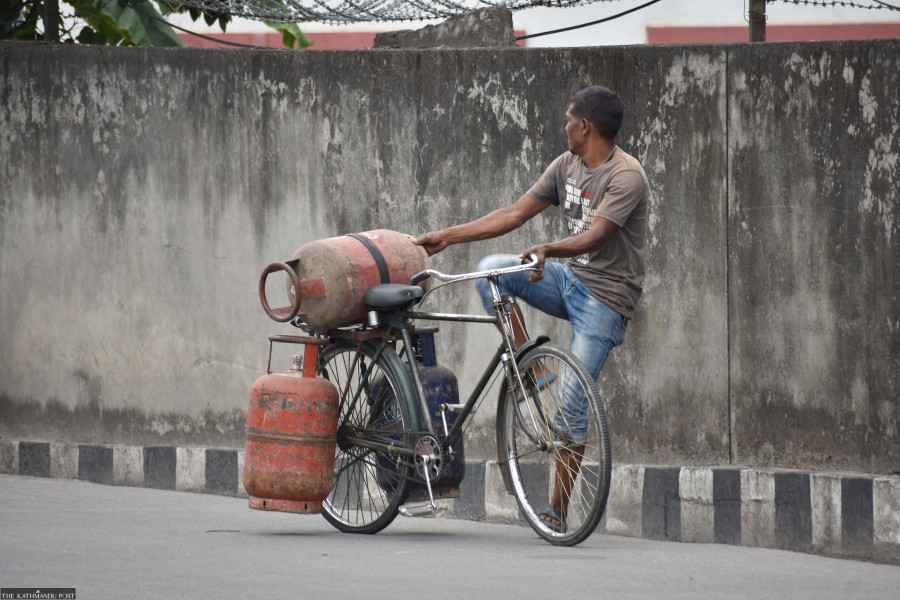
Rising cost of rice, edible oil and transport squeezes households as stagnant incomes and global shocks fuel stagflation fears. Kitchen costs have shot up due to price rises including of cooking gas. Post file photo
Radha Sanjel from Kirtipur bought a 25-kg bag of Pearl brand jeera masino rice for Rs2,000 a month ago. It now costs Rs2,250, an increase of Rs250 per bag.
Not only rice, the prices of mustard and sunflower oil have also soared.
A litre of sunflower oil now costs around Rs300, while mustard oil sells for more than Rs400 per litre, up by Rs20 to Rs30.
“Everything is expensive,” said Sanjel, who works as an office assistant at a private hospital.
She and her husband together earn Rs65,000 a month to support their family of four.
“Almost all our income goes into consumption. It is really difficult to manage household expenses, school fees, transportation costs, and healthcare,” said Sanjel, whose two children study in school.
Like Sanjel, many consumers are struggling as prices of daily essentials, particularly rice and edible oil, continue to rise sharply.
Economists and traders say multiple factors are behind the price surge, including the conflict in West Asia. As an import-dependent country, Nepal is highly vulnerable to global market disruptions, which hit low-income households the hardest.
Diesel prices have risen by 60 percent and petrol prices by 28 percent over the past three months. The price of an LPG cylinder has increased by 11.5 percent.
Following the fuel price hikes, public transport fares have risen by nearly 20 percent, while average cargo transportation costs have increased by 17 percent.
Fuel prices are not the only reason behind the rise in consumer prices.
The appreciation of the US dollar against the Nepali rupee has made imported goods more expensive.
Nepal Rastra Bank data show consumer inflation reached 4.47 percent in mid-April, the highest level in 13 months. The index includes both food and non-food items, with non-food items carrying a larger weight in the inflation basket.
However, food and beverage prices have risen at a much faster pace.
In the first nine months of the current fiscal year ending mid-April, the year-on-year price index for ghee and oil rose by 12.87 percent, fruits by 11.67 percent and vegetables by 9.18 percent.
Pavitra Bajracharya, president of the Nepal Retailers Association, said rice prices increased by Rs5 to Rs10 per kg due to higher transportation costs. He added that the rising costs of plastic packaging materials have also pushed up food prices.
Global crude oil prices have driven up the cost of key polymers such as polyethylene and polypropylene as the West Asia conflict drags on.
Nepal imports plastic materials from third countries, and most packaging materials—plastic bags, bubble wrap, foam tarpaulin and industrial plastics—are petroleum-based.
Importers say plastic prices have jumped by 40 to 50 percent, with the additional cost ultimately passed on to consumers.
“Nepal imports plastic materials from third countries to package rice. The printing is done here,” said Vibor Agrawal, executive director of Radha Krishna Rice Mill.
“Not only packaging costs, but the price of paddy imported from India has also increased by Rs100 per quintal, or Re1 per kg. These combined factors have pushed up prices of different rice varieties,” he said.
Nepal meets most of its demand for fine and long-grain rice through imported paddy from India, which is processed in domestic rice mills. Domestic production of fine rice remains limited despite strong demand among urban consumers.
According to the Department of Customs, Nepal imported 449,602 tonnes of paddy worth Rs16.74 billion from India in the first 10 months of the current fiscal year ending in mid-May. Rice imports during the same period stood at 219,261 tonnes worth Rs17.32 billion.
Agrawal said jeera masino rice prices increased by Rs50 to Rs75 per 25-kg bag within a week. Long-grain rice prices rose to Rs3,400-Rs3,500 per 20-kg bag from Rs3,100-Rs3,200 after the Middle East conflict intensified.
Bajracharya said sunflower oil prices climbed to Rs300 per litre from Rs265, while mustard oil prices rose to Rs460 per litre from Rs350-Rs375.
At the same time, weak economic growth has kept household incomes stagnant. Nepal’s average economic growth rate over the past decade has hovered around 4 percent.
As a result, remittance income has become increasingly critical for many households to finance basic consumption.
According to the National Statistics Office, remittances are projected to be equivalent to 33.02 percent of Nepal’s GDP this fiscal year, up sharply from 27.80 percent last year, highlighting the country’s growing dependence on overseas earnings.
A preliminary assessment report titled Military Escalation in the Middle East: Human Development Impacts Across Asia and the Pacific, published by the UNDP in mid-April, warned that Nepal could face some of the highest risks of cumulative human development losses if the conflict persists.
The report said Nepal’s food security could worsen if remittance inflows decline due to weaker Gulf economies reducing household purchasing power.
“Obviously, we are in stagflation as growth is slowing while inflation is rising,” said economist Chandra Mani Adhikari.
“This will affect the overall economy, government revenue and household income.”
He said higher diesel prices have increased agricultural input and transportation costs, hurting farmers and reducing returns.
“The Nepali rupee has depreciated against the dollar, increasing overall economic costs and weakening people’s purchasing power,” Adhikari said.
“People’s income has not increased. More than 60 percent of household income is spent on daily consumables.”
He added that prices of eggs, vegetables, fruits and rice have all risen in double digits, while education inflation has climbed to 6-7 percent.
Prem Lal Maharjan, president of the National Consumers Forum, said the government has failed to provide relief despite mounting pressure on consumers.
“External factors have definitely pushed up prices, but like the previous administration, the current government also appears least concerned about intervening in the market and supporting consumers facing hardship,” Maharjan said.
“People are suffering. Low income and rising expenditure have become a serious concern for everyone.”
Krishana Prasain is a business reporter for The Kathmandu Post covering markets. Before joining The Kathmandu Post in 2018, she spent 3 years in New Business Age magazine covering business.




 14.4°C Kathmandu