Q&A: Social media has made Everest ascent look easy, but it isn’t
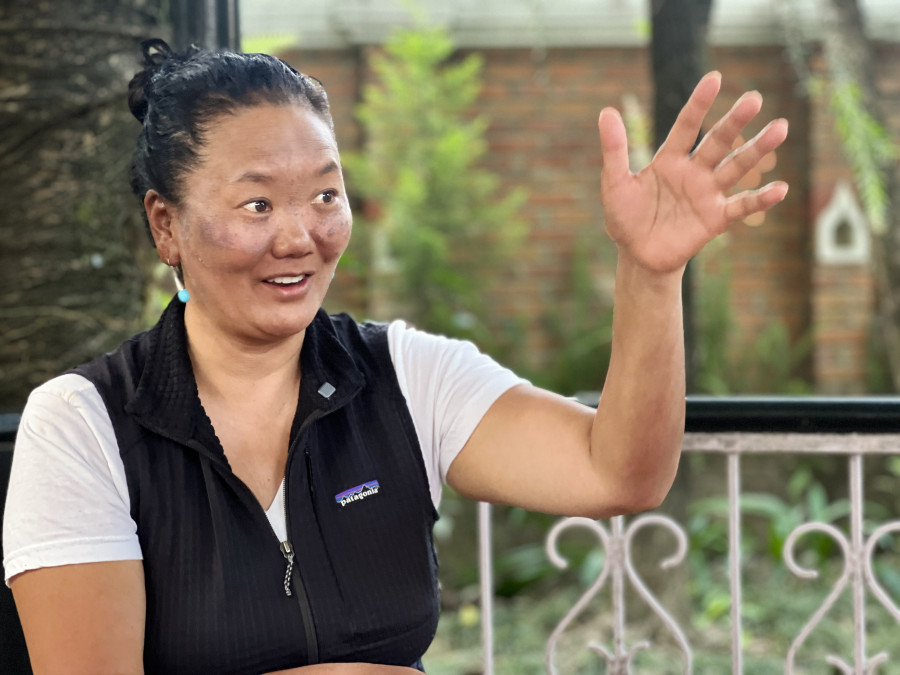
'Mountain Queen' Lhakpa Sherpa reflects on surviving abuse, gruelling immigrant labour in the US, balancing motherhood with mountaineering, and witnessing climate change reshape the world’s highest peak. Lhakpa Sherpa, Record holder Everest summiteer Post Photo: BIken K Dawadi
At 53, Lhakpa Sherpa is a living legend. With her latest successful ascent, she has extended her record as the world’s most successful female Everest summiteer, having stood on top of the world eleven times. Yet, behind the history-making headlines lies a story of profound survival, gruelling immigrant labour, and an unbreakable spirit.
In an interview with The Post’s Biken K Dawadi and Suraj Kunwar, Sherpa opens up about her struggles in the US, overtaking the ‘Everest Man’ Kami Rita Sherpa on the upper slopes this year, dealing with the realities of climate change, and how her children saved her life. Excerpts:
People look at you today and see the ‘Mountain Queen’. But your journey wasn’t always smooth, was it?
People do not always see the years of physical labour and the emotional pain behind my achievements. I have worked so hard to survive, and I have endured mockery from people. When I first moved to the United States, people ridiculed me. They looked at my situation and said, “Look at the Everest summiteer, she is washing dishes for a living.” They thought my life was a failure.
But I am not an educated person. I am not a doctor, nor am I a lawyer. My true skill is the mountain. I had to raise my children entirely by myself in a foreign country. I couldn’t just beg people for food or money; I had to earn it through hard labour. There were times on the mountain when the conditions were so extreme that I felt like I had died and come back to life. But back in the US, the struggle was different. I couldn’t leave my young kids alone at home while I worked, or they would be taken away by social services. I had to care for them through sheer hardship, balancing work and childcare.
Your recent Netflix documentary has inspired millions of women globally. How do you process that impact?
At my core, I am a lover of the outdoors. But, first and foremost, I am a mother. Before the documentary, I went through a very difficult marriage, raised my kids through financial and emotional difficulty, and then went through a painful divorce. Many people lose their minds or give up on life during a divorce. Then, my ex-husband passed away, which added more emotional weight.
My daily survival struggle was so intense that climbing Everest felt like nothing compared to it. On the mountain, the rules are simple, but in the city, it is very complicated. People used to scoff at me and say, “Lhakpa Sherpa won’t climb anymore, she is just washing dishes at Whole Foods.” They thought my mountaineering days were over. But now, seeing women watch my movie and say, “If Lhakpa can do it, so can I,” changes everything. When they see my struggles and find the courage to face their own lives, it makes me happy. It shows that my suffering had a purpose.
Take us back to those early days in the US.
I started climbing Everest back in 2000 when I was very young and had one child to take care of. Then I got married and moved to the US. I didn’t go to school when I was a child. I didn’t know English. I came from Makalu, which is a very remote region in Nepal. Growing up there, we often slept without proper shoes or warm clothes. We lived a very basic, rugged life.
After my divorce, I had three children in my arms with no financial support. I had to pay the monthly rent and all the utilities by myself; otherwise, we would be homeless. To make enough money, I had to work a double shift every single day. I would drop the kids off at school in the morning, do my daytime work, pick them up, put them to sleep at night, and then immediately go to work the night shift. Double shifts mean double money, and I needed every dollar. I would return home at 6:00 AM, wake the kids up, take them to school, rest for a tiny bit, and then go right back to work.
Did you ever feel like giving up on mountaineering during those years?
I walked away from Everest for a decade to focus on raising my children. I did not have the luxury to climb. I did housekeeping work and washed dishes. But once my daughters grew up and became more independent, I looked at my life and realised that the outdoors was still my true calling. I didn’t have a regular desk job or a career in an office. I knew that the mountain was the place where I had the most skill. So I sat down and told my daughters, “I am returning to Everest. I am going to do this for your future. This is what I have mastered.” They understood me, and that is how I started again.
Your daughters are grown up now. How are they involved in your life and career today?
They have grown into incredible individuals, and they are my biggest support system in life. Sunny is now 23 years old, and Shiny is 19 years old. Sunny went to college and studied business, so she understands how to manage money and operations. Shiny loves media and digital work—she makes videos, handles photography, and wants to direct her own movie one day. Because they are educated in the American system, they were able to help me register my official guiding company, which is called ‘Hiking with Lhakpa’.
I am very good at climbing, but I couldn’t have handled the legalities, the tax paperwork, and the emails by myself. Now, my daughters manage everything related to my expeditions. Before I leave for a mountain, they look at me and say, “Mama, you just do the physical climbing and focus on staying safe, and we will handle all the rest of the business details.”
It sounds like your sacrifices paid off in the form of their love.
They understand what I went through to give them a life in the US. They saw the hard work firsthand. Just yesterday, they called me from the US asking if I needed any extra money for my stay in Kathmandu or if they should start planning a celebration party for me when I return. It touches my heart because it shows they care. My children are paying me back now with pure respect and love. That is the greatest reward for a mother. I made a choice during those years not to remarry. I wanted to focus on my children. I sacrificed my personal life so that they could have a stable future, and seeing their gratitude now makes every single sacrifice worth it.
Let’s talk about your latest climb. How did this ascent compare to your previous ones?
After climbing K2—which is a difficult, steep and highly technical mountain—Everest felt much more manageable this time. My body was well-prepared for the altitude. But high-altitude climbing always takes a physical toll. If you look at my hands right now, they do not look like a typical woman’s hands at all. They look like a man’s rough hands. I want to hide them away.
On Everest this year during the summit push, I was moving very fast and leading my group from the front. Near the South Summit, I caught up to and passed Kami Rita Dai (Kami Rita Sherpa). His group was moving a bit slowly. When you are standing still in that extreme cold, your blood circulation drops and your hands and feet freeze. I knew that staying stationary was dangerous for my team, so I made the decision to pass them and lead my group forward. I kept a strong pace and reached the summit an hour and thirty minutes ahead of him.
So the Mountain Queen overtook the Everest Man this season?
(Laughs) Yes, that is what happened on the upper slopes this year. I passed his group on the ridge and reached the top an hour and a half earlier than he did. My guiding team this season consisted of about 15 people who came from different countries, including Russia, Australia and Canada.
You are currently at 11 summits of Everest, and the closest woman behind you is far off. Do you ever worry about your record being broken?
I do not climb for the records or the numbers anymore. I climb because my body is built for the mountains. The woman behind me is currently at six summits of Everest. And from Nepal, we have younger climbers like Purnima Shrestha who are doing an amazing job and moving very fast in the mountaineering world.
I want them all to succeed. My daughters always look at my health and tell me, “Mama, your body is still strong. Keep going for ten more years, and then we will all go to the summit together.” Hearing that gives me a long-term goal that goes beyond just keeping a record.
What is your goal for those ten years of mountaineering?
I want to document how Everest changes in the next ten years. You can already observe that while Sherpa guides used to be from the Khumbu region, they are increasingly hailing from the Makalu region now. As more Sherpa youths get better education and venture into different professions, I want to see where the Sherpa community heads next. Perhaps there will be robot guides one day, or helicopters will airlift people to higher points in the climb. I want to see it all.
You withdrew from your Everest expedition last year. What happened?
My eldest daughter came with me all the way to Base Camp last year. But once she saw the harsh reality of the environment, she started overthinking. She began to panic, thinking to herself, “If my mama dies, how will I manage to go back to the US all alone?” She got sick from the sheer anxiety. I couldn’t just leave my beautiful daughter sick alone at Base Camp. Family always come first, before any career goals or records. So I made the immediate decision and chartered a rescue helicopter and took her down to the lower altitude of Lukla. She felt very guilty about it later and apologised to me for interrupting the climb. This year, my daughters stayed back in the US.
How much has Everest changed since your first climb, in terms of technology and crowding?
The technology on the mountain has exploded over the last two decades. The Sherpas are technical now, and the gear we use is advanced. But sometimes technology can be very confusing. This year, while I was on the mountain, I heard a loud, strange buzzing sound. I panicked and ran away, fearing it was an avalanche. It turned out to be a drone!
Aside from technology, overcrowding has become a very serious issue on Everest. When you have hundreds of people trying to summit on the same day, mixing experienced mountaineers with inexperienced tourists, the situation becomes hazardous. Social media has made Everest ascent look easy, but it isn’t. It is no joke. The government needs to implement strict regulations and limit the total number of climbers allowed each season.
What about the physical impact of climate change?
The ice on the mountain is melting at an alarming rate, exposing bare black rocks. Streams of running water are now flowing in areas where there used to be ice. Even the structure of the Khumbu Icefall has changed over the years due to the rising temperatures.
It is heartbreaking to see the mountain decay like this over time. It is a visible reminder of global warming. However, this is a global issue, and local climbers cannot fix it alone.
What went through your mind when you reached the summit this year?
I reached the top in the morning this year. The weather during our summit push was great. The sun was shining, the wind was calm, and the view toward Tibet was clear. Whenever I stand on the summit, I turn my face toward Makalu. I look at that peak and think, “That is the exact region where I grew up, and that is my mother’s home.”
I bow down and pay my respects to the sacred peaks. But you cannot celebrate for long at that altitude. My immediate thought is: I have succeeded in reaching the top, and now I must descend safely.
Despite your global fame, you choose to live very simply. Why?
I have no desire for luxury. I am a simple person. I don’t wear nail polish, I don’t use makeup, and I don’t care about owning jewellery. Those things do not match my true character.
Even when I don’t have much money myself, I prefer to take whatever resources I have and give them directly to struggling Sherpas. I know what it feels like to have nothing. I would rather use my position to help someone else who is currently suffering the same way I used to.
Your late husband was also a mountaineer. Have you ever paid tribute to him?
My late former husband was a Romanian-American climber. We first met during his first ascent of Everest. Over our years together, he climbed Everest nine times, mostly with me. Later, he passed away. His lifelong dream had been to reach the summit of K2, but he was never able to achieve it.
Before I left for my own K2 expedition, my daughter handed me his photograph and said, “Mama, please take Papa’s photo to the summit.” She asked me not to post it on social media, so I kept my promise to her. I quietly placed his photograph at the very top of K2 and sent a photo of it to my daughter.
Finally, what do you miss most about Nepal when you are in America, and what do you love about both countries?
When I am in the US, I miss my mother, my childhood village and my old friends. My mother is still living in the remote Makalu region. We manage to talk regularly over video calls. My life is split between two different worlds, and I see the value in both.
What I love about the US is its organised system—the rule of law is reliable, and it applies equally to all. What I love about Nepal is the heart and warmth of its people. In Nepal, if you are lost or confused, you can ask a stranger for help. Their kindness is genuine and unmatched anywhere else in the world.
Suraj Kunwar is a senior correspondent with over two decades experience covering Aviation, Tourism and Mountaineering. He received the IFJ Tolerance Award in 2005.




 13.76°C Kathmandu