Q&A: Until football matters to the state, World Cup stays a dream
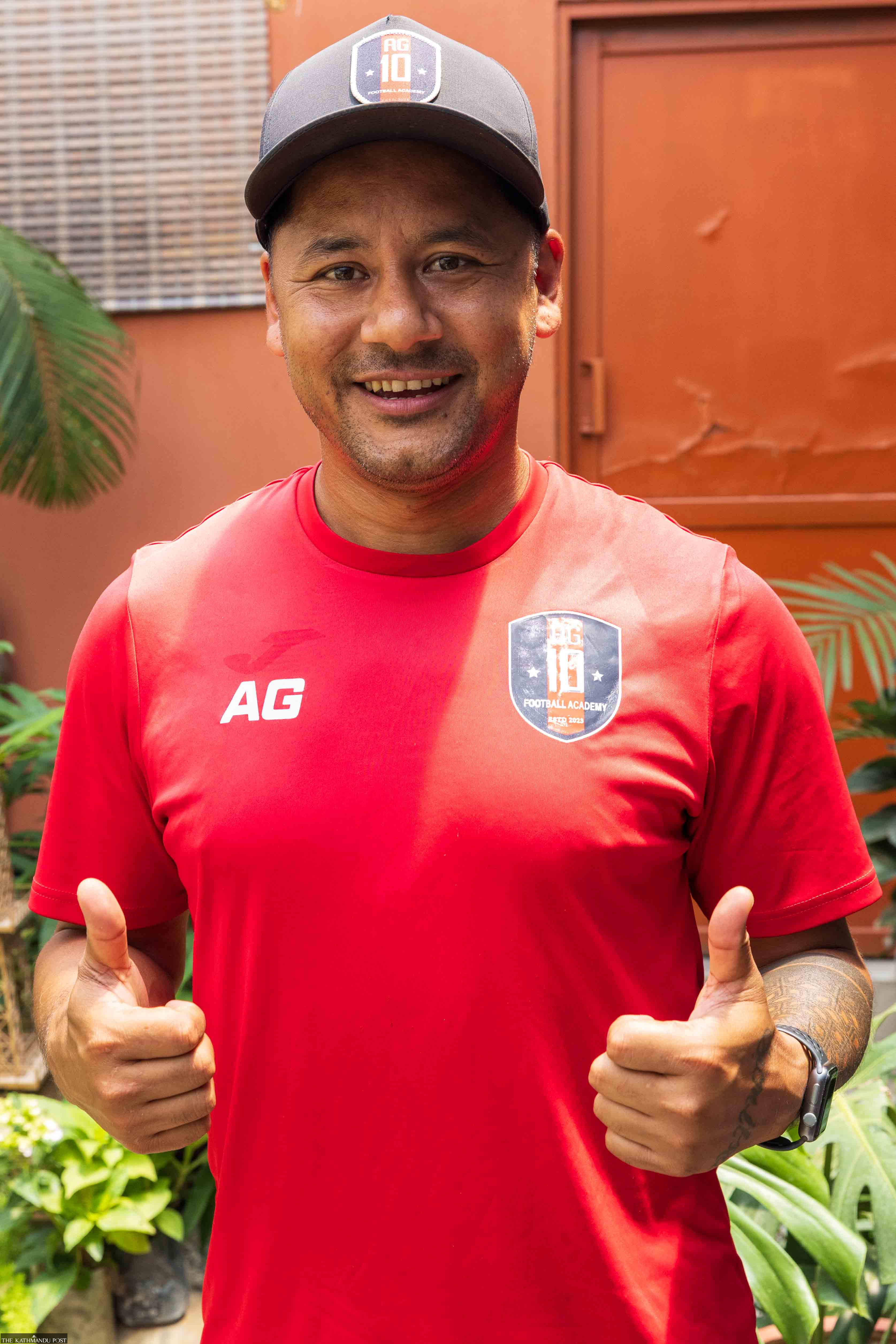
Legendary striker Anil Gurung reflects on Nepal’s stalled domestic league, the rise of the NSL, football’s enduring appeal, and why women may reach the World Cup before men. Anil Gurung, former skipper of Nepali national football team Noah Epps/TKP
As the 2026 FIFA World Cup kicks off across North America, capturing the imagination of billions with its newly expanded 48-team format, football fever has once again gripped the globe. In Nepal, fans eagerly crowd around screens late into the night, dreaming of a day when the red and blue of the national flag might grace the sport’s ultimate stage. Yet, against the backdrop of this global celebration, the reality of domestic football back home presents a stark, sobering contrast.
For over a decade, the name Anil Gurung was synonymous with the clinical, high-octane frontline of Nepali football. From his legendary 32-goal season for Brigade Boys to his stint in India’s I-League, Gurung embodied the grit and ambition of a golden generation. Yet, nine years after retiring from international football in 2017, the former national team skipper finds himself navigating a severely fractured domestic landscape.
The vibrant local calendar that once propelled players like Gurung into the spotlight has ground to a painful halt. With the country’s premier A-Division League plagued by a devastating four-year hiatus, the local game faces an existential crisis. As structural stagnation pushes the country’s brightest young talents to seek futures on foreign shores, Gurung has refused to abandon the pitch. Instead, he has redirected his tenacity toward the roots of the sport.
Through his AG10 Football Academy, Gurung is quietly staging a grassroots revolution, providing young prodigies with critical international exposure at tournaments like Denmark’s prestigious Dana Cup. The Post’s Biken K Dawadi recently sat down with the iconic forward for an interview where he reflects on the dismantling of the domestic league system, the rise of the franchise-model Nepal Super League (NSL), and why the booming popularity of cricket isn’t the threat football fans think it is. Gurung, who is 39, dives deep into his Pokhara roots, his memories of playing under Graham Roberts, and his firm belief that Nepal’s truest shot at global glory lies with the meteoric rise of the women’s national team.
How have you been keeping yourself busy these days?
After my retirement in 2017, I continued playing at the club level till 2021. But then, the domestic leagues just stopped happening regularly. That lack of a consistent league meant that even though I could have played for another two or three years, there was simply no platform to do so. Once I realised the league wasn’t returning anytime soon, I decided I needed to contribute to the sport in a different way. That’s why I am currently fully immersed in running my own academy, the AG10 Football Academy. We are currently conducting our training sessions at the Chyasal Football Ground. Since there aren’t many club-level games happening right now, the academy has become my primary focus and where I spend most of my time.
Let’s talk more about the academy. I heard a rumour you are heading to Denmark soon—what is that all about?
Yes, that’s correct. Every year, we take a group to Denmark for the Dana Cup, which is essentially a massive football festival. It’s a worldwide event where teams from all over Europe and the rest of the world come to compete. It is a vital exposure trip for young kids. We go every year, and last year we took teams in the Under-14 and Under-12 categories. Our Under-14 team actually performed exceptionally well and came back as winners in the 7-a-side tournament. This success gives me hope. I believe Nepal needs many more academies like this, focused on grassroots programmes. It is this grassroots work that keeps the flame of Nepali football alive. It’s the reason people can still believe that football in Nepal hasn't ‘died’ yet.
Grassroots is the foundation, but the A-Division League is the peak. We remember you scoring 32 goals in a single season for Brigade Boys and Manang Marshyangdi. How does the current absence of a national league affect the sport?
You’ve hit the nail on the head. The A-Division League is the backbone of Nepali football. There is a universal truth in this sport: If a country’s domestic league is strong, its national team will naturally be strong. It has been almost four years now without a consistent A-Division League. This is a disaster. Because there is no league, we are seeing a trend where football players are slowly being forgotten by the public. When there are no events, the craze for the sport naturally starts to dip. It’s not that people have stopped loving football—we have some of the most passionate fans in the world—but without a league, players feel they have no future here. I came through the Sahara Academy myself, and even after retiring, I chose to stay in Nepal to build something for the next generation. But it is becoming incredibly difficult for players to justify staying when the league is non-existent.
In the absence of the A-Division, we see the Nepal Super League gaining traction. Can the NSL replace the traditional league?
I have been involved with the NSL from the start. I played in the first season and moved into a management role for the second. The NSL is an important event because it introduced a high level of professionalism and a franchise model that we used to only see in places like the Indian Super League. When I was playing in the I-League in India, I used to wish we had something like the ISL in Nepal. Now we do. However, I must be clear: Nepali football cannot survive on the NSL alone. While the NSL provides a great space for fans and a professional environment for players, the A-Division League is still the primary requirement. Ideally, we should have a fixed football calendar where both leagues coexist. If we can coordinate the dates so that players are busy with club matches, national duty, and franchise games, we could run the sport effectively throughout the year with only a two-month off-season.
Cricket is booming in Nepal right now. Do you think football is losing its ‘hype’ to cricket?
No, no, no. That is totally wrong. While it’s true that the lack of domestic football is disappointing for fans and makes it hard for them to find a reason to go to the Dasharath Stadium, their passion hasn’t faded. Fans are our backbone. Cricket is doing well and has great hype, which is wonderful, but the moment a football rolls into the stadium, it will be packed again. Football is a global language. I don’t think there is anyone who doesn’t like football. In Nepal, children grow up kicking a ball from the moment they can walk. If you look at the World Cup jerseys selling out in shops or the buzz on social media, you can see the craze is still there. It’s a part of our culture.
You have mostly worn the number 10 shirt in your professional career. Are you a Messi fan?
People always ask me if I am a Messi fan or a Ronaldo fan. But both are incredible, world-class players who serve as huge inspirations for the kids coming up today. Personally, though, I’ve always been a fan of England. It started with David Beckham; watching him on TV is what made me an England fan and a Manchester United fan. Later, because I was a striker myself, I started following Wayne Rooney closely. My loyalty to England also comes from my roots in Pokhara. In Pokhara, there is a strong Lahure culture where almost every household has someone who has gone to the UK to serve in the British Army. That connection makes the support for England very natural there.
Noah Epps/TKP
Do you think England will actually win this time? Or is there another team you’re watching?
England has the best league in the world in the Premier League, and they always have great players. Their national team is always strong, even if the results haven’t always gone their way recently. I always want England to win, but if I’m being honest about this specific World Cup, I have a different wish. Since Messi has already won a World Cup, I would love to see Cristiano Ronaldo and Portugal lift the trophy. It would be a fitting face-off for his career.
The World Cup format has changed to 48 teams. Some critics hate it—what do you think?
I think the format change is a good thing. We need a system where South Asian teams eventually have a realistic pathway to the World Cup. Currently, it is incredibly tough for us. If the format allows more diversity, it will encourage our government to invest. Without state investment, playing in a World Cup is simply impossible. Even if it takes another 10 or 15 years, a format that includes South Asia would change the entire investment landscape of sports in this region.
Speaking of the World Cup, we once reached the second round of the qualifiers. I remember the match against Jordan. What was that experience like from the inside?
I remember it vividly. We had beaten Timor-Leste to qualify for the second round against Jordan. The away leg in Jordan was a nightmare. The facilities were world-class, the crowd was intense, and we lost 9-0. We were devastated. We wondered how we could even face our fans back home in a full stadium after such a loss. But our coach at the time, Graham Roberts, was incredible. During the press conference in Kathmandu, a journalist asked him about the 9-0 loss and what he expected for the home match. Roberts boldly replied, “We will win 2-0.” That gave us so much hope and energy. We didn’t win, but we fought for a 1-1 draw in front of our home crowd, which was a huge moment for us.
One perennial complaint from fans is the lack of a ‘consistent striker’ in the national team. Why don’t we see prolific scorers anymore?
The problem is multifaceted. Back when we were playing, the league was regular, and players were selected based on their top performance in those leagues. Today, we see players who perform well in the league but crumble under the pressure of the national team. Playing for the country requires a different level of experience and an understanding of how to interact with foreign coaches and tactics. We stayed in the national team for ten years because we had that continuity. But the biggest issue now is migration. In the past, players would only think about going abroad for work after they were 30. Now, 18 and 19-year-olds are leaving for Australia because it’s so easy to go there and play for community teams. Instead of giving ten years to the national team, they give one or two years and then leave the country. That is where the consistency is lost.
Is the dream of Nepal playing in a World Cup just a fantasy, or is it possible?
Right now, being honest, it is just a dream. When you see how much European teams invest and still struggle to qualify, you realise how far behind we are. To even think about the World Cup, we need 20 years of regular, uninterrupted league play. We need the state to stop ignoring sports. Under Graham Roberts, we reached a ranking of 135, which was excellent. Now we are down to 177. We need to focus on maintaining and slowly improving that ranking through regular games. Until the government invests in football as a priority, we cannot expect World Cup miracles.
On a brighter note, Sabitra ‘Samba’ Bhandari is getting global recognition. Does women’s football have a brighter future than men’s in Nepal?
Absolutely. I remember a time when the women’s team was just formed to participate in SAFF tournaments without much hope of winning. But recently, they have reached a level where players like Samba are being recognised as the ‘Ronaldo of Asia’ and are playing in Europe. It’s a complete reversal—the women’s team is now getting the hype the men’s team used to have. They are ranked 87th in the global ranking. If the state and ANFA invest seriously in the women's team, I believe they could actually qualify for a World Cup much more easily than the men.
What needs to happen specifically for the women to reach that level?
Grassroots and family support. In my academy, I see so many young girls training now, and their parents are fully supporting them. That shift in mindset—where parents believe their daughters can have a career in sports—is the biggest change. We need a women’s franchise league and a consistent domestic calendar for them. If we can provide the same platform as the men’s, the women’s national team is definitely on the path to a World Cup.




 22.15°C Kathmandu