Q&A: Generating Rs29.32 billion from power exports is a remarkable national milestone
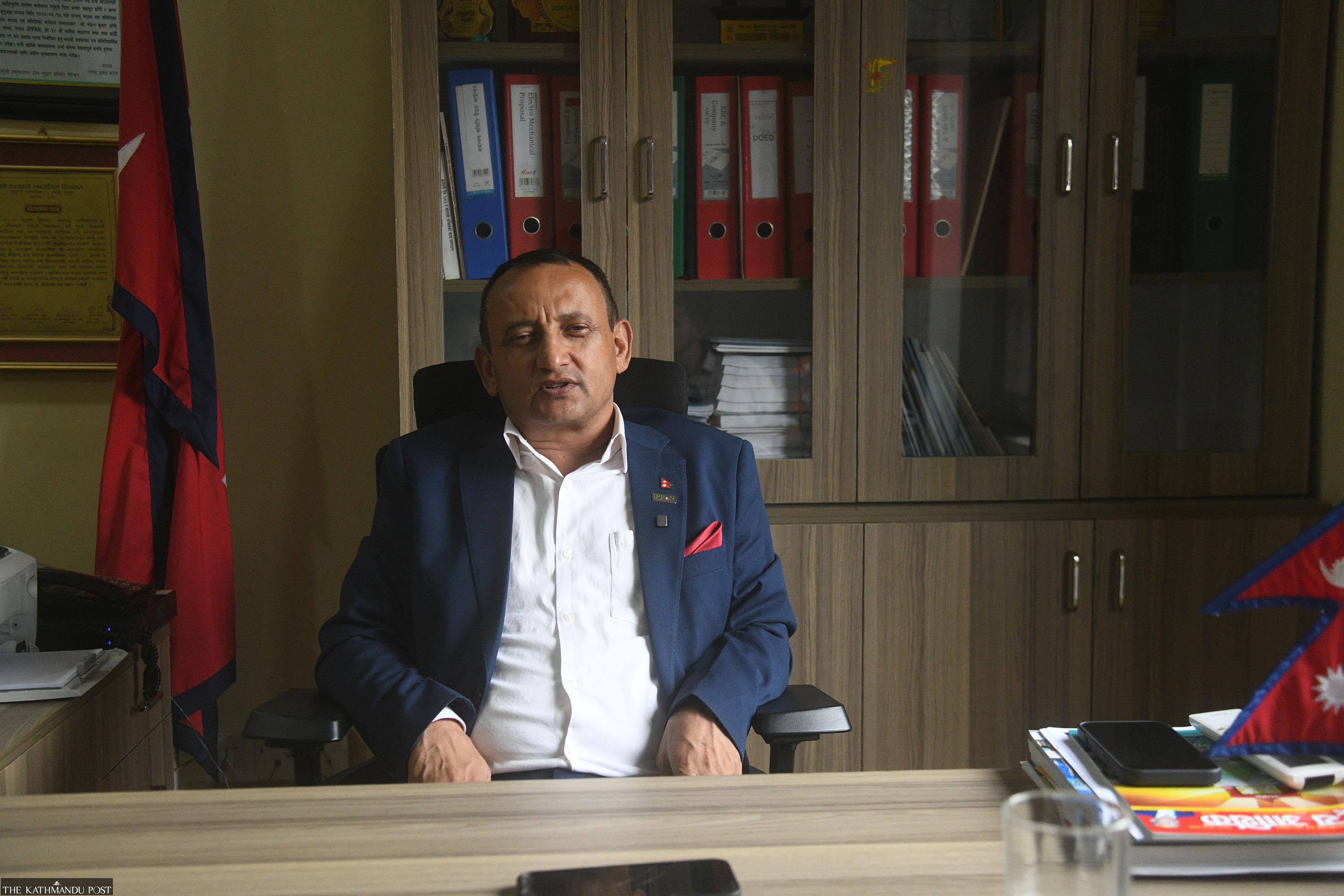
Newly-elected IPPAN President Mohan Kumar Dangi emphasises the necessity of power trading rights for private developers, the causes behind the PPA backlog and the strategic roadmaps required to transform Nepal’s energy sector. Mohan Kumar Dangi, newly-elected IPPAN President Deepak KC/TKP
For a country aiming for ambitious energy targets, Nepal’s private power producers find themselves navigating a maze of regulatory halts and a massive gridlock. The Nepal Electricity Authority (NEA) currently faces a backlog of unsigned Power Purchase Agreements (PPAs) totalling nearly 16,000 megawatts, leaving project developers in uncertainty. While the government previously introduced a policy framework to generate 15,000 MW, rapid exhaustion of designated quotas led to a prolonged suspension of standard PPAs since 2018/19. As developers call for policy consistency and open market access to allow private sector power trading, the urgency to address these systemic bottlenecks has never been higher.
The Post’s Biken K Dawadi and Seema Tamang sat down with Mohan Kumar Dangi, the newly elected President of the Independent Power Producers’ Association, Nepal (IPPAN), to dissect the structural causes behind the PPA backlog, the necessity of power trading rights for private developers, and the strategic roadmaps required to transform Nepal’s energy sector from quota-driven constraints into a fully realised necessity.
Nepal Electricity Authority (NEA) has a backlog of several unsigned Power Purchase Agreements (PPAs), totalling around 16,000 MW. How does the IPPAN plan to break this gridlock?
Let us look at the background first. Back in 2015/16, the Government of Nepal introduced a policy to develop 15,000 MW of power. That 15,000 MW target was categorised into three primary types: Run-of-River (RoR), Storage/Reservoir, and Peaking Run-of-River (PRoR), alongside a 10 percent quota dedicated to solar energy to achieve an optimal energy mix concept that would make our nation self-reliant. Under that target, a quota of 5,250 MW was designated specifically for RoR projects.
That 5,250 MW quota for RoR projects was exhausted very quickly. Consequently, from 2018/19 onwards, standard RoR PPAs were suspended. Later, during the tenure of former minister Rajendra Lingden, 1,500 MW was transferred from the unused reservoir quota to the RoR quota because not a single reservoir-type PPA had taken place, whereas PRoR PPAs were continuing. That brought total RoR PPAs to 6,750 MW.
The point I am emphasising is that this issue is not something that just happened yesterday. Standard RoR PPAs have been largely halted since 2018/19. The PRoR quota has now been exhausted as well. The storage quota remains unfulfilled because storage projects haven’t been initiated. The government did bring forward positive measures for reservoir projects in the recent budget—such as extending licenses to 50 years and permitting developers to collect 40 percent equity from the public after financial closure.
Currently, projects generating around 16,140 MW have completed their feasibility studies, and many have obtained or applied for generation licenses. They are all lined up waiting for PPAs. The government previously pledged in its 100-point action plan that PPAs would be executed within 180 days. We have placed our trust in the government’s official announcements. Over 100 days have elapsed out of those 180 days, and we expect a breakthrough soon.
So, effectively, since 2018/19, barring that 1,500 MW transferred quota in 2022/23, there have been no regular PPAs?
Exactly. That 1,500 MW PPA was done purely by shifting allocations from the reservoir pool. It cannot be considered part of a regular, continuous process. Therefore, standard PPAs have remained stalled since 2018/19.
And Peaking (PRoR) PPAs are not moving forward either?
The peaking quota of 2,800 MW has also been filled. So, PPA processing across these categories is virtually at a standstill right now. While the reservoir category remains open, there are few viable private reservoir projects ready, rendering the overall situation stagnant.
Last year’s budget introduced a ‘take-and-pay’ provision. Previously, through IPPAN’s initiatives, former leadership at NEA had agreed that projects up to 10 MW would not have to wait in a queue for PPAs. But with the introduction of the take-and-pay provision, even those small-scale projects came to a halt.
Many private developers are deeply concerned about these conditions. How is IPPAN engaging with the government to protect investor capital?
First of all, ‘take-and-pay’ cannot be considered a real Power Purchase Agreement. It is not bankable. Financial institutions will not extend loans under a take-and-pay clause, making such agreements practically useless.
Regarding capital protection, private developers did not take survey and generation licenses on a whim. The Government of Nepal opened these opportunities. The Ministry of Energy, Water Resources and Irrigation, alongside the Department of Electricity Development, issues licenses to us. It is unjustified for the state utility, NEA, which falls under the same ministry, to say it will not execute PPAs.
Deepak KC/TKP
We recognise the operational challenges. Currently, around 4,300 MW is operational in Nepal’s total system, and roughly 6,200 MW of projects are under construction. Managing all this capacity is challenging for NEA alone. That is precisely why we advocate issuing power trading licenses and transmission construction licenses to the private sector.
If we strictly insisted on our constitutional rights without offering solutions, our single demand would simply be: “Sign our PPAs regardless.” But we observe that the NEA is struggling to manage energy absorption, explore export markets, and expand domestic demand. Look at the domestic market potential—we import LPG gas worth Rs60 billion annually. If we replaced LPG with electric cooking, or expanded electric vehicle infrastructure, domestic consumption would surge.
Since state mechanisms have not fully capitalised on these areas, opening up power trading and transmission to the private sector is a constructive solution. If the government issues licenses, collects taxes, and regulates under existing law, refusing to sign PPAs afterwards is untenable.
Despite these challenges, Nepal achieved nearly Rs29.32 billion in revenue from power export. In light of this milestone, how do you view IPPAN’s push for private cross-border power trade?
Generating Rs29.32 billion from power exports is a remarkable national milestone. It underscores the vast economic potential of Nepal's energy sector. However, we must recognise that this record revenue was built on the foundation of private sector investments. Over 80 percent of the operational capacity generating that exported energy was constructed by private power producers.
Our demand for internal and cross-border power trading licenses is supported by this proven track record over the past twenty-five years.
The Electricity Act was promulgated in 1992, followed by the Electricity Regulations in 1993. By 1998, standard PPA tariffs were established, facilitating private sector entry. In 1998, Nepal’s total installed capacity was merely 252 MW. Today, total capacity stands at roughly 4,300 MW, with over 3,500 MW built directly by private power producers. State-owned generation accounts for only about 800 MW. This proves that the private sector possesses the technical and financial capacity to execute large-scale infrastructure.
Second, private developers have built hundreds of kilometres of transmission lines to connect their power stations to NEA substations across multiple voltage thresholds—33 kV, 66 kV, 132 kV, and 220 kV.
Consider a recent example: the 220 kV Markhu-Chok to Bharatpur line. The NEA had awarded that major transmission corridor to a Chinese contractor eight to ten years ago, but the project stalled due to low bidding, local disputes, and cost overruns. Private developers stepped in, took over the project, injected the shortfall capital, and completed the line within six to seven months. This demonstrates our ability to construct transmission corridors efficiently.
Third, look at regional dynamics. India’s installed capacity stands at nearly 600,000 MW, with private enterprises accounting for approximately 49 percent. Major private corporations like Tata Power, Adani Power, and Torrent Power handle thousands of megawatts seamlessly under clear statutory guidelines for open access, wheeling, and private power trading.
Following your recent interaction with the Indian Ambassador, what progress or resistance are you seeing regarding private power trade?
Our primary market is India. Bangladesh represents a secondary market, while China currently shows limited interest in power imports from Nepal. In India, private companies trade freely without governmental bottlenecks. Why should Nepal rely solely on Government-to-Government (G2G) mechanisms when Business-to-Business (B2B) trade can be far more flexible and responsive?
Even with the record-high export numbers achieved by the state utility, imagine how much higher those figures could be if private entities were granted trading licenses. Trading power is not a luxury for us. It is an urgent necessity. Developers have effectively become farmers who grow perishable crops but are barred from selling them while their produce goes to waste. Seven or eight private applications for trading licenses have been sitting at the Ministry for six to seven years without action.
Officials often point to the Electricity Act of 1992 (2049 BS) as a legal hurdle for granting private trading licenses. What is your position on this legal argument?
I disagree with that interpretation. A subsidiary company established under NEA—which is registered as a limited company just like our private companies—was granted a power trading license three to four years ago. That entity has held a license without conducting significant trade, while private developers who are ready to trade are denied licenses under the pretext of the law.
The law cannot treat one corporate entity differently from another simply based on state ownership. If the existing framework allows a state-owned subsidiary to trade, it permits private corporate entities to trade as well.
When late Minister Shailaja Acharya fixed PPA rates in 1998, critics doubted whether the private sector could build power projects. Had the government not trusted the private sector back then, total national capacity today would remain around 800 MW—the exact capacity built directly by the state—and the country would still be facing 18 hours of daily load-shedding. Today, the private sector supplies over 3,500 MW.
Obtaining a trading license does not mean trading begins overnight. Setting up international trade desks, strategic partnerships, wheeling arrangements, and commercial agreements takes four to five years. Power development and trading require long-term planning.
Under the 25-year agreement between Nepal and India, Nepal aims to export 10,000 MW of electricity to India over the next decade. Is this target realistic from IPPAN’s standpoint?
It is achievable. Following joint steering committee meetings, Nepal’s approved export capacity to India reached 1,650 MW. We have nine years remaining to scale up production and export the remaining 8,400 MW. Indian investments, such as the Arun III project, are actively underway. The government has set a broader target of generating 30,000 MW within ten years.
During our executive committee’s recent meeting with the Indian Ambassador, the Ambassador expressed keen interest in ensuring this 10,000 MW target is realised efficiently. When power is generated and exported, the broader economy benefits. Private hydro construction directly sustains domestic industries like steel, cement, transport and local employment.
Nepal recently reached an agreement to export 40 MW to Bangladesh via the Indian grid. How do you view the prospects there?
Bangladesh is an attractive market with high demand, and tariff rates offered there are competitive. However, cross-border transmission to Bangladesh requires transit through Indian territory, making India’s cooperation essential. That involves diplomatic channels beyond the direct scope of private developers.
Some commentators argue that Nepal should retain all generated electricity domestically rather than exporting it. Domestic utilisation is indeed the top priority because local consumption yields high economic multipliers. However, when surplus power is generated during the monsoon, and domestic demand cannot immediately absorb it, exporting that excess energy prevents financial losses for both developers and the state.
Beyond PPAs and power trading, project financing, climate risks, and disaster insurance remain major challenges for developers. How is IPPAN addressing these issues?
Liquidity in the banking system fluctuates. To secure long-term capital, we are encouraging alternative financial tools such as green bonds, specialised mutual funds, and climate finance structures. Hydropower yields predictable, long-term cash flows backed by fixed PPA tariffs, making it a suitable candidate for these instruments.
On insurance and natural disaster risks, recent floods demonstrated the vulnerability of headworks and powerhouses located near riverbeds. IPPAN is working to establish tailored insurance mechanisms specifically for the energy sector. We are advocating for policy guidelines that prevent a single insurance company from taking on excessive risk concentration within a single river basin. Distributing policies across multiple underwriters ensures structural stability for both the insurance industry and energy developers. Furthermore, engineering designs must adapt to rising climate risks by incorporating higher safety margins and headframe elevations.
What is your unifying vision for IPPAN during your tenure?
IPPAN was established in 2001 and has grown over the past two decades into a vital national institution representing around 700 member companies. Having worked closely with the last three leaderships, I have observed internal debates during leadership transitions. Healthy debate and democratic competition within an active organisation are positive forces.
Once elections conclude, internal differences end. My goal is to lead a fully unified IPPAN. Our main priority remains clear: Securing investment safety, ensuring policy certainty, breaking the PPA gridlock, and opening private power trading and transmission lines for the sustainable growth of Nepal’s energy sector.




 20.45°C Kathmandu