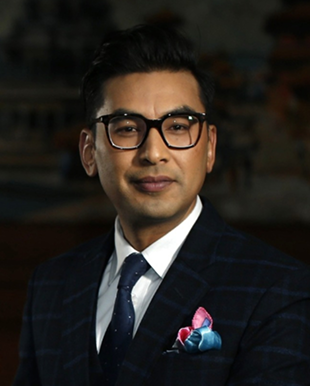
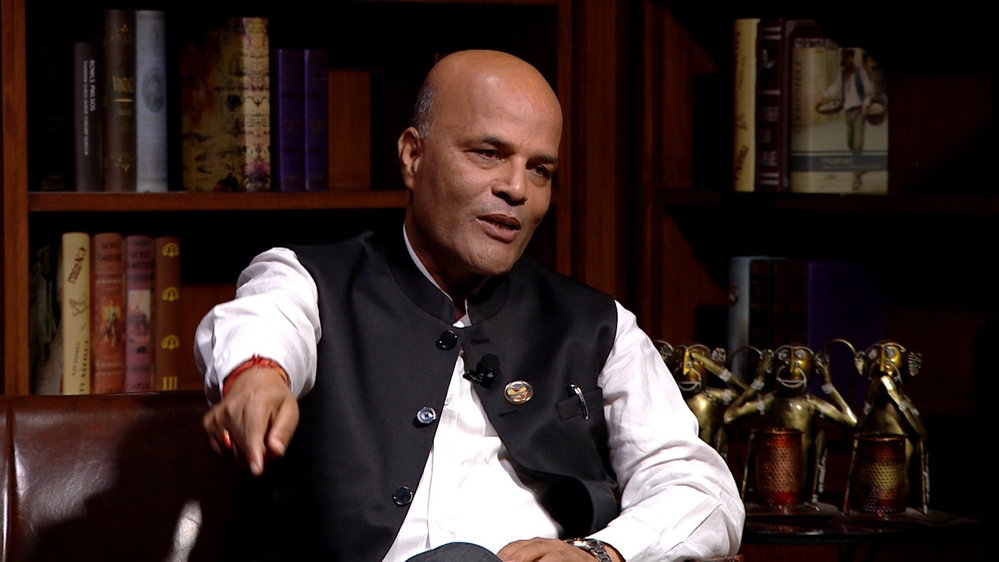
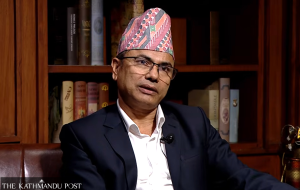
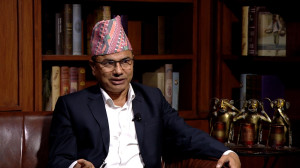
Amresh Kumar Singh warns of a disruption to Nepal’s geopolitical balance
Singh says the government has failed to maintain balanced ties with Nepal’s neighbours, build private-sector confidence and deliver meaningful progress on good governance.
Eight months after joining the Rastriya Swatantra Party, lawmaker Amresh Kumar Singh says the government faces serious shortcomings in governance, economy, private-sector confidence and foreign relations. Singh, elected from Sarlahi-4, also says the government must maintain a careful balance in its relations with next-door neighbours and address the concerns of people in the Tarai-Madhesh, which he says provided the core electoral support for the ruling party.
Although Singh began his political career with the Nepali Congress, he served one parliamentary term as an independent lawmaker. He joined the RSP shortly before the March 5 election as a strong supporter of Balendra Shah and defeated Congress President Gagan Thapa. Singh is now critical of some aspects of PM Shah’s style of functioning and his team of advisers. Rupesh Shrestha talked to Singh for Kantipur Television’s Fireside. Here is an edited excerpt from the interview.
You have been with the Rastriya Swatantra Party for eight months. How has the experience been?
It has been a very adventurous period in politics for me.
Adventurous? Why?
It has been a different kind of politics, somewhat different from traditional politics. The country was looking for change, and we got an opportunity to work with many young people.
This is the youngest parliament in Nepal’s history. Around 85 percent of its members are first-time lawmakers. Most are also relatively young. People elected them because they wanted an end to the distortions, corruption and delays of the past and wanted to replace some of the old political faces.
I spent the previous two-and-a-half years as an independent lawmaker, continuously raising my voice in parliament. Now I have launched a kind of campaign: if there are 100 problems in the country, we have to speak out against corruption 100 times.
Politics had become a kind of syndicate system. For about a decade, there was an arrangement involving three leaders—Pushpa Kamal Dahal, Sher Bahadur Deuba and KP Sharma Oli. Two would be in government while one remained in opposition, and the arrangement would change.
Corruption had become so widespread that there appeared to be all-party agreement on it. Nepotism was also dominant. I had said that the Nepali Congress had undergone the ‘familisation, commercialisation and corruption’ of politics. Those who genuinely represented the party’s ideology had lost their influence. People who were engaged in business and sought to make money through shortcuts began to dominate the party. Its democratic character gradually weakened.
The same group continues to have influence over Gagan Thapa as well. That is a reality.
You have described these eight months as ‘adventurous’. In what sense?
People voted with great ambition, hope and trust. The scale of that voting pattern was unprecedented in Nepal. Across the Tarai-Madhesh, the RSP won 72 of the 78 first-past-the-post seats. Such a result had never happened before. I cannot say what will happen in the future, but I think it will be difficult to repeat such a result because history rarely repeats itself in exactly the same way.
Does that mean you think the RSP will not get the same level of support if Balendra Shah contests again after five years?
I can speak about myself. I defeated Gagan Thapa, the Congress President, by a margin of around 14,000 votes. I defeated a leader of a party with more than seven decades of history. If Thapa contests against me again, I may not win by the same margin. That is the reality. I am confident that I can win again, but the margin will not remain the same.
So you remain confident of defeating Thapa, but expect the margin to narrow?
Yes. The margins of 30,000 or 20,000 votes that we are seeing now will not remain.
The RSP received votes on the basis of a strong public mandate and formed the government. Do you believe that trust remains? Are you confident that the government is working to maintain it?
Whether I am confident is not the most important question. The important question is whether the people are confident. People are facing difficulties. Farmers, for example, did not receive enough fertiliser, so paddy production is likely to fall this year. I do not completely deny that some steps have been taken towards good governance, but there is an atmosphere of fear in the market and among investors.
The share market has been declining, which is an indication that we have not been able to build investors’ confidence. Businesspeople are also worried.
Around the world, financial crimes involving companies or businesspeople are often dealt with through financial penalties. If someone has defrauded people of Rs50 million, for example, they may be fined Rs200 million rather than necessarily being sent to prison. We should not imprison people simply to satisfy someone’s ego because our economy is small. We have not been able to make the economy dynamic.
I am worried about three things. I do not know whether the government is equally concerned. First, our geopolitics has been disrupted. We have not been able to win the confidence of either our northern or southern neighbour. The recent visits by our foreign and finance ministers provide examples. What concrete achievements did they bring back in terms of bilateral relations?
You are a lawmaker from the ruling RSP and have a doctorate in international relations from India. What do you think those visits achieved?
That is precisely what concerns me. I did not see anything particularly substantive. Bilateral visits should always produce substantive outcomes. We should be looking at how much economic assistance and investment we secure, how trade increases, and how imports and exports and border crossings can be made easier.
I come from a border area. My birthplace and constituency are connected to the Nepal-India border. Since this government came to power, border management there has become looser or more disorderly.
There is an English saying: ‘Neither side is honest.’ Neither the Indian nor the Nepali side is being honest, and people living along the border are suffering as a result.
Stop large-scale smuggling in the name of trade, but do not harass ordinary people who need to buy two kilograms of sugar or a couple of vests for daily use. If necessary, establish proper markets along the border.
Over the past 30 years, we have seen places such as Gaur lose out as Chandranigahapur developed, Jaleshwar lose out as Bardibas developed, and Parasi lose out as Butwal developed. Similarly, development shifted from Inaruwa to Itahari and from Malangwa to Lalbandi and Hariwan.
Then people in these places are told that they cannot bring goods from across the border. Someone from my village will not travel 50 kilometres to Hariwan just to buy two kilograms of sugar and two vests. What I am trying to say is that the recent election demonstrated that the Tarai-Madhesh is at the core of Nepal’s politics and government. The Tarai-Madhesh is relatively accessible and flat.
Take Jhapa and Ilam as examples. The RSP won in Jhapa but did not win a single seat in Ilam. It could not make the same electoral impact in the hills. It could not do so in Rasuwa either. The result came from the Tarai-Madhesh, so life there should become easier. The people whose support and mandate brought this government to power must have their problems addressed.
You have identified three main concerns: geopolitical relations have been disrupted; industrialists and businesspeople have lost confidence and the environment is not investment-friendly; and relations between parliament and the government, or between the party and government, are not as harmonious as they should be. You have also said the government has not made even a single step forward on the good governance agenda championed by the RSP.
Some steps have been taken on good governance, but their impact has not been sufficient. For me, the real test of good governance is very simple: has the practice of police inspectors or sub-inspectors in district police offices taking bribes from ordinary people to register cases stopped? Has the practice of taking money to increase or reduce charges in government attorney offices stopped? Ordinary people are suffering there. The key question is whether an environment has been created in which ordinary citizens and Dalit children can easily access government services and education.
You were the lawmaker who once declared that Balendra Shah should become prime minister and that you were prepared to set yourself on fire otherwise. Today, you are saying that there has been little progress on good governance, relations between the government and parliament and the party are not smooth, international relations have deteriorated, the economy is not moving in a positive direction and the private sector has not gained confidence. As a ruling-party lawmaker, do you therefore see the government moving towards failure?
No. The government has no room to fail. If the government fails, the country fails. That is why we will do everything possible to make this government successful.
We are cautioning the government precisely to help it succeed. We are not against the government. It is our party’s government and I am on the government’s side.
You mentioned my earlier statement. Among the 30 million people across the country, I was the only Amresh Singh who spoke so strongly in support of Balendra Shah. That was part of creating a political narrative.
But as a lawmaker of the ruling party, do you see the government heading towards failure?
The government has some shortcomings and they need to be corrected. We have to maintain geopolitical balance, which is a necessity for our country. We have three neighbours—the northern neighbour, the southern neighbour and our wider international neighbourhood. We cannot afford to lean towards any one side.
We need balanced bilateral relations in the national interest, so that no one has reason to fear that Nepal’s territory could be used against them. There is a saying: ‘You can change friends, but you cannot change neighbours.’ If there is distrust or conflict with our neighbours, the country cannot progress.
You also spoke in parliament targeting the prime minister’s advisers. Have you told them this directly?
My accountability is to the country, the people, the prime minister and the party president. I am not someone who knocks the doors of advisers or personal secretaries, and my position does not allow me to do so. Authority without accountability is extremely dangerous.
Recently, the education minister faced protests from students during a visit to Madhesh. You had earlier said that ‘RSP lawmakers would find it difficult in Madhesh after Chhath’. That seems to have happened.
I was outside Kathmandu at the time. There is anger in Madhesh over poverty, rising prices and the difficulties people face in the border areas. The growing disappointment and discontent are the result of a mismatch between the promises made at the Janakpur rally and the actual delivery.
You recently said, ‘If we fail to protect this constitution, the country will be trapped in civil war for years.’ Did you say this because you genuinely see a threat to the constitution?
The constitution is under attack. That is what I was trying to point out.
From where is this attack coming from?
Yes, I stand by what I said. The constitution is under attack from various internal and external quarters. It is a document of compromise built on the foundations of the Maoist insurgency, the Madhesh movements and the 2006 People’s Movement.
If its core principles—federalism, republicanism and inclusion—are undermined, the country could be plunged into a major conflict. Therefore, protecting the constitution is the responsibility of all citizens and elected representatives.




 15.26°C Kathmandu