Former foreign minister Pradip Gyawali emphasises the importance of Nepal taking the lead on the mountain agenda
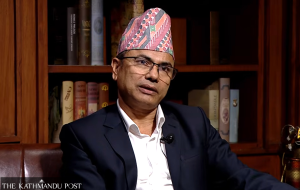
He argues that Nepal is well-positioned to lead the Himalayan region and proposes establishing a trilateral mechanism among Nepal, India and China, echoing Prime Minister Balendra Shah’s remarks at the UNGA. Pradeep Gyawali, former foreign minister Photo: KTV
Last month’s Bhotekoshi flash flood starkly showed how climate change is affecting Nepal. In global climate forums, Nepal has long highlighted that climate change affects the country first and foremost, urging the global community to take notice and provide necessary support as a matter of justice rather than charity. This time, the disaster struck right before the UN General Assembly, leading Prime Minister Balendra Shah to raise Nepal’s concerns.
In this context, former foreign minister Pradeep Gyawali sees the need for Nepal to lead the Himalayan region in addressing the impacts and consequences of climate change. He proposes establishing a trilateral mechanism among Nepal, India and China, echoing the Prime Minister’s remarks at the United Nations General Assembly. In an interview with Kantipur Television, DP Upadhyay spoke with Gyawali. Excerpts:
How do you view the points raised by the prime minister at the UN General Assembly?
I see four key elements in the prime minister’s address. Although initially there was talk that he had no fixed agenda for attending the General Assembly, we in the opposition maintained that such an issue must be raised at the highest level in international forums. Therefore, we urged the prime minister to represent the country. The visit was planned accordingly.
First, by highlighting the devastating floods in Nepal and the suffering they caused, he conveyed that while this problem is local and we bore the tragedy, the alarm bell rings for the entire world. He urged the international community not to view this solely as Nepal’s problem, but as a precursor to an even more hazardous future.
Second, he pointed out the immense scale of the damage—amounting to roughly 10 percent of our GDP. He stressed that Nepal cannot bear this loss alone; while we are resource-constrained, we did not cause this damage, and we cannot take out loans for reconstruction. Therefore, he demanded climate justice.
Third, he proposed establishing a Himalayan Climate Resilience Mechanism specifically between Nepal, India and China. Fourth, he touched upon the global order.
These were precisely the core issues that needed to be raised within the allotted time. I believe Nepal’s message was delivered effectively. However, given the current neglect of the UN by major powers and their growing preference for bilateral and deal-based approaches over multilateral and rule-based systems, we will have to wait and see how strongly our voices are heeded in the days ahead.
The Prime Minister has raised the idea of a trilateral partnership among Nepal, India and China on climate issues. Does our Ministry of Foreign Affairs have a roadmap for this mechanism?
I would like to thank UN Secretary-General António Guterres, who visited Everest Base Camp three years ago to deliver a powerful message and strongly advocated Nepal’s position in his opening remarks. That was significant.
Nepal has actually been working in three or four key areas for quite some time, particularly concerning the changes happening in the Himalayas, which are turning into a climate crisis. Eight countries are directly connected to this region, stretching from Afghanistan in the west to Myanmar in the east. This Himalayan region provides clean drinking water to nearly two billion people, and countless livelihoods depend on it. It is a civilisation in its own right. Recognising that this must be raised forcefully, the Government of Nepal—during my tenure as Foreign Minister—established the ‘Sagarmatha Dialogue’ as a permanent platform.
The three countries are interconnected through the Himalayas. Several rivers originate in China, flow through Nepal, and reach India, meaning impacts are felt downstream. Therefore, several steps are vital.
First is data sharing. Continuous study of satellite data through a data-sharing mechanism would allow us to receive critical updates on severe trends in a timely manner. Had there been data-sharing, rapid analysis mechanisms, and an early warning system based on them, many losses could have been averted—minimising human casualties at the very least, even if physical damage occurred. This has become extremely urgent.
How feasible is it for Nepal, India and China to cooperate on the climate crisis?
I believe both our neighbours are ready to cooperate on this matter. This is not a strategic issue; it is not tied to national security. This mechanism can and should be built purely on the foundation of the climate crisis and natural disasters. The climate crisis has become a problem that no nation, no matter how powerful, can tackle alone.
What scope of work can such a mechanism hold for ordinary citizens? Does it cover search and rescue, information sharing, or efforts to mitigate climate-induced damage ahead of time?
First, we need a comprehensive study of the changes occurring in the Himalayas and the risks emerging from climate change. Reports indicate that if temperatures continue to rise, two-thirds of the Himalayan snow could melt by 2100. What impact will the melting of two-thirds of the snow have on the plains? Coupled with that is permafrost thaw—where underground ice melts and turns soil into mudflows at an accelerated pace.
A mechanism would be useful to meticulously study these phenomena. Second, to assess potential impacts. Third, to establish an early warning system. Fourth, to develop preventive measures, including climate-resilient infrastructure.
How can India and China be brought together for a trilateral partnership?
We need to be clear about the framework detailing what kind of structure we want to build, its terms of reference, its funding sources, the centre’s location, and how data security will be managed.
Once we have a clear proposal, we should hold separate bilateral talks with both friendly nations to explain why we need this mechanism. If either country has concerns, we should work to address them from our side. Following that, Nepal can host a trilateral meeting or establish a permanent mechanism.
How optimistic are you about the creation of this mechanism?
I am optimistic. The Himalayan region in India is also facing severe risks, and China has seen various incidents as well. China has recently suffered massive damage too. Because of this, there is urgency, and everyone is paying attention. If another global event or a different natural disaster strikes tomorrow, attention will easily be diverted.
All political parties are on the same page regarding this issue; there is political consensus. To put this matter into practice immediately, let us first draft the framework ourselves—a clear proposal outlining the mechanism we need and the functions it will perform—and then consult India and China. I am confident that we can build a consensus for all three to sit together.
How can Nepal continue to champion the climate agenda on international platforms moving forward?
To articulate our views, climate should not be the only agenda; we should also incorporate other relevant issues. We should keep the forum we have established continuously active, invite foreign representatives and voice our positions strongly. We should engage in similar forums and ensure robust follow-up, which is the most crucial part.
Nepal should remain the hub for dialogue and discussion. We must lead the mountain agenda. Climate change has multiple dimensions; the United States experiences climate change impacts, Australia suffers from wildfires, and Greece, Spain and France face massive damage from blazes. These are different issues, but the mountain agenda and the Himalayas are unique to this region. The highest mountains are in Nepal. Over the past three or four years, we have seen events in Thame (Solukhumbu), Humla and Rasuwa. Given all of this, we must lead this agenda—the mountain agenda—while taking other allied nations along with us.




 22.39°C Kathmandu