Infrastructure Minister Sunil Lamsal on rebuilding after the Bhotekoshi floods
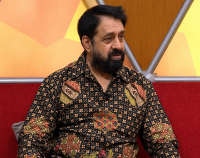
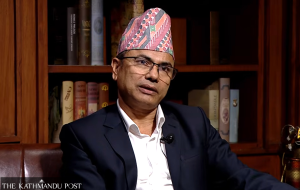
The infrastructure development minister discusses plans for resettlement, damaged roads and bridges, the China border crossing and efforts to build safer settlements for disaster-prone communities.Minister for Infrastructure Development, Sunil Lamsal Post Photo
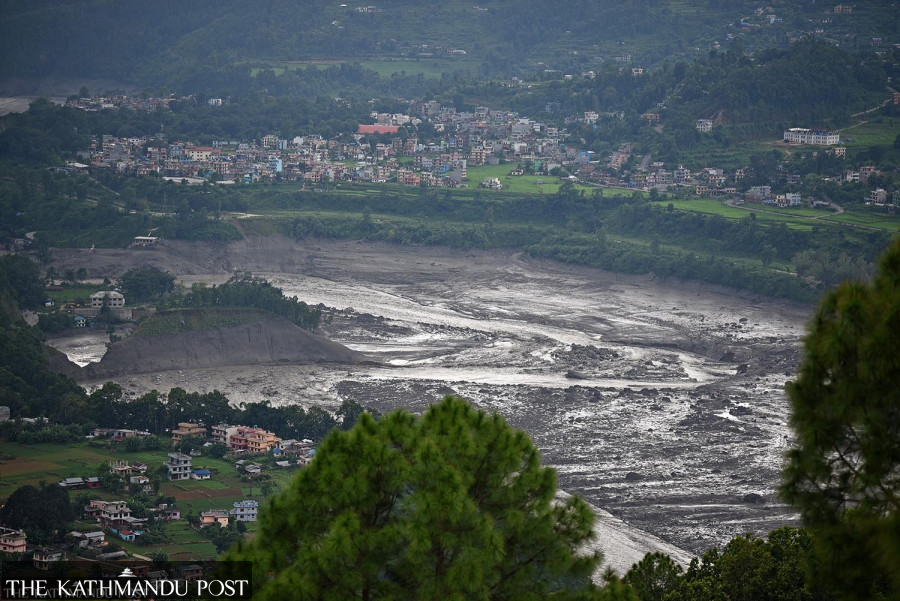
Nepal’s Minister for Infrastructure Development, Sunil Lamsal, is actively overseeing the government’s efforts to restore physical infrastructure damaged by the catastrophic Bhotekoshi floods of August 26, while also helping shape plans to relocate communities exposed to future disaster risks. The floods have killed at least 1,384 people and left over 4,000 missing, according to the latest government figures. They also displaced thousands of families and damaged roads, bridges, hydropower facilities and other critical infrastructure across several districts.
In an interview with Kantipur’s Gaurav Pokharel and Krishna Acharya, Lamsal discusses the government’s plans to provide temporary accommodation before the upcoming festive season, build safer settlements over the longer term and restore connectivity with China. He also dissects the response to the disaster, the role of foreign rescue teams, the damage to hydropower projects and roads, and criticism over the government’s handling of squatter settlements.
We are speaking to you immediately after Thursday’s Cabinet meeting, which focused largely on the Bhotekoshi floods, resettlement and reconstruction. What was discussed at the meeting, and what is the government’s plan?
Although the meeting was expected to focus on the Bhotekoshi floods, it was a regular Cabinet meeting. Naturally, however, the disaster and its aftermath were discussed.
A total of 8,692 households, comprising 39,114 people, have been affected by the floods. We have set up 39 holding centres to accommodate the affected people. Our initial plan was not to keep people in these centres for more than a week. We felt that prolonged stays would create psychological and sanitation problems. But the stay has been extended because of circumstances on the ground.
The Cabinet has now taken decisions for both the short and long term to ensure that the survivors are not kept in holding centres any longer than necessary.
For long-term resettlement, the government has decided to develop integrated settlements. The Ministry of Land Management, Cooperatives, Federal Affairs and General Administration will identify suitable land. If privately owned land is selected, the government will purchase it. If forest or other public land is considered suitable, the government will take the necessary decisions to designate it for settlement development.
How long will that re-settlement process take place?
This process is expected to take two years. We cannot keep people in holding centres for two years. Our initial plan was to move them to temporary accommodation within 15 days, but connectivity problems prevented us from doing so.
What is your main priority for now?
Our main priority now is restoring connectivity. Without it, the situation will become even more difficult, so we are working to restore access as quickly as possible.
At present, we can reach Betrawati by road. But to travel beyond Betrawati, we need to install a Bailey bridge. Another Bailey bridge is required on the road from Betrawati towards Syaphrubesi. The bridge has already arrived, but initially we could not reach the site where it was supposed to be installed.
What bottlenecks delayed the installation of the bridge?
A stretch of marshland, in places as deep as 20 metres, stood between the access point and the construction site. It was impossible to tell whether the ground was firm enough to walk on or whether someone would sink into the mud. Several technicians got stuck, and two machines sank. What we encountered was far more difficult than we had expected. It took three days just to recover the machinery.
We have now reached the bridge site and are working to restore the connection to Syaphrubesi as quickly as possible.
We have also asked the Chinese government to help restore the road from Rasuwa to Syaphrubesi. They have said they will help, although no agreement has been signed yet. As I understand it, they are preparing to assist us.
What latest updates can you offer regarding the bridge installation?
We had one 10-metre Bailey bridge and three 75-metre Bailey bridges. One has been installed at Devighat, and another will connect Betrawati with Syaphrubesi. The remaining bridges are not particularly useful for the current requirements.
We need a Bailey bridge of up to 120 metres to cross the Trishuli River. China sent two 100-metre bridges, but they did not meet our requirements. In the meantime, we have had to transport supplies by helicopter. Food, cooking gas and other essential goods have become difficult to deliver.
That is why we are talking to various companies about constructing the required bridge on a fast-track basis. We are working to restore all major connectivity before the festive season, if possible. This would improve access for 600,000 to 700,000 people.
The Cabinet has given us the mandate to do whatever is necessary to restore connectivity.
What has the government decided to do about people currently living in holding centres?
We have agreed on two approaches.
At Thursday’s Cabinet meeting, we decided to provide Rs15,000 a month to families of up to four members. For families with more than four members, an additional Rs2,000 per person will be provided.
The money will be distributed through the local units. It is intended as accommodation assistance for people who choose not to remain in holding centres.
Those who want to receive the assistance have to fill out a form at their local government office. We sent the forms to the local units a week ago.
In addition, those who choose temporary accommodation will be provided with temporary homes before the festive season, if possible.
Depending on the size of the family, we could provide one-bedroom, two-bedroom or three-bedroom units. The size will be determined by the number of family members.
What kind of temporary housing are you preparing for the affected people?
They will be proper temporary homes, not the kind of shelters built after the 2015 earthquake. These will not be sheds or tents. They will have toilets and kitchens. We refer to them as capsule houses. They are designed to function much like permanent homes.
The houses will be prefabricated in factories and assembled on site, with each unit capable of being completed in a day. They will serve as temporary accommodation until new townships are developed.
We will identify suitable sites and build the units there. They are prefabricated houses that can be assembled in a day.
Where will these temporary homes be built? Will they be close to the areas affected by the floods?
We have already identified 22 or 23 possible sites, mostly near the communities where the affected people lived. The local governments will recommend suitable locations. If no suitable land is available within an affected municipality, we will look at nearby areas.
Where will the components come from?
Primarily from China. Large quantities of these houses are manufactured there, and importing them from China is also more cost-effective.
We are exploring both options: receiving the houses as assistance from China or purchasing them. If China provides houses that meet our requirements, that would be fine. Otherwise, we will buy them.
When will these temporary homes be ready?
We aim to have them ready within 15 days of receiving verified details on the affected families and their accommodation needs.
We first need to establish how many people want temporary homes and how many prefer to receive rental assistance and live elsewhere.
Has the government started implementing the programme, or is it still in the planning stage?
We are currently identifying locations. We are considering various options.
The government is also preparing to identify other areas across the country that could be at risk from glacial lake outburst floods. We need to determine which routes and markets could be exposed to such risks and, where necessary, relocate them.
That assessment has already begun.
For long-term planning, including identifying safer locations and relocating settlements, we have formed a task force. We expect it to submit a detailed report, probably within a month.
We will then decide how to move the process forward. We have also formed task forces to deal with other aspects of the response. There is one looking into bridges, another for roads, and separate teams for temporary shelters and the management of holding centres. We also have task forces focused on drinking water, restoring connectivity and health. All of them have already started work.
Where will you eventually move the displaced people once the new settlements are ready?
We are considering developing small towns through a land-pooling model.
The idea is to create small urban settlements and rebuild them on a township model.
We made a mistake during the reconstruction after the 2015 earthquake. We talked about integrated settlements, but they were not actually developed as such.
This time, we want to adopt a more scientific approach than simply creating integrated settlements.
Will the government decide where to build the new settlements, or will affected people be involved from the beginning?
Both.
The affected people and local units will be involved in the process.
They are currently living in temporary shelters, and later they will be moved into permanent homes. They will be involved from the beginning in all stages of that process.
You have said that local units must be involved in the resettlement process. But immediately after the Bhotekoshi disaster, you were criticised for saying that local units and other agencies should have taken action themselves but failed to do so. What led you to make that assessment?
I did not say that.
A short clip from an internal meeting was circulated, which created that impression.
The wards and municipalities have been doing what they can within their capacity. What we learned from the disaster is that they lack adequate resources and equipment. I instructed officials to identify what changes were needed to make it easier for local units to respond and to make those changes.
I did not say that the local units had failed to work.
We have been coordinating with the ward chairs and mayors of every local unit since the day of the disaster.
The federal government and local government are both governments. We do not care which political party controls a particular local unit. Local units are autonomous as well, and we have been working with them accordingly.
Is the government considering setting up a separate authority, as was done after the 2015 earthquake, to oversee reconstruction following this disaster? Or will the National Disaster Risk Reduction and Management Authority (NDRRMA) handle it?
We plan to carry out the reconstruction through the NDRRMA. We are not considering creating another structure.
After the earthquake, there was no disaster management authority, so a separate structure had to be created. The National Reconstruction Authority was established because the need for such an institution became apparent after the earthquake.
But once that authority was dissolved, the institutional memory and technical expertise accumulated during the reconstruction were not properly transferred or retained. The state effectively lost the institution that could have preserved that knowledge.
We do not want that to happen again. That is why the reconstruction will be handled through the NDRRMA.
But even with the disaster management authority in place, some issues appear to remain unresolved. For example, people displaced by the Jajarkot earthquake have yet to be fully resettled.
That is precisely why we have already started work on amending the relevant law.
Jajarkot earthquake victims had to put considerable pressure on the authorities to receive the second instalment of reconstruction funds. We are now working to amend the law so that such payments and other processes can be handled automatically rather than requiring victims to repeatedly push the administration to act.
You have said the government plans to resettle people affected by the Bhotekoshi disaster within two years and eventually relocate other settlements at risk from glaciers or rivers. Is this an immediate priority or a long-term plan?
This is a long-term plan.
We have agreed that this issue should be incorporated into the Post-Disaster Needs Assessment (PDNA). The plan should not cover only the Bhotekoshi area. It should also identify other places that could be affected and include their relocation and resettlement.
The Bhotekoshi river corridor is the immediate priority, but other vulnerable areas will also be included.
Relocating settlements across the country would require a huge investment. How will you mobilise the necessary resources?
First, we need to identify the settlements and land currently occupied by people living in high-risk areas. The government will acquire the land from its owners and compensate them accordingly.
We will then identify safer land for relocation. If it is privately owned, we will purchase it. If it is government land, we will make the necessary decisions to allocate it. People will then be relocated according to established standards.
This will take time and require substantial investment. That is why we have already started the study.
The long-term programme could take five to seven years, or even 10 years. We are preparing to plan these settlements along the lines of programmes such as the ongoing urban development and new-town projects.
All of this will require money. Before we can determine how much, however, we need a credible PDNA.
We will involve international organisations in preparing the assessment. Once we have reliable figures that everyone can trust, international institutions will also be more willing to assist.
We will approach them directly and say: This is what we are trying to do, and this is where we need your support.
We are preparing to complete the PDNA within a month. After that, we will focus on mobilising the necessary resources.
Will the government seek only technical support from international donors, or financial assistance as well?
We will seek all forms of assistance, including both technical and financial support.
The road connecting Syaphrubesi to Rasuwagadhi has been severely damaged. Rasuwagadhi was becoming an important trading point with China. Will the government rebuild the road and restore the border crossing, or could it remain closed while a new route is considered?
It is not simply a border crossing. There are many settlements and villages along that corridor.
In the long term, we need to build a safer road from the villages onwards. Once we identify a safe corridor, we will also restore the border crossing.
We are discussing several options with China and remain in regular contact with the Chinese authorities. We have formally proposed that the Chinese government assist with the work and have also discussed it with them.
They have agreed verbally, but a written agreement is still pending.
The border crossing will be reopened. We may have to relocate the route slightly, depending on where a safe corridor can be established.
Post Photo
Some have said the government was slow to bring in foreign rescue teams and initially indicated that it would not seek foreign assistance. Why was there confusion over this?
There was no confusion. Not for a single minute.
From the outset, we planned to bring in foreign experts. Foreign specialists were involved from the first and second days of the disaster.
But to be frank, the actual rescue operation was carried out by the Nepali Army. The foreign experts came, assessed the situation and said it was extremely complicated. They were there to provide technical assistance and worked alongside the Nepali rescue teams.
Australian expert Arnold Dix has even spoken publicly about how difficult the rescue operation was.
So it was not a matter of delay or confusion.
You have said the rescue was carried out by the Nepali Army. Were Nepal’s agencies adequately equipped and trained for such an operation?
If the roads in the affected areas had not been destroyed to such an extent, moving equipment there would not have been a problem, and the work could have been done much faster.
But the terrain was extremely difficult. Even large helicopters could not reach some areas. If helicopters capable of carrying four tonnes had been able to operate there, the situation would have been different.
Even in areas that helicopters could reach, four or five excavators had already been brought in, but they were stuck and could not be used.
The geography itself made helicopter operations risky. In addition, the affected areas were small, and the rescue had to be carried out in several stages. We could not send large numbers of helicopters in at once.
At the same time, the tunnels of 11 or 12 hydropower projects were affected. We had to work on all of them simultaneously.
Despite all these challenges, more than 20,000 personnel were mobilised around the clock.
As rescue operations continue, does the government still believe there could be people alive inside the affected areas?
The possibility has become extremely low in tunnels that were still under construction.
Some hydropower tunnels were located beneath river channels. In some cases, the lift shaft itself extended 20 to 30 metres upwards. The hydropower bed is at least 50 metres above the river level, and some of those structures have been buried.
Rescuing people from such locations is extremely difficult.
But there is still a possibility of people surviving in cases where they were inside a powerhouse. There would be food and other supplies there. Powerhouses can also have four or five floors and considerable internal space.
We are continuing to make every possible effort to reach those areas.
The disaster has exposed weaknesses in both cross-border and domestic early warning systems. What is the government planning to do to strengthen them?
Nepal has already signed an agreement with India to exchange disaster early-warning information. The process with China is also underway.
On the very day this disaster occurred, the Cabinet decided that preparations should be made to strengthen such arrangements and assigned the Ministry of Foreign Affairs responsibility for taking the process forward.
In the case of the Bhotekoshi floods, it appears that even the Chinese side was unaware of what was happening at the source. No one was monitoring that particular location.
There was some movement or disturbance there, but nobody noticed it. The area itself also suffered extensive damage.
The first warning came when someone at the border point on the Nepali side saw the flood approaching and raised the alarm. The army personnel at the border post saw it first, but they were unable to save anyone. The border point was essentially wiped out.
In situations like this, we need a mechanism to monitor such disturbances in real time and track what is happening at the source. We have discussed this kind of mechanism with China.
Obtaining weather information is not particularly difficult. The challenge is receiving timely information that an avalanche has occurred or that a glacial lake has burst. That is where we need to improve.
The floods caused extensive damage to hydropower projects. Is it possible to restore them to their previous condition?
Our position is that people should be compensated for the financial losses they have suffered.
This is not limited to hydropower projects. Private property was also destroyed, including land held under formal ownership certificates. Once we relocate those people, they will have to be compensated for their losses.
The amount we can allocate will depend on the resources identified through the PDNA.
Many people also have insurance, so they may be able to recover part of their losses through insurance claims.
Let’s turn to Krishnabhir. What happened there, and how will the road be rebuilt? When will it reopen?
Krishnabhir was also affected by the Bhotekoshi flood. The flood carried a large amount of mud and debris, which accumulated on the opposite side and pushed the river towards the road embankment. As the river shifted towards the hillside, it began hitting the slope and putting increasing pressure on it. That caused the damage.
And it is not limited to Krishnabhir. The river has eroded and cut into the slopes at several locations from Bidur and Betrawati downstream, causing damage along the road all the way to Muglin. The shift in the river channel towards the hillsides has created a major challenge.
During the dry season, we will have to redirect the river away from the slopes. This will require work at many locations, not just Krishnabhir.
Krishnabhir itself has very unstable geology. The river has eroded the slope from the base, making the site particularly vulnerable.
For now, we will carry out only temporary stabilisation work at Krishnabhir. We cannot consider the site fully reliable. It could fail again at any time.
That is why we have also opened an alternative route on the opposite side.
For a permanent solution, we are studying the possibility of constructing a tunnel at Krishnabhir. That study is underway.
Another option is to address the section where the road has been cut into the hillside by constructing a slope from the bottom upwards. We are studying all these options before deciding on the permanent solution.
Let’s move to another issue. Soon after your government took office, bulldozers were used to clear informal settlements. At the same time, people displaced from those settlements are still living in holding centres, and 12 people have died since the displacement. Does the government acknowledge that it may have mishandled some aspect of this process?
The displaced people were placed in temporary holding centres. There are now very few of them left there, probably no more than 5 percent of the total.
For the rest, we are providing monthly financial assistance. The process of providing land to those who have been verified as landless has also begun.
Those whose status as landless squatters has been verified are already being allocated land. The Ministry of Land Management has the exact figures on the amount of land allocated so far.
The government’s responsibility is to properly accommodate people who are helpless, vulnerable or unable to manage on their own.
If people are not in a position to leave the holding centres, we have to continue accommodating them. We have given them an alternative: they can move out and rent accommodation, for which we are providing Rs15,000 a month.
Under Nepal’s legal framework, identifying landless squatters itself can be difficult. For example, someone who has a small piece of land in a village but has lived in Kathmandu for years may not legally qualify as landless. How will such cases be handled?
We have to follow the law.
We do not yet know whether everyone in question qualifies as a landless person. In some cases, we do not even have complete records.
Initially, some people were unwilling to submit their citizenship documents. In some cases, citizenship documents were subsequently issued.
Now the local units will verify their status, followed by verification at the district level.
The people who are verified as landless are our responsibility. We will provide them with land and financial assistance.
What does the government plan to do with the land that has been cleared after removing the informal settlements?
That falls under the authority of the local government.
A budget has been allocated for developing parks at the locations, and the High Powered Committee for Integrated Development of the Bagmati Civilisation will carry out that work.
But whether to proceed is primarily a matter for the respective local unit. If the local unit does not do it, then we will.
At present, the local units are taking the lead and assessing what should be done. In the case of Kathmandu Metropolitan City, I believe a budget has already been allocated.
The objective is to retain the land as open space. It can be developed as parks, sports parks or other sports facilities, including playgrounds.
Some lawmakers from the ruling Rastriya Swatantra Party have been openly criticising the government’s work and decisions. Are differences emerging between the group that was already in the party and those of you who joined through the pre-election merger?
I think that should be taken as normal. I am not aware of any such internal disagreement.
The relationship between the two main leaders is very good.
This is also a new party. It is not a party with decades of parliamentary experience. Most of its lawmakers are young.
There is freedom of expression, and they are free to criticise the government. We take that in our stride.
If they criticise something because they do not have the full information, we invite them and explain what has actually happened.
We also have a mechanism for dealing with their concerns. Our secretariat communicates with the ministries and their agencies every day and listens to the issues raised by lawmakers.
When lawmakers raise questions in their capacity as parliamentarians, we immediately refer them to the relevant agencies for action.
It has been some time since the party’s general convention, but appointments to several nominated positions have still not been made. There has also been speculation that nominations from your side of the party have been delayed. What is happening?
I do not know about that.
It is something that the party chair and senior leader will resolve through an understanding between them. We have not been involved in it.
There has also been speculation that you could be appointed as a vice-chair. Have you expressed an interest in the position, or has it been offered to you?
I do not know of that. I have not expressed any interest either.
I am happy even as an ordinary member of the party. No one has made such a proposal to me so far, and there has been no discussion with me about it.




 14.72°C Kathmandu