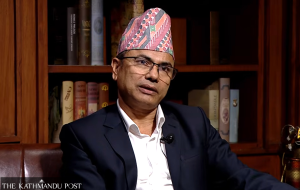
Minister Geeta Chaudhary on the Jeetpur-Simara case, the government’s response, and what she believes needs to change
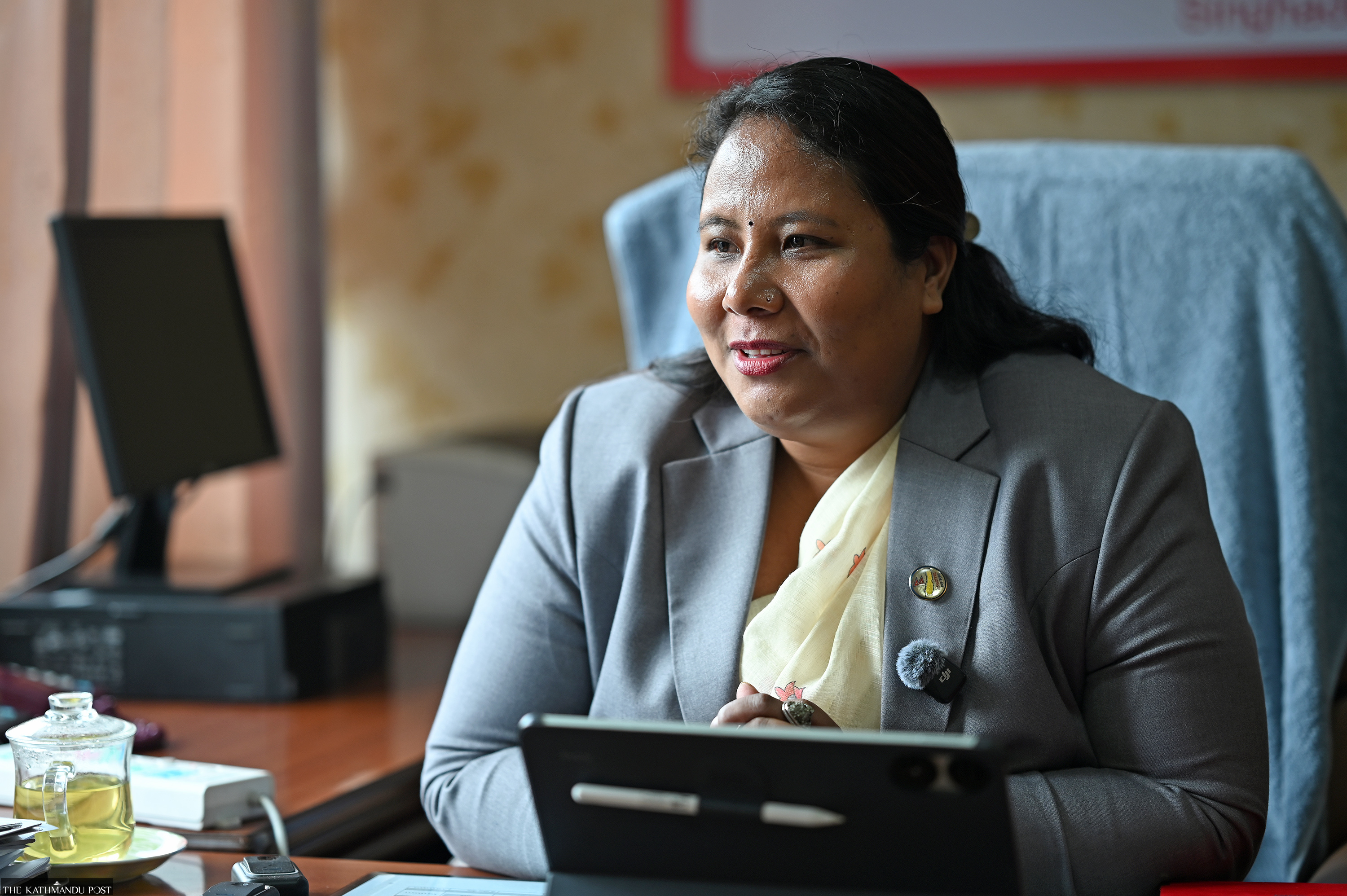
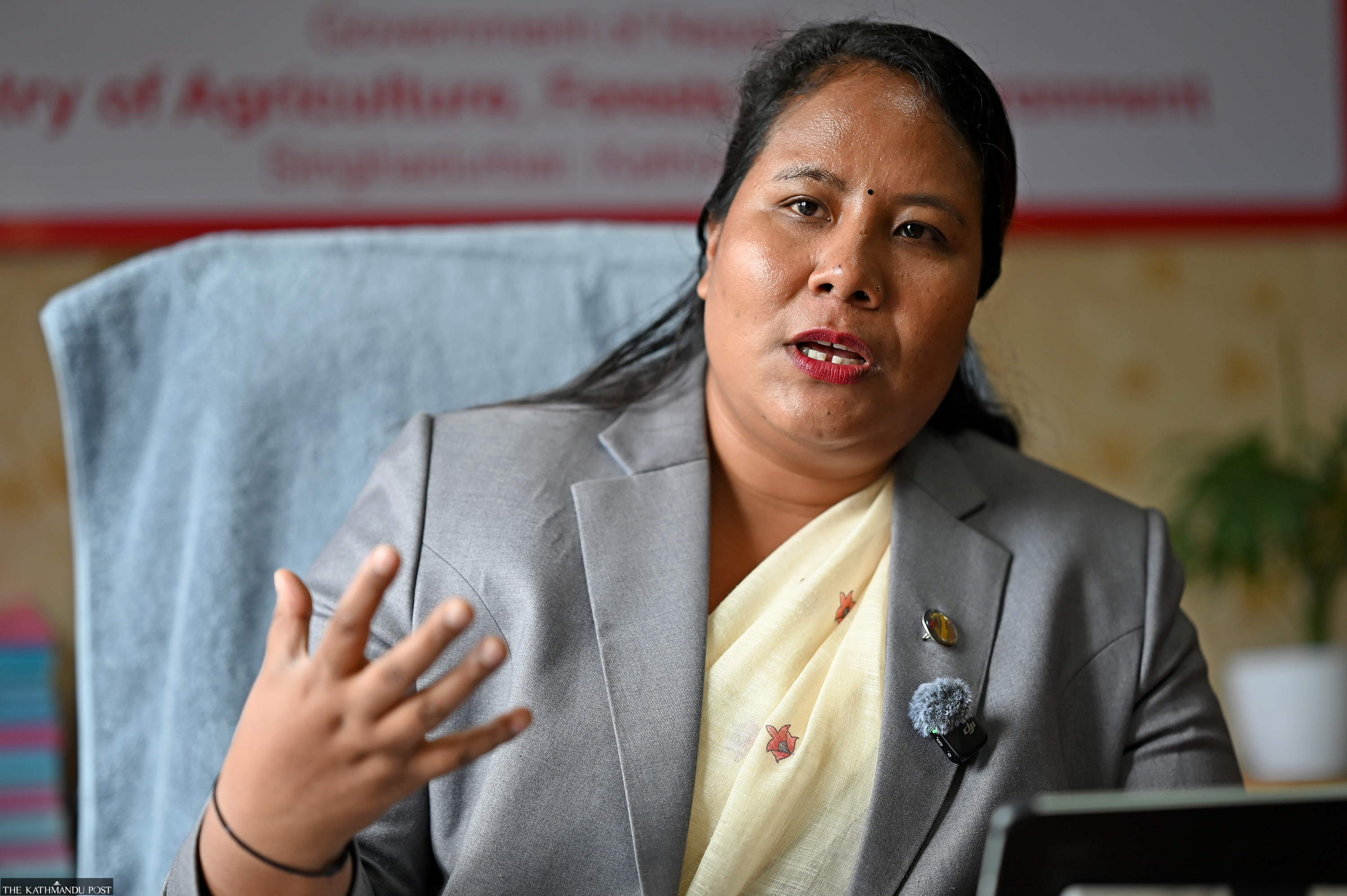
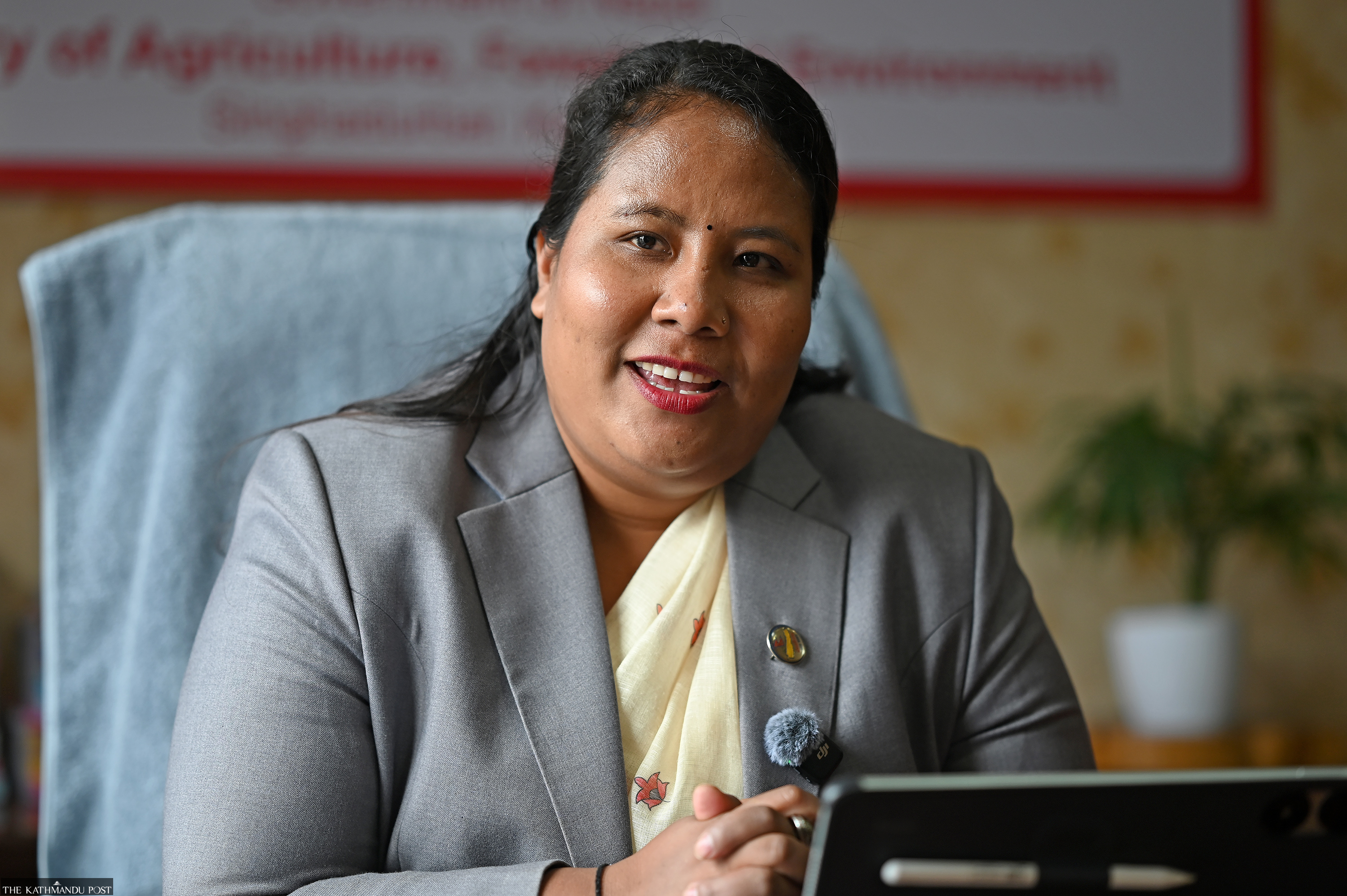
A cabinet minister’s unvarnished look at why out-of-court settlements and a lack of economic rights continue to fuel Nepal’s cycle of violence. Geeta Chaudhary, Minister for Agriculture, Forests and Environment Angad Dhakal/TKP
Just a month ago, the nation’s conscience was violently shaken by the brutal murder of a three-year-old toddler in Jeetpur Simra—a tragedy that drew furious street protests, demands for swift capital punishment, and harsh scrutiny over police inaction. Today, however, the public’s frantic gaze has largely shifted toward the devastating Bhotekoshi flood, leaving the Bara case in danger of fading into the background noise of national life.
Yet, for Geeta Chaudhary, Minister for Agriculture and Livestock Development, and Minister of Forests and Environment, the agony of Jeetpur Simra is far from over. In a wide-ranging, deeply personal interview with The Post’s Biken K Dawadi, Chaudhary—a former legal practitioner, activist, a member of the indigenous Tharu community and a mother—reflects on the systemic rot inside local law enforcement, the cruelty of victim-blaming, the myths surrounding government compensation, and why she believes true safety for women in Nepal demands an absolute overhaul of both our laws and our patriarchal mindset.
As someone who has litigated cases like this before entering government, what does the police’s initial delay tell you about how they handle such complaints?
The family went to the local police on a Sunday to file a missing person’s report, and it wasn’t treated with the urgency it deserved. Some officers admit that if urgency had been shown from the start, this might not have ended in death.
Investigations into missing children have become more complicated because adolescent behaviour has changed a great deal from a generation ago, and that shift isn’t always understood. So there’s a tendency, at the outset, to assume the child has simply wandered off. In this case, it took two days before the urgency matched the gravity of the situation.
Once the case reached the Home Minister, action followed immediately. The police officers involved have since been questioned over why the response was so slow. We are taking this extremely seriously, and looking at how to ensure stronger, faster consequences going forward.
Cases like Nirmala Panta’s and now Jeetpur Simara—tend to follow a familiar pattern of victim-blaming. Yet this time, commentators note there was nothing to blame the victim for.
Exactly. Society usually looks for something to blame the girl for: her clothes, her behaviour. Nobody can do that to a three-year-old. So instead, people turned on the parents, accusing them of not paying enough attention.
I am a mother myself, with a five-year-old. And what I’d say is this: A child isn’t raised by two parents alone—she’s raised by a community, particularly in a village. To then turn around and blame the parents is deeply unfair.
I think the root of it is that we still haven’t learned to treat daughters as equal human beings. When my own daughter was born, a woman in the same ward wept beside me. She told me she was crying because her daughter would now suffer the same things she had. We still read essays in school portraying women only in relation to others, never as individuals entitled to their own choices. We have never really looked at this from the victim’s perspective.
A woman who has survived rape carries the stigma for life—marriage becomes harder, she’s judged wherever she goes. The man who committed the crime walks back into society the next day and lives freely, because we tend to treat what he did as negligence or an ordinary mistake. Until that mentality changes, nothing will.
Angad Dhakal/TKP
You’ve spoken before about property rights as part of this. How does that connect?
On the first day of any class I teach, I ask my students to raise their hands. I tell them: you have equal property rights, the same as your brothers. Whoever is an only child, or has only sisters, usually agrees—of course it’s theirs. That in itself is progress. Not long ago, uncles would simply hand family property to whoever had a son.
Then I ask: How many of you would actually file a case if your parents or brothers denied you that right? Almost nobody raises a hand. We are in the twenty-first century, and yet we still can’t stand up for the rights we’re entitled to—economic rights above all, because they enable everything else.
I’ve told my own father that if he doesn’t give me my share of the inheritance, I am ready to file a case. If a son said the same thing, claiming what he considers his right, he’d say it happily, and the family would hand it over without a second thought—even if that son had betrayed the family or vanished for twelve years, his share would still be waiting. But if a daughter files a case, she is disowned for life. That is the real difference. Until we reckon with it honestly, blame will keep falling on daughters.
I've helped a fifty-five-year-old woman get divorced after her husband beat her for years while drunk. I convinced her to claim her share of the property rather than walk away. When she and her son eventually became financially secure through her share, the same son later beat her for it—because he’d come to see the property as his by right, once she no longer ‘needed’ to survive on it. I’ve raised this within my own family too, and even my father—someone I consider more progressive than most in our society—reacted defensively. It shows how deep this runs, even among people who mean well.
Angad Dhakal/TKP
Let’s turn to your meeting with the victim’s family. You spent around seven hours with them. What was that like?
When we arrived, they could barely speak. Their only fixed point was: My daughter isn’t coming back, but I don't want another mother to go through this—I want the law changed, I want the death penalty. We couldn’t offer false promises, but they were in a state of complete grief. For the first two or three hours, we simply listened. They hadn’t eaten in days. We provided them food, water and medicine. Their hands were shaking.
Once they calmed down, I sat alone with the mother. Because of my own background working with victims, I understood what she needed—not to be managed, but simply to be sat with. After three or four hours, she was able to speak more freely, and eventually asked for her husband to join us.
They said they had been used politically. People came to shout, to stir things up, day after day, and then vanished. “You, the state, will still be here tomorrow,” they said. “The people creating noise today won’t be.” They didn’t want money—they were very clear that they hadn’t come to sell their daughter. What the mother wanted was simply somewhere she could see her child every day. That’s why they’d asked for the house to be rebuilt near where she was found. Beyond that, they wanted nothing for themselves—only that no other family should go through what they had.
Some have criticised the optics of the meeting—ministers sitting on the floor, the Home Minister seemingly agitated in front of the cameras.
I understand the concern, but the point of sitting that way was precisely to avoid intimidating them—five ministers, one of them heading the largest ministry in the federal government, arriving in a manner that would have overwhelmed a family who work as labourers and dishwashers. We didn’t want them to feel we were there as officials. We wanted them to feel we were family. None of us went dressed as ministers. That mattered.
Angad Dhakal/TKP
You’ve also spoken about how the media covered this case, and Nirmala Panta’s before it.
Sensitivity has been a problem across the board—not just with the police, but with the media and with us as a society. I’ve called journalists directly, more than once, to say that publishing identifying details, or the girl’s name, does lasting damage—not just to the case, but to the family. In Nirmala’s case, when photographs and clothing details were published, I called eight or ten reporters myself to say this was wrong. A criminal investigation depends on discretion, not exposure. The same pattern repeated here. One suspect’s police statement has already circulated on social media—which raises real questions about whether the investigation itself is airtight, or whether it’s simply being managed for public consumption before the facts are settled.
Everyone with a phone now is effectively a journalist, chasing views rather than restraint. That makes ethical reporting more urgent, not less.
Where does the review process go from here?
There’s no question this needs both legal and institutional reform. We’re looking at fast-track courts, at whether sentencing needs to be stricter, and doing this from several angles at once. Nepal is a signatory, without reservation, to most major international human rights treaties—the ICCPR, the Convention against Torture, among others. Other countries sign with reservations; we haven’t, on the treaties that matter most for crimes like this. That commitment has to be reflected in how seriously we treat cases like this one.
There’s been a strong public call for the death penalty. Where do you stand?
Personally, I don't think it’s something we can move towards, given our human rights commitments. Nepal’s criminal justice philosophy is reformative, not retributive—the aim is to return people to society changed, not simply to punish. I understand the anger behind the demand. People are reacting from a place of real grief. But even if the answer is no to the death penalty, we still owe the public something that reassures them the system works—the same principle behind ‘a hundred guilty going free rather than one innocent convicted’ cuts both ways. It also means guilty people cannot walk free through delay or mishandling.
What I’d push for instead is victim-centric laws. The victim shouldn’t be the one made to feel diminished—she has done nothing wrong, and the law should reflect that plainly, rather than leaving her to carry the burden of proving her own innocence.
Turning to the practice of out-of-court settlement in rape cases. You’ve said this is one of the least discussed drivers of the problem.
This is something I saw constantly as an activist, long before I held office. Rape convictions are difficult because direct evidence rarely exists—often it comes down to hearsay rather than eyewitness testimony, and that weakens a case from the very first stage of investigation. There’s no clear rule on how quickly a complaint must be filed. And a woman who is seen as too confident, too unafraid, is often dismissed by police as ‘that kind of girl’—often because the officers investigating are men, in a system where very few senior police posts are held by women.
The perpetrator knows this. He knows that even in the worst case, he serves his sentence and returns to a society that will eventually forget, whereas the survivor carries the stigma for life—remarriage becomes difficult, she’s socially tagged. So many choose instead to settle privately, because the compensation the state offers is minimal, a fraction is deducted as tax, and a private settlement leaves her better placed to rebuild her life. I’ve seen this succeed practically—a woman who used a settlement to start a business rather than pursue a case that would likely end unresolved. It disproportionately affects Dalit and Janajati communities and lower-income families, who are targeted precisely because they’re seen as unable to fight back.
But doesn’t that erode any deterrent effect? If perpetrators know they can pay their way out?
That’s exactly the danger—cases keep rising because there’s no real fear attached to the act. But to be clear: Settlement in a criminal case has no legal standing. Mediation exists in civil law, not criminal law. There is no such thing as compensation extinguishing a criminal charge under our law. What I described is something that happens informally, outside the law, which is precisely what we’re trying to reduce by strengthening enforcement.
Doesn’t that gap—a widely accepted informal practice existing alongside a law that doesn’t recognise it—explain a good deal of the impunity we’re discussing?
It’s a significant part of it, yes. We’ve been in government five months. What we’re doing for the first time is trying to properly contextualise the law—not simply legislate in the abstract, but understand why enforcement has failed for years, whether from political instability or fragmented ownership across ministries. Previously, coordinating five ministries on one issue could take weeks. Now we can align within a single phone call. Our priority is policy review and coordination, translating that into implementation at the local level, because that is ultimately where the law has to be lived, not just written.
Angad Dhakal/TKP
Beyond legal reform, what about education? You mentioned school curricula avoid reproductive health altogether.
Entirely—that chapter was skipped, or handed off exclusively to female teachers, effectively signalling it wasn’t a subject boys needed to understand either. That has to change, alongside how the curriculum portrays women more broadly—the language itself is often derogatory. This needs both legal and educational reform, and the Ministry of Education is now looking at this as part of the new curriculum design.
What happens to families like this one after the media attention fades, as it has by now?
That’s what I intend to follow up on myself. Legal reform and public discourse matter, but so does what happens to this family once the cameras leave—whether they’re able to settle, to live with some sense of security. I met the parents of the victim again a week ago, not as a minister, but in the way I sat with them the first time.
What has happened to the task force formed to recommend legal changes to rape laws?
While it was supposed to submit its report to the government a week after its formation, the attention was largely diverted to the floods. This, however, does not mean the progress was stalled. We have been in constant communication and hope to receive the report by today (Monday).




 18.07°C Kathmandu