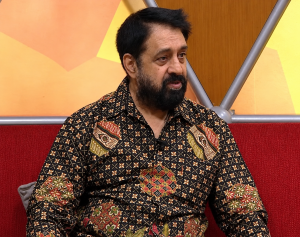
NDRRMA Chief Upreti on what Nepal must change after the Bhotekoshi disaster
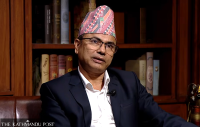
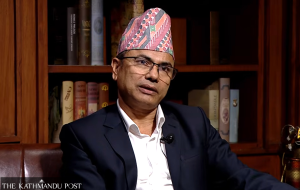
A month after the Bhotekoshi flood, Nepal’s disaster authorities are assessing the damage, planning reconstruction and considering the relocation of settlements in high-risk areas. Chief Executive of the Natural Disaster Risk Reduction and Management Authority, Dharmaraj Upreti. Post Photo
Natural Disaster Risk Reduction and Management Authority (NDRRMA) Chief Executive Dharmaraj Upreti spoke to Rupesh Shrestha on Kantipur Television’s Fireside about early warning systems, institutional preparedness and the lessons from the disaster.
It has been a month since the Bhotekoshi flood, and the country also experienced three consecutive days of heavy rain last week. What is the scale of the damage caused by these and other disasters? Has the authority made an assessment?
We formed a Rapid Damage and Needs Assessment team comprising representatives from the sectoral ministries, the National Planning Commission and the authority. The team used drone surveys to compare conditions before and after the disasters. We also collected details of roads, bridges and the investment made in them.
The preliminary assessment puts the damage to infrastructure at around $3 billion, or more than Rs450 billion. This includes damage to schools, vehicles and private property. For household belongings, however, we have only been able to make estimates. Bank assets are not included in this assessment.
We prepared the preliminary report within 15 days. We then invited development partners, diplomats and United Nations agencies to the Ministry of Finance and briefed them on the findings. Our preliminary estimate is that reconstruction will require $4.77 billion, or more than Rs700 billion. The detailed survey is still under way.
Can settlements be rebuilt in the affected areas?
Areas reached by the flood marks are not suitable for habitation. In some places, sand has been deposited up to 40 feet above the previous riverbed. If a flood of the same magnitude occurs again, it could reach even higher. Technical teams are therefore assessing how far above the flood marks the risk extends.
We have formed a committee headed by the director general of the Department of Survey to identify which land is safe, how much is private and public, and who owns it—whether the land belongs to an electricity authority, the forest sector or private individuals.
There is a proposal to nationalise the areas reached by the flood and plant trees there rather than develop parks. If parks are built, people may return to those areas and remain exposed to risk.
Individuals have property rights, so the state has a responsibility to resettle affected people elsewhere. After an earthquake, houses can sometimes be rebuilt at the same location. Reconstruction after a major flood needs to be approached differently.
The prime minister and the heads of the affected local governments have expressed the same view. Within a few days, the government will identify safe locations and begin preparing a Post-Disaster Recovery Framework. The first phase will focus on temporary housing.
A new risk has also emerged in Manang. What does this indicate?
The effects of rising temperatures are particularly rapid in high mountain areas. Places where snow used to fall are now receiving rain. This increases the possibility of avalanches and glacial lake outburst floods.
In Manang, a landslide has blocked a river and created a lake. If that lake suddenly bursts, it could have a cascading impact similar to what happened in Bhotekoshi. Chame Bazaar is not safe, and some houses have already been inundated.
Specialists are needed to blast and drain the lake safely. We could not find the required expertise within the Nepali Army or other security agencies, so a team of experts had to be flown in from Kathmandu by helicopter.
What should be done as settlements such as Chame become increasingly exposed to risk?
All settlements connected to river systems face risks. Communities in the lower reaches of the Karnali, the Koshi basin, along streams in Surkhet and along the Narayani are affected by flooding every year.
Instead of spending money on rescue operations every year, the state must take the bold decision to relocate settlements where risks have already been identified. International studies indicate that every dollar invested in disaster risk reduction before a disaster can save between five and 10 dollars in post-disaster expenditure. Nepal is estimated to suffer losses equivalent to around Rs4 billion every year.
We cannot leave people in places where they may lose their lives prematurely. The authority has risk maps, but having maps alone is not enough; they must be implemented.
We have the Disaster Risk Reduction and Management Act, the Disaster Risk Reduction National Strategic Plan of Action 2018–2030, the Sendai Framework and the Paris Agreement. Yet our implementation remains weak. We are also holding serious discussions with the National Planning Commission on this issue.
The name of the authority you lead is very long. Does its institutional strength, autonomy, resources and human resources match the length of its name?
The Disaster Risk Reduction and Management Act 2017 envisioned an authority as powerful as India’s National Disaster Management Authority or Pakistan’s National Disaster Management Authority. Those institutions have a degree of autonomy, resources such as helicopters and situation rooms, and their executive heads can mobilise the military.
We do not have that level of capacity.
What kind of human resources does the authority have?
We have two joint secretaries—one responsible for technical matters and the other for administration. We receive around 10 requests a day from local governments, many of them seeking geographical assessments of areas at risk. Since I took office, we have received at least 150 such requests.
The authority has one geologist, one hydrologist and one meteorologist, and they also have to handle administrative responsibilities. When the Department of Hydrology and Meteorology provides information about rainfall, we need experts within the authority who can interpret whether that rainfall could lead to flooding, landslides or inundation. We do not have enough specialists in this regard.
We need a multidisciplinary team comprising climate scientists, geologists, hydrologists and meteorologists.
What about the response mechanism?
The command post includes brigadier general-level officers from the Nepal Army and Armed Police Force, senior superintendent of police-level officers from Nepal Police, and representatives from the relevant ministries. However, the response unit lacks sufficient technical personnel with expertise in dealing with specific hazards such as floods, landslides, lightning and windstorms. We are therefore mobilising external service providers to fill these gaps.
At the UN, the prime minister spoke about the need for a mechanism involving Nepal, China and India. What would such a mechanism look like?
After the Bhotekoshi incident, we held discussions with the International Centre for Integrated Mountain Development (ICIMOD) and experts from the Hindu Kush Himalaya region. Experts from China and South Asia also participated.
The following day, we invited ambassadors based in Nepal, including the ambassadors of China and India. I made it clear that unless we now make early warning systems genuinely accessible and useful to ordinary people, this issue will remain something discussed only at major international forums.
Our river basins are connected to China in the north and India in the south. This is the basis of the discussion about the system extending “from the Himalayas to the sea”. If a hazard occurs in the mountains, its effects can be felt in the Tarai.
The main challenges in cross-border early warning are technical security concerns and data sharing. Our northern neighbour has more advanced data systems for the Himalayan region, while the World Meteorological Organisation’s regional office is in India.
There has been some progress. The Department of Hydrology and Meteorology and the Chinese government have reached an agreement on the exchange of early warning information, and implementation began a few days ago.
We have started receiving daily information from the Chinese side on the condition of lakes, cracks and other indicators. The Regional Integrated Multi-Hazard Early Warning System (RIMES), based in Bangkok, also covers South Asia. It has access to satellite data and has provided Nepal with access.
Our weakness lies in data analysis and technical capacity. Nepal does not have its own satellite.
The prime minister has described the phenomenon as a “Himalayan tsunami”. Is that a scientific term or a phrase intended to convey the scale of the impact?
It is not an official scientific name at present. A team has been formed with the Department of Hydrology and Meteorology to determine an appropriate name, and a name will be selected from six or seven proposals. An official name is expected within a few days.
We still need to reach agreement on how to describe an event in which rocks collapse, blocks of ice fall into a river and a sequence of cascading and compounding effects develops into a disaster of enormous scale.
For now, the term being used is simply the strongest expression we have available to describe the phenomenon.
Has relief reached the people staying in temporary camps?
On the night of the incident—August 26—I went to the airport at around 2:30am to check whether trucks and relief materials were ready. I went there with the home minister, and we decided that the trucks should leave that very night.
We reached Bidur within three to four hours, and the supplies arrived overnight. We established 37 holding centres.
Because road connections to Rasuwa were cut off, supplies could be delivered there only by helicopter. In Nuwakot, supplies could also be transported by road. Nuwakot has enough relief materials in stock to last at least four months.
There have been complaints about delays in some places, particularly in several wards of Gosainkunda Rural Municipality, where only smaller helicopters could operate.
Elsewhere, information on where supplies originated and where they were delivered has been uploaded to the Setu app. I have not received information indicating shortages. If you send us the links relating to the places where complaints have been made, we will look into them.
More than 5,000 people are missing and the search appears slow. Has the state given up hope?
A joint team, including South Korean experts, is working on search and rescue operations in the tunnel. Local authorities have already announced that the search and rescue operation inside the tunnel is almost complete.
However, there may still be people or remains beneath houses and mud. We are therefore moving from a “search and rescue” operation towards a “search and recovery” mission.
The executive committee will meet next Wednesday under the chairmanship of the home minister. All reports, including the Nepali Army’s report, will be presented at the meeting, and a decision will be taken on when the search and rescue phase formally ended.
Such a declaration is necessary because the relief available to the families of the deceased depends on it.
A draft has been prepared in consultation with the Ministry of Law, Justice and Parliamentary Affairs, and today is the final day for collecting public feedback. From tomorrow, we will move towards amending the relevant law. The process should not take very long.
What is the relief package?
There is no restriction on providing relief to people whose deaths have already been confirmed under the Social Security Guidelines.
A decision is being taken to declare those who remain missing—currently around 5,285 people—as deceased for the purpose of providing the same relief package.
Under the package, the state provides Rs200,000 when one member of a family dies. If additional members of the same family die, an additional Rs100,000 is provided for each person.
This is immediate relief, not final compensation. A separate recovery package will be provided to people whose houses have been destroyed or washed away.
Some countries have offered assistance with DNA testing. Why didn’t Nepal send the samples abroad?
We have received assistance from experts in several countries. Nepal Police is responsible for DNA testing, and kits have arrived from several countries.
However, we consulted the Ministry of Foreign Affairs about the international implications of taking DNA samples from Nepal to a third country, particularly regarding the rights and privacy of foreign nationals.
In accordance with data protection policies, we decided to bring foreign experts to Nepal and have the work carried out here. Even if this takes an extra week or two, or even a month, we believe this is the appropriate approach. It also provides an opportunity to build Nepal’s own capacity for the future.
Nepalis in the United Kingdom are sending two machines worth around $100,000, which are expected to arrive within a day or two and will be handed over to Nepal Police.
There is a difference in efficiency between manual processing and machine-assisted testing, so the process should become faster once the machines arrive. But the work has not stopped: sample collection and testing are continuing.
I agree that the process has been slower than expected.
How can victims who have lost their documents register their names and receive relief?
Data collection in coordination with local governments is in its final stage.
We have decided that, rather than insisting on procedural documentation, we will also recognise people who make a self-declaration stating, “These members of my family are missing.”
We have agreed to address the documentation required for bank accounts through local governments. Bidur Municipality has shown considerable initiative in this regard.




 15.34°C Kathmandu