New national cricket captain says Nepal has no alternative left but to win
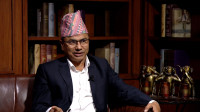
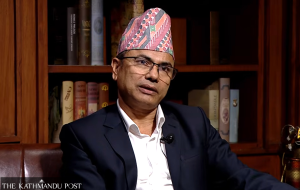
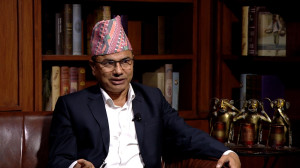
In an interview with Kantipur, newly appointed captain Sandeep Lamichhane talks about the daunting task of guiding a struggling team through a critical phase for ODI survival. Sandeep Lamichhane was re-appointed the captain of the Nepali national team across the ODI format on Monday. Post Photo
As the Nepal national cricket team gears up for a gruelling stretch of must-win fixtures to salvage their ODI status and secure a spot in the Asia Cup, the mantle of leadership has shifted once again. Stepping back into the role of captain, Sandeep Lamichhane faces the daunting task of guiding a struggling batting order through challenging away conditions, all while carrying the weight of a nation’s expectations.
Lamichhane was training in the nets at the TU International Cricket Ground on Wednesday when he opened up to Kantipur’s Subash Rokaya about taking over the reins from Rohit Kumar Paudel, navigating his own recent wicketless streak, and why he remains confident in Nepal’s cricketing future.
Excerpts:
How much of a challenge is this responsibility that you have got again?
I see this as an opportunity. It’s less about the title of captain and more about how we move forward together as a team. Of course, there is a lot of responsibility on my shoulders to keep the boys united. Rohit left a great legacy and set a standard for us, and I guess my job is to carry that forward.
If we can set a standard for the future that shows exactly why cricket is important to this country, that’s what we aim to do. Of course, to set that standard, these remaining four games of the World Cricket League, along with the Asia Cup qualifiers—the Premier Cup—are crucial. Every single opportunity coming our way right now is incredibly important, and we have no alternative left but to win. So, we are trying to get as much out of this group as possible, utilising everyone’s efforts and skills to make Nepal win.
How do you sum up Nepal’s League-2 journey so far?
Looking at recent games, we shouldn’t have put ourselves in a position where we have to depend on other teams. But given the current scenario, we have to play the equations. We need to figure out when to attack and when to be defensive. If we win our remaining four CWC League-2 games, we will definitely be in a strong position to save our ODI status. It’s all about taking it one game at a time. For now, there’s no alternative to winning.
Nepal’s recent away performances haven’t been memorable. We have more games on foreign soil. Going into new conditions again, what needs to be the primary focus?
The recent conditions we played in were heavily stacked against us. It’s not that we didn’t try. We gave it our all, but the results just didn’t go our way. Still, I feel we put up a good fight in every game. Of course, getting bundled out for 157 doesn’t reflect the standard of our national team. It was largely the conditions that pushed us back.
Looking ahead to Oman and Malaysia, we will prepare thoroughly. We’ll try to find similar pitches during practice and put in the hard yards. If we stick together and execute our plans, I’m highly confident this team will deliver a good result.
During the Netherlands tour, you went wicketless in three consecutive games—a rare occurrence for you. With both your individual form and the team’s batting form needing a turnaround, what kind of homework is required?
To be honest, I don’t really believe in this concept of “form”. Hitting a hundred one day and getting a zero the next doesn’t mean your form is just coming and going; it’s about consistency. The conditions were challenging, and you also have to give credit to the opposition. The way Namibia and the Netherlands played against us was commendable.
A lot depends on my role in the middle overs. If I can control the run rate in the middle, it makes the job easier for the fast bowlers at the death, just like Karan dai and Som daju did for us up front in the past. If the pacers strike early and I keep things tight in the middle, we have a team capable of producing great results.
You’ve played under several captains across different formats—Paras Khadka, Gyanendra Malla, Dipendra Singh Airee and Rohit Kumar Paudel. How would you reflect on Rohit’s tenure and the success he achieved?
I guess no one really needs to say much about Rohit because he has been very kind, very sweet. Look at the circumstances under which he took Nepal forward—it takes immense guts to unite everyone and carry the team like that when our cricket was practically falling apart. We’ve seen him since he was very young. He always had that very calm nature.
To suddenly get such a massive opportunity and responsibility, and to shoulder it the way he did—a leader isn’t made overnight. He proved himself time and again across every tournament, be it as a batter, as a captain, sometimes as a bowler, and as a fielder—he is a gun fielder. From every possible angle, he gave his absolute best. You can’t even rate him, because he has been fantastic.
I guess if you don't have that deep desire inside you—to go out on the field and say, ‘I want to play, and I want to win the game for the team and for the country’—then I don’t think we are truly carrying that passion.
But that passion has always been there in this Nepal team. The mark we have left behind, that obsession—be it during Paras dai’s era, under Gyanendra dai’s captaincy, or under Rohit—we created a legacy together.
Rohit made his friends, his family, and the entire nation proud. Whenever he looks back at his cricketing journey, he will know one thing for certain: he did more than everything within his capacity to make Nepal proud, and all of us are immensely proud of him for that.
So of course, my role now is to carry forward the legacy he created as captain. I’ll need everyone’s support, love, and blessings, and as captain, I will give my absolute best to push that legacy forward.
You are generally known as a more aggressive, attacking player compared to Rohit’s calmer demeanour. Will we see any difference in the team’s mentality under your leadership?
No, I don’t think so. It’s true that a person’s nature on and off the field can be different. On the field, my natural game is attacking. But as a leader, you have to adapt to what the team needs and the nature of the other players. If Lalit is naturally a defensive bowler, there might be times he needs to attack. If Karan dai is an attacking bowler, sometimes he needs to defend.
We will adopt aggressive or defensive options based purely on the match situation.
About the ACC Premier Cup—will Nepal qualify for the Asia Cup for a second time?
Of course, we will.
How?
By playing good cricket. By going out there, bringing in good results, and executing proper plans. We have to play for Nepal, which we always do. The passion and obsession every player has inside them isn’t something you can just show off. We know our recent results haven't been there, and that hurts—it’s in everyone’s hearts. Because of that, we have no other option left but to show it through our results.
Looking at the squad for the Premier Cup, there are experienced players, but also players making a comeback. There are changes in every department except spin. What is your plan regarding the returning players?
I want them to enjoy their game. I’m not the kind of captain who puts pressure on players. My role is simply to extract the absolute best from them and properly utilise whatever skills they bring. Everyone in this squad is incredibly talented. It’s just about going out there and expressing yourself.
As the ODI captain, what is your message to the fans?
Rather than making a commitment, I just want to promise that we will put our heart and soul, our blood and sweat, into every game for this country. Please keep your love and blessings coming. Every player in this dressing room needs it. Your support gives us incredible energy, especially when we lose—that’s when your belief matters the most. We will win, we will do well, and we will prove exactly why Nepal is considered one of the best Associate teams in the world.




 17.32°C Kathmandu