Q&A: Youths must understand that politics demands time and energy
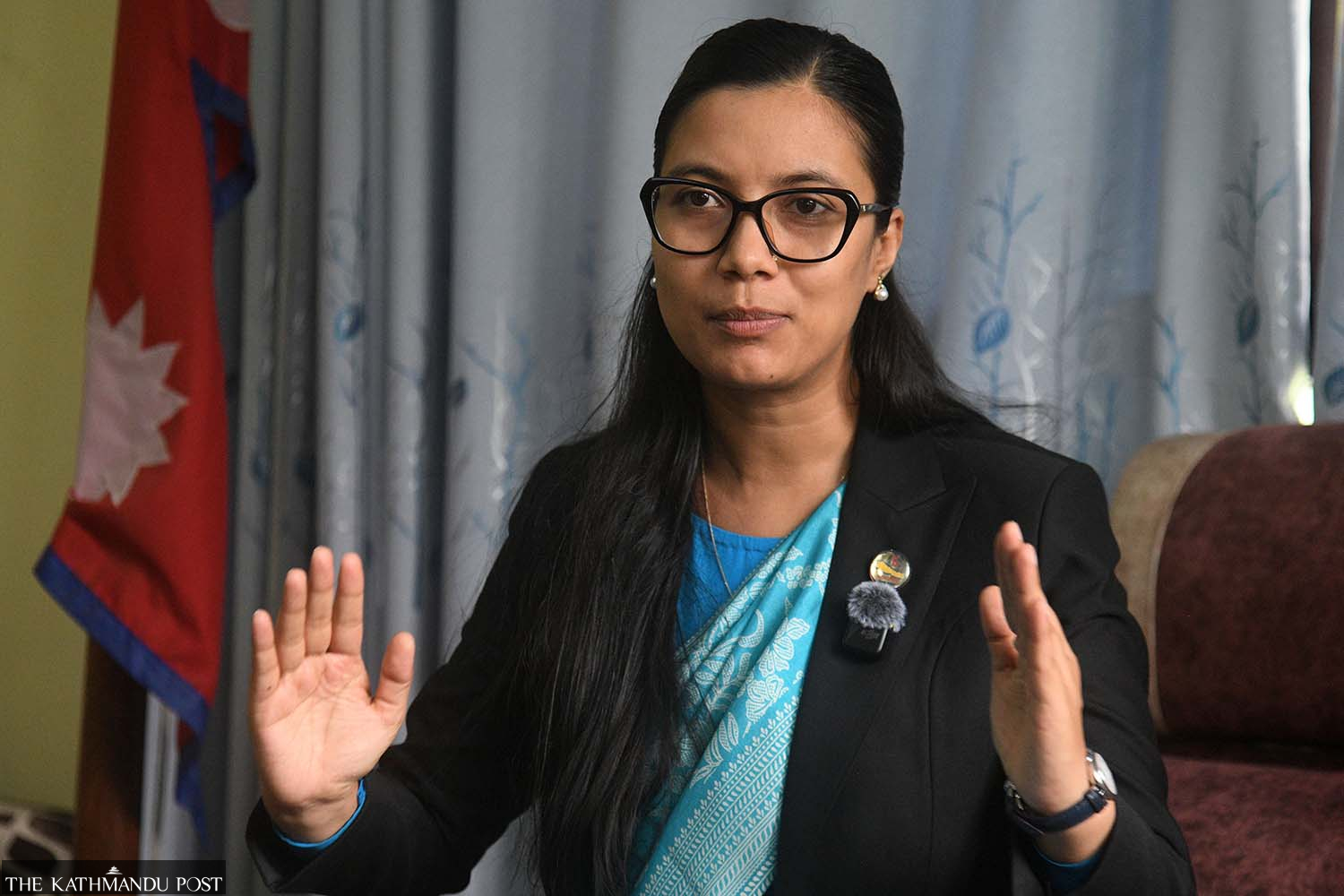
Law Minister Sobita Gautam takes aim at the judiciary’s ‘inverted pyramid’ and announces plans to reclaim state policy from external consultants. Sobita Gautam, Minister for Law and RSP vice-Chair Deepak KC/TKP
When Sobita Gautam entered the federal parliament in 2022 at just 27, she was framed as a symbolic byproduct of a transient anti-establishment wave. Fast forward to today: at 31, the lawyer and former television host heads the Law Ministry, shaping the halls of power. Having secured a high-stakes electoral victory in Chitwan-3 in the 2026 snap polls, Gautam has rapidly consolidated her political capital, recently defeating high-profile peer Dr. Toshima Karki to claim the coveted seat of Vice-Chairperson of the ruling Rastriya Swatantra Party (RSP).
As the Minister for Law, Justice and Parliamentary Affairs, she finds herself at the helm of an ambitious yet heavily encumbered legislative system. Her first hundred days in office have forced a transition from the absolute freedom of her activist rhetoric to the rigid pragmatism of governance. Her approach targets structural inertia head-on: Laying out a framework for a specialised Infrastructure Court to address chronic development delays, establishing a ‘Centre of Excellence’ to dismantle a decades-old culture of outsourcing legislative drafting to external consultants, and championing civic literacy via grass-roots legal campaigns.
Minister Gautam sat down with The Post’s Biken K Dawadi to reflect on the hard administrative lessons of her first hundred days, the organisational and logistical friction that exposed the RSP’s growing pains during its inaugural General Convention, and what it truly takes for a young woman to exercise structural authority in Singha Durbar.
What sets the Law Ministry apart from other ministries?
Every other ministry operates within its own specific domain, whereas our role is cross-cutting and foundational. Unlike ministries that engage in direct, day-to-day interactions with the public, our ministry does not typically handle work of that immediate nature. While other ministries might function by issuing direct orders or instructions within their sectors, our work is primarily focused on the policy level. Effectively, the initial impetus for creating new laws begins in the respective sector-specific ministries, but those drafts must pass through our ministry at two distinct stages during their development. Our primary responsibility is to filter these drafts to ensure they fit within the established legal framework and, crucially, do not conflict with the Constitution. Consequently, a vast amount of our energy and resources is dedicated to this legislative vetting process.
What has been the primary focus of your ministry during this first hundred-day period?
In these first hundred days, since the new government took office with a new sense of urgency, every ministry has brought forward visions that require a legal basis to be implemented. A minister’s success is often tied to the creation of these necessary laws, and we have been working closely with various ministries to understand their visions. We have held comprehensive discussions to prepare a roadmap for the laws that must be enacted within the current fiscal year.
Despite our limited resources, our various branches have been working continuously and actively, completing approximately 24 legal tasks or reviews within this hundred-day period. Beyond this, our routine work includes providing written responses to legal queries, advising on international agreements, and vetting treaties. However, looking back at these first hundred days, I believe two specific initiatives stand out as particularly significant: the progress towards an Infrastructure Court and the restructuring of the Law Commission.
What specifically motivated the decision to move forward with the formation of an Infrastructure Court?
The initiation of a dedicated Infrastructure Court was a process we started upon taking office, driven by deep public frustration. Much of this anger stems from the extreme delays in public construction projects. It is disheartening to see projects that should be completed in two years taking twenty years instead. As someone from the grassroots level, I empathise deeply with this public irritation. When we analysed why construction projects are delayed, we found a complex web of stakeholders and issues. Problems range from consultants not delivering on time to contractors misusing mobilisation advances. For instance, a contractor might take an initial advance intended for road construction and use it to buy a private vehicle instead. We tried to address these systemic failures. Currently, when disputes arise, parties often take their claims to regular courts or seek writ jurisdictions, which only adds to the existing mountain of cases.
How does the current judicial structure contribute to the backlog of cases in the higher courts?
Our judicial structure is currently an inverted pyramid. While the district courts have fewer issues, the High Courts are under more pressure. By the time you reach the Supreme Court, the backlog is overwhelming because dissatisfied parties naturally appeal upwards from the lower levels. This is why the initiation of the Infrastructure Court is one of the most significant achievements for the Law Ministry, as it provides a specialised venue for these complex disputes. We are deeply concerned about this ‘inverted pyramid’ and are looking for mechanisms to diffuse the caseload further down.
The Supreme Court should ideally be the venue for ultimate justice, reserved for cases of extreme injustice or significant legal interpretation. While we are not yet in a position to announce a definitive timeline, we are working seriously on a comprehensive solution that may take three to six months to finalise, as reducing this backlog is one of our core agendas.
Deepak KC/TKP
What changes are you implementing to improve the quality and independence of legislation drafting?
A major priority is the fundamental restructuring of how we draft our laws. We noticed a trend where outside consultants were hired to draft legislation, which effectively meant that state policy was being written by external actors rather than by the government maintaining control. We questioned this practice even when we entered Parliament in 2022. To rectify this and systematise the process, we are restructuring the Law Commission to turn it into a ‘Centre of Excellence for Legislative Drafting’. This body, chaired by the Law Minister and composed of a board of experts from various sectors, will engage in broad dialogues and coordinated drafting. I believe this will yield excellent long-term results for the country by ensuring that law-making remains a coordinated, expert-led government function. Furthermore, we want to connect the law-making process with the people through our campaigns.
Could you elaborate on the ‘Know Your Law’ and ‘Make Your Own Law’ initiatives?
We launched the ‘Know Your Law’ and ‘Make Your Own Law’ campaigns specifically to connect the legislative process with the citizens. These initiatives empower citizens to give voice to the types of laws they wish to see, fostering a sense of ownership over the legal system. However, this also requires a level of public engagement where citizens read and understand existing laws so they can provide informed suggestions. This is an effort to both teach the law and involve the public in its creation.
Parallel to this, we are working extensively on reforming legal aid. We have practically rewritten the old act regarding free legal aid to create a new, more effective framework. We are creating digital records to identify both those who need service and the lawyers who are providing pro bono work. This ensures that these contributions are officially recognised in government records, which has not been the case previously.
How are you addressing the historical issue of political interference and horse-trading in judicial appointments?
Reforming the judiciary is a core priority, and while the Law Ministry does not have total control, as a member of the Judicial Council, I have a significant role in shaping the government’s approach. We strongly advocate for meritocracy. However, we must also apply human intelligence to this process because a purely automated or seniority-based system can be flawed. For example, if someone reached the top of the list by exploiting the old, corrupt system, a purely automated process would simply continue to give them priority. We need to evaluate performance more holistically, looking at the quality of a judge’s rulings, their conduct, and any complaints filed against them in the Judicial Council. Once we have established a robust system of evaluation, it can eventually become more automated. We are engaged in a regular, transparent dialogue within the Judicial Council to create a judicial system that is satisfactory and transparent for everyone.
Turning to party politics, what were your primary takeaways from the Rastriya Swatantra Party’s first General Convention?
The first General Convention was an amazing experience for me, especially as a founding central committee member. Seeing the party grow from a small team of 21 people in a single room to such a massive movement was deeply moving. When you have planted the seeds yourself, seeing the party flourish on such a scale brings a unique sense of pride. However, the convention also highlighted areas where our preparation was lacking. Since many of our members come from non-political backgrounds, we were somewhat weak in anticipating what to expect next in the political process. There were many lessons learned regarding how to improve our programmes and procedures for the future. We realised that we need to be better prepared for the technical aspects of such a large-scale political event.
What core agendas do you believe resonated most with the delegates and led to your election as Vice-Chairperson?
Interestingly, a party election is quite different from a general public election. In a public election, you try to convince voters of what you will do in the future, but in a party election, the delegates often look at what you have already done. Rather than making grand new commitments, I focused on my role as a founding member who helped build the party. The message I received from the delegates was a desire for leadership that can protect the party and bring everyone together across the country’s diverse geography. They wanted leadership that could manage the party’s growth while maintaining stability. I feel I internalised their message of inclusivity and stability more than I pushed a specific new agenda, and this resonated with their evaluation of leadership practices from the ground up.
How do you respond to the criticism that your victory was primarily due to being part of the ‘establishment faction’?
I think this is more a matter of human nature than formal factions. People naturally gravitate towards names they hear often and individuals they are already in touch with. It was naturally easier for delegates to recognise older members, whereas newer members faced more of a challenge in introducing themselves. We actually played a role in trying to introduce these new colleagues to the delegates to help bridge that gap. In my specific case, however, there were many aspirants for the post, and we had extensive dialogues even with those I eventually contested against, who were also old colleagues. Therefore, I don’t think the ‘establishment’ label strictly applies to the dynamics of my specific election. It was a natural process where delegates chose people they knew and trusted to lead.
Is the party finally clear on its ideology, particularly regarding the concept of ‘Social Democracy’?
It is a natural process for any new entity in the market to take some time to establish its identity. While there was some early confusion, we actually clarified our party’s ideology during the Jaleshwor meeting about a year ago. However, a narrative had been set in society that the RSP lacked an ideology, and that narrative was difficult to penetrate. We have long been clear on our political modality, our economic structure, our views on inclusivity, and our stance on religion. During the first General Convention, the Chairman and Vice-Chairs presented their reports, which finally delivered this clear message to all our members at once. We have been clear about it for a long time, but the convention provided the platform to communicate it effectively to our entire membership.
As a woman under 35 in a high-ranking leadership position, how do you plan to prepare the next generation for politics?
My entry into politics feels like a symbolic breaking of barriers, having been elected as an MP at 27 and becoming a Minister and Vice-Chair of the biggest party in the parliament at 31. My role now is to prepare the younger generation so they are ready for these positions, countering the common criticism that young people are not mature enough. We have developed concepts like a Leadership Academy and ‘Candidate Clubs’ to shape youth and help them understand the political process. It is vital that they understand politics is not just glamour—an idea that gained traction after the Gen-Z movement—but a demanding process that requires great time and energy. I want to help youth prepare themselves from the heart for the true costs of a political career, ensuring they are ready for the responsibility of governing.




 14.7°C Kathmandu