Western Tarai swelters as temperatures hit 40 degrees
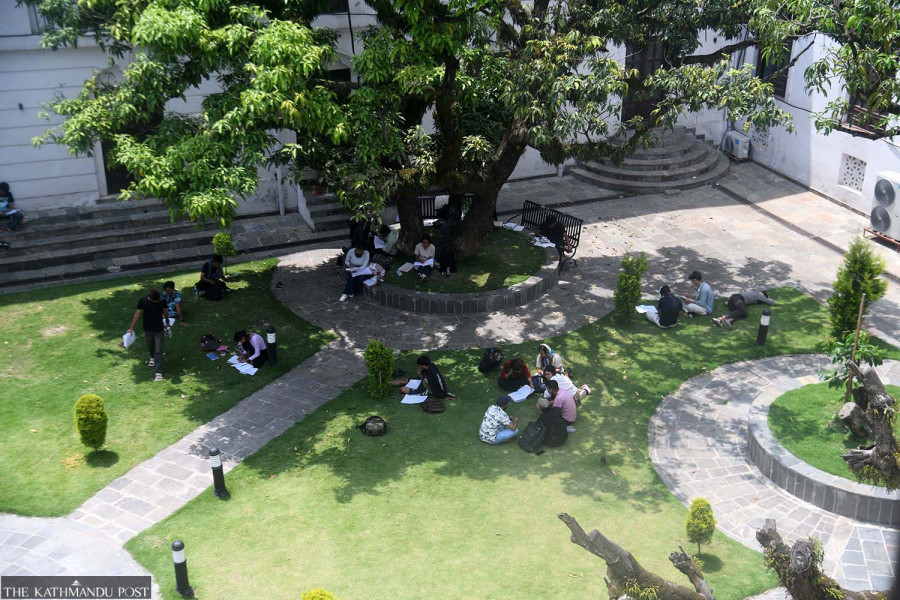
Bheri Hospital in Nepalgunj is treating around 100 heat-affected patients daily in recent days. Library-goers are seen in the shade of a tree in front of Kaiser Library in Kathmandu on Sunday. Deepak KC/TKP
Amid reports of deaths caused by extreme heat and heatstroke coming from neighbouring India, people in Nepal’s western Tarai have also been affected by the scorching heat.
For the past several days, Bheri Hospital in Nepalgunj has been treating around 100 patients every day for heat-related illnesses. Most patients complain of severe headaches, nausea, vomiting, dehydration, fever, and respiratory problems.
“All 200 beds of our hospital are occupied, including by patients affected by the heatwave,” Dr Nabin Darnal, Medical Superintendent at the hospital, told the Post over the phone from Nepalgunj. “Our emergency is overwhelmed with patients. We anticipate more cases of heat stroke if the temperature rises further.”
As daytime temperatures have exceeded 40 degrees Celsius in several places, people residing in western Tarai—including Nepalgunj, Dhangadhi, and Dipayal—have been reeling under intense heat.
Due to rising heat, Krishnapur Municipality in Kanchanpur has decided to close schools for three days starting Monday.
The decision applies to all community and institutional schools within the municipality. “The heat has made it very difficult for children to travel to and from school,” Mayor Hemraj Ojha said.
Elsewhere in the Tarai—across Lumbini province and parts of the Sudurpaschim province—temperatures have also been hovering around 40 degrees Celsius, creating heat wave conditions.
Doctors at the Bheri hospital said those working during the daytime, including farmers and daily-wage labourers, have been affected the most by the hot weather. Along with patients directly affected by the heat, the number of fever, diarrheal, and snakebite cases has also increased at the hospital.
At least 16 people have reportedly died of heat stroke in southern India this summer, as temperatures in most places of the country crossed 45 degrees Celsius.
Nepal’s Meteorological Forecasting Division under the Department of Hydrology and Meteorology has issued a heat wave warning for Tarai districts and hot-day conditions in the hilly areas of the two provinces.
“The maximum temperature in several places in western Tarai has exceeded 40 degrees Celsius, which has triggered heat wave conditions,” said Binu Maharjan, a meteorologist at the division. “The temperature in Dhangadhi and Nepalgunj had already reached close to 38 degrees Celsius before noon on Sunday.”
This year, it is the third heat wave bulletin issued by the division. The previous two bulletins were issued around a month ago. But with the intensification of premonsoon rainfall, temperatures across the country had declined for around a month.
Compared to people in western Tarai, those residing in eastern Tarai have not yet experienced heatwave conditions this year, as temperatures there are still around 30-31 degrees Celsius.
Officials say that temperatures in western Tarai could come down on Tuesday, as there is a possibility of brief rainfall on Monday night.
Doctors say health facilities across the country generally see a rise in the flow of patients suffering from infectious and vector-borne diseases in the summer season. However, they warn that health facilities in the Tarai could be overwhelmed in the coming days, as many have remained ill-equipped and understaffed for years.
They say infectious diseases, including water-borne diseases, such as diarrhoea, dysentery, cholera, hepatitis A, hepatitis E, as well as infection of vector-borne diseases like malaria, dengue, and scrub typhus, are likely to rise in the coming days due to increasing temperatures and contamination of drinking water sources.
Moreover, cases of snakebite, already being reported from various districts, are expected to surge as temperatures rise.
Last year, heatwave conditions affected hundreds of people across the Tarai.
A heatwave occurs when maximum and minimum temperatures at a location remain unusually high for at least three consecutive days.
Exposure to excessive heat can result in headaches, nausea, weakness, dizziness and fainting. Heat-related illnesses include heat stroke, heat exhaustion, heat cramps and heat syncope (fainting). Heat stroke is the most severe form of heat-related illness and requires immediate medical attention.
Doctors advise people residing in the Tarai region to take precautions, remain hydrated, and avoid outdoor activities during daytime whenever possible.
Nepal is one of the world’s most vulnerable countries to the climate crisis and has witnessed frequent extreme weather events over the past decade and a half. In recent years, the country has seen unusual rainfall patterns that triggered devastating landslides and floods. Experts link these incidents to climate change.
According to a 2017 study conducted by the Department of Hydrology and Meteorology, Nepal’s average annual maximum temperature rose by 0.056 degrees Celsius between 1971 and 2014.
Globally, extreme temperature events are increasing in frequency, duration and intensity. Scientists blame climate change for an early onset of summer and increasingly intense heat.
What to do to avoid heatwave:
Drink plenty of water
Bathe with cold water
Use an umbrella when going out in the afternoon; cover your head with a thin cloth and wear light cotton clothes.
Work in the field during the morning and evening.
Drink lemon water, coconut water, and fruit juice; eat fruits, cucumber, and freshly cooked homemade food.
What not to do
Avoid tea, coffee, soda, and other caffeinated drinks, as they can increase urination.
Do not go outside during the afternoon
Avoid staying in the kitchen for long periods; if you must, drink plenty of water.
Avoid smoking and consuming alcohol.
The Ministry of Health and Population has urged everyone to seek immediate medical attention if they experience increased heartbeat, breathing difficulties, low blood pressure, absence of sweating, severe headache, nausea, or high fever.
Arjun Poudel is a health reporter for The Kathmandu Post. Before joining the Post, he worked for Sagarmatha Television, Naya Patrika, Republica and The Himalayan Times.




 25.92°C Kathmandu