India’s recurring barriers expose battle over Nepali tea and Darjeeling brand
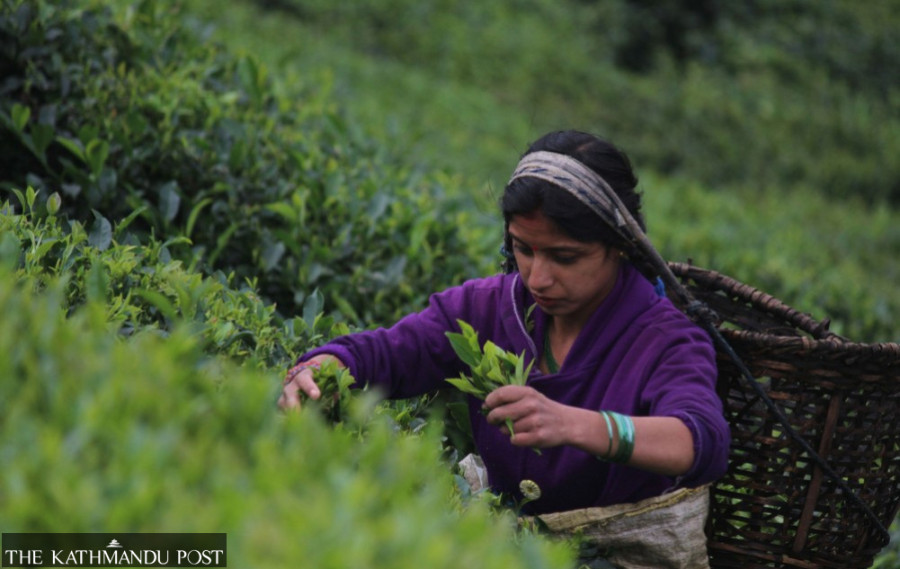
Political pressure and trade competition—not quality alone—lie behind repeated restrictions on Nepali tea exports to India, industry insiders say. Post File Photo
In July 2017, India’s then-president Pranab Mukherjee travelled to Darjeeling on the occasion of Bhanu Jayanti. Taking advantage of the visit, the Darjeeling Tea Association arranged a special meeting with the president and submitted a memorandum carrying a single demand: “Imports of Nepali tea must be stopped.”
After receiving the memorandum, the president returned to New Delhi. Two years later, the same issue echoed in the West Bengal Assembly.
In 2019, former West Bengal legislator Shanta Chhetri argued in the assembly that Nepali tea was of “inferior quality” and its import should be halted immediately.
On April 10, 2024, Indian authorities effectively began implementing stricter controls. Citing concerns over the quality of Nepali tea, Indian customs authorities required 100 percent sample testing before allowing consignments to enter the market.
Surveillance on Nepali tea imports intensified following a verbal order from the Chief Commissioner of Customs in Kolkata, West Bengal.
In June 2025, the West Bengal government itself decided to tighten restrictions further. During an administrative review meeting, then Chief Minister Mamata Banerjee said that duty-free tea entering from Nepal was harming the brand and reputation of Darjeeling tea.
Indian media reported that Banerjee instructed the Tea Board of India and the central government to take stronger measures to protect Darjeeling tea. Following her remarks, the West Bengal government wrote to New Delhi requesting a review or withdrawal of the tax exemption granted to Nepali tea under the Nepal-India Trade Treaty.
“The entry of Nepali tea has affected the identity and market reputation of Darjeeling tea, putting the local industry at risk,” Banerjee had said.
Indian authorities have long alleged that Nepali tea is being rebranded and sold as Darjeeling tea, weakening the authenticity of the globally recognised Darjeeling label.
Not only tea, but Nepali ginger, cardamom and broom grass products have also faced barriers in India, though tea has remained the most heavily targeted commodity.
Most recently, India introduced new restrictions on Nepali tea beginning May 1. About 20 days later, New Delhi partially eased the measures after amending its Standard Operating Procedure on tea imports and relaxing mandatory laboratory testing requirements.
Following instructions from India’s Ministry of Commerce, the Tea Board of India issued a fresh notice last Tuesday, exempting tea sold in the domestic Indian market from compulsory testing for the time being.
Under the revised provision, tea imported for domestic sale in India will no longer require mandatory testing. However, tea intended for re-export will still undergo testing, while authorities have retained the right to conduct random checks.
Barriers in the Indian market are nothing new for Nepal’s tea industry.
Under different pretexts, India has repeatedly imposed restrictions on Nepali agricultural products, particularly tea. In recent years, the same pattern has resurfaced through quality concerns, testing rules, quantitative restrictions, labelling requirements and cumbersome paperwork procedures.
Tea remains the most vulnerable product because it is a high-value commodity dependent on branding and international reputation.
Although the Nepal-India Trade Treaty guarantees uninterrupted trade in tea and other products, Nepali traders say India has repeatedly acted contrary to the spirit of the agreement.
At the centre of the dispute lies the Darjeeling brand.
Darjeeling tea is one of the world’s premium tea brands, but production is limited. Annual output currently stands at only around 6,000 to 6,500 tonnes.
Industry insiders allege that because Darjeeling production cannot meet global demand, Nepali orthodox tea is informally blended into Darjeeling tea before being sold internationally.
In November 2021, allegations surfaced that Tata Consumer Products had blended Nepali tea into its products and marketed them without clearly disclosing the tea’s origin. Following the controversy, India’s federal Ministry of Commerce instructed the Tea Board to investigate.
According to Tea Board of India statistics, India imported more than 13.3 million kilograms of tea from Nepal in 2023. Last year, imports were estimated to have climbed to nearly 16 million kilograms.
“Most tea imported from Nepal is re-exported abroad,” a Darjeeling Tea Board official said.
Tea entrepreneurs and experts say the dispute is driven by multiple factors, including market control, protection of the Darjeeling brand, trade competition and regional political pressure.
Tea entrepreneur Uday Chapagain argues that the “quality” issue raised by India is more political and commercial than technical.
“If India were genuinely concerned about quality, it could establish modern laboratories right at the border,” Chapagain said. “But sending samples to Kolkata and holding tea shipments for two weeks is a way of prolonging procedures and discouraging trade.”
Most orthodox tea exported from Nepal to India has a taste, aroma and quality similar to Darjeeling tea, according to Chapagain, putting pressure on producers in Darjeeling.
“Tea produced in Nepal’s hill regions is tastier and of higher quality than Darjeeling tea,” he said. “They are deeply worried that the Darjeeling brand could lose its identity.”
Shiva Kumar Gupta, senior vice president of the Nepal Tea Producers Association, said the core problem was not poor quality but competition.
“Darjeeling tea has a very high production cost. Once Nepali tea began challenging its market share, quality became an excuse,” Gupta said.
Businesspeople say the practice of blending Nepali tea into Indian products and re-exporting it as “Darjeeling Tea” has existed for years.
“On one hand they use Nepali tea to meet international demand, and on the other they pressure authorities to block the same tea. That is a double standard,” another entrepreneur said.
Tea expert Prithvi Bikram Rai described the issue as fundamentally “brand politics”.
Darjeeling tea is internationally recognised, but production has steadily declined, with more than a dozen tea factories in Darjeeling already shut down. Limited output cannot satisfy global demand, prompting greater dependence on Nepali tea.
“That is where the problem begins,” Rai said. “The Indian side fears that if Nepali tea develops its own separate identity, the Darjeeling market could weaken.”
Analysts say repeated anti-Nepali tea statements by West Bengal politicians reflect the same anxiety.
Economists also point to domestic political pressure. Since the Darjeeling region’s economy heavily depends on the tea industry, local industrialists and labour groups have long pushed the Indian government to shield the sector from foreign competition.
Aditya Parajuli, president of the Nepal Tea Producers Association, said India appeared determined to maintain practical control over Nepali tea despite officially offering open market access.
“Nepal became excessively dependent on India. First, India provided easy market access, and later that dependence itself became a tool of pressure,” he said.
Economist Bed Raj Acharya argued that such obstacles would persist unless Nepal develops its own tea brand, expands packaging industries and diversifies export destinations toward China, Europe and the Middle East.
According to the National Tea and Coffee Development Board, Nepal produces around 27.5 million kilograms of tea annually. Tea is cultivated across more than 20,000 hectares and provides employment to around 60,000 people nationwide.
“Nearly 80 percent of tea produced in Jhapa and Ilam is sold in the Indian market,” said Indra Adhikari, agricultural development officer at the board’s regional office. “Only 20 percent is consumed domestically.”
Adhikari said Nepal produces around 19 million kilograms of CTC tea annually, of which nearly 10 million kilograms are exported to India.
Jhapa accounts for the country’s highest CTC tea production. Of the 7 million kilograms of orthodox tea produced annually, around 6 million kilograms go to the Indian market, while roughly 1 million kilograms are exported to Europe, the United States, Japan and other countries.
Orthodox tea is mainly produced in hill districts such as Ilam, Panchthar and Dhankuta.
According to the Mechi Customs Office, Nepal exports tea worth between Rs4 billion and Rs5 billion to India every year. However, repeated Indian restrictions have left Nepali tea farmers and exporters increasingly frustrated.




 20.86°C Kathmandu