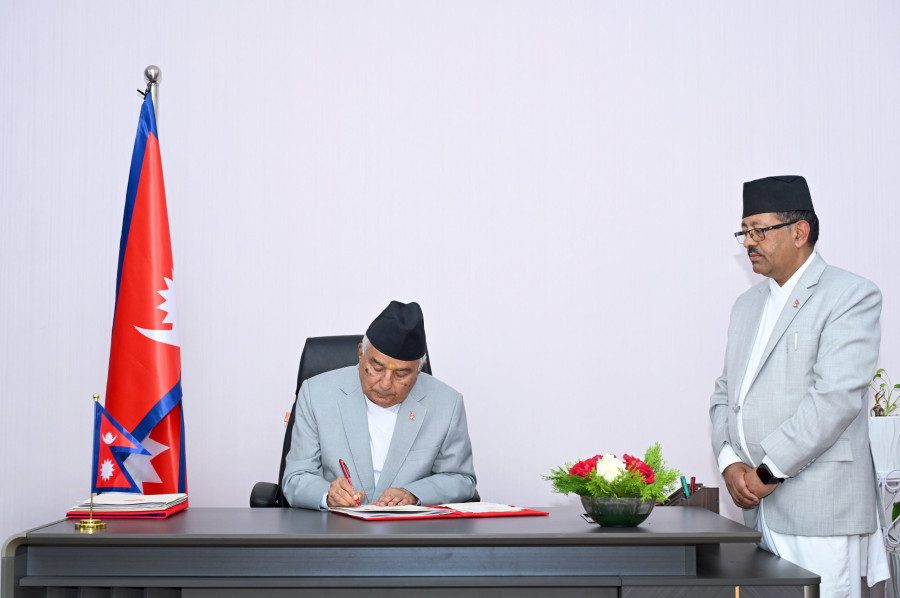
President Ramchandra Paudel on Tuesday authenticated the ordinance relating to the Constitutional Council (Functions, Duties, Powers and Procedures), despite maintaining his earlier concerns, after the government resent it without any revisions.
The move brings a temporary end to a prolonged constitutional and legal standoff between the President and the government. The ordinance had first been forwarded to the President on April 27, following a Cabinet recommendation.
Hours after the ordinance was issued, the Balendra Shah-led Cabinet recommended that the President summon a new session of the federal parliament. Paudel promptly convened the session of both houses for May 11, which will primarily focus on the presentation and endorsement of the government’s policies and programme and the national budget for the upcoming fiscal year.
Paudel had returned the ordinance, stressing that decisions of the six-member Constitutional Council must ensure a clear majority of its full membership. He has consistently raised similar concerns in the past, including when returning bills endorsed by Parliament and withholding ordinances recommended by previous governments.
However, a Cabinet meeting on Monday chose not to address the President’s concerns and resent the ordinance in its original form. Baburam Kunwar, a senior advocate and adviser to the President, said the ordinance was issued in line with constitutional practice and its underlying spirit.
Prime Minister Balendra Shah had also sent a two-page explanatory note responding to the President’s concerns. “The prime minister resubmitted the ordinance with reasons and justifications addressing the issues raised. In his capacity as the custodian of the constitution, the President decided to authenticate it,” Kunwar said.
The note also clarified that certain contentious phrases from earlier drafts had been removed and that provisions had been aligned to ensure quorum based on the full membership of the council.
Under Section 6(3) of the Constitutional Council Act, a meeting requires the presence of the chairperson and at least four members to meet the quorum. Subsections 4, 5, 6 and 7 of the same provision outline the decision-making process, previously requiring attempts at consensus before decisions could be taken by a majority of the total membership.
The newly issued ordinance modifies this framework, allowing decisions to be taken by a majority of members present. This means that if four members attend a meeting, decisions can be made with the support of three members.
Successive governments have altered these provisions through ordinances to suit political needs. In 2020, then prime minister KP Sharma Oli faced widespread criticism for introducing an ordinance that allowed decisions with the presence of just three members, enabling controversial appointments to constitutional bodies.
At the time, the absence of the speaker and the leader of the main opposition party made it easier for the government to push through recommendations. The current ordinance attempts to avoid such criticism by requiring at least four members to be present, while still allowing decisions by a simple majority of those attending.
It also addresses the possibility of a tie in the six-member council. In the event of a 3–3 split, the side supported by the chairperson will be deemed the majority, a provision aimed at preventing deadlock in decision-making.
In his explanatory note, Prime Minister Shah argued that the ordinance was necessary to avoid a legal vacuum. He said there is no established practice whereby previous legal provisions automatically revive once an ordinance becomes inactive.
He cited an example from 2006, when a separate bill had to be introduced to restore provisions of an earlier law after an ordinance lapsed. “As earlier provisions did not automatically revive, a legal vacuum emerged, necessitating this ordinance,” the prime minister argued.
However, the Supreme Court has previously ruled that such a vacuum does not arise, stating that earlier legal provisions revive if an ordinance is rejected or becomes inactive. The court has also clarified that a parent Act cannot be considered amended on the basis of a repealed ordinance.
Some legal experts have cited this precedent to question the government’s intent, arguing that the ordinance may not be necessary and could be politically motivated.
The ordinance is expected to facilitate long-pending constitutional appointments. Under Article 284 of the Constitution of Nepal, appointments to key positions, including the chief justice, auditor general and heads of constitutional commissions, are made on the recommendation of the Constitutional Council.
Currently, 18 positions remain vacant across various constitutional bodies, including the post of chief justice. A total of 17 vacancies exist across 13 commissions.
The National Natural Resources and Fiscal Commission, Muslim Commission, Tharu Commission, Madhesi Commission and National Inclusive Commission are all without chairpersons.
At the Election Commission, two positions, including the chief election commissioner, are vacant. Additional vacancies exist in the Commission for the Investigation of Abuse of Authority, National Human Rights Commission and National Women Commission.
The National Natural Resources and Fiscal Commission, which plays a crucial role ahead of the national budget, is currently functioning with only one member, acting chairperson Bipin Raj Niraula.
The commission is responsible for determining the framework for revenue sharing among federal, provincial and local governments, recommending equalisation and conditional grants, and advising on the utilisation of natural resources.
Commission spokesperson Sukdev Prasad Baskota said that while recommendations related to equalisation grants have already been completed, other functions have been affected. “With only one member in place, other planning and operational work is inevitably affected,” he said.
Since the ordinance allows decisions to be taken with the support of three members, it significantly eases the process for convening meetings and making recommendations.
The six-member council currently includes Prime Minister Shah and Speaker Dol Prasad Aryal from the ruling Rastriya Swatantra Party, National Assembly chair Narayan Dahal, Nepali Congress leader Bhishma Angdambe and deputy Speaker Rubi Kumari Thakur. The chief justice position remains vacant, with Sapana Pradhan Malla serving as acting chief justice.
Given the current composition, the prime minister could push through recommendations even in the face of opposition dissent.
Despite its authentication, the ordinance must still be approved by both houses of the federal parliament to remain in force.
Article 114(2)(a) of the constitution requires that an ordinance be tabled in both the House of Representatives and the National Assembly after they convene. If either House rejects it, the ordinance becomes inactive.
The Rastriya Swatantra Party has no representation in the National Assembly. Without support from parties such as the Nepali Congress, the CPN-UML and the Nepali Communist Party, the ordinance faces a significant risk of rejection in the upper house.
A similar situation had arisen in the past when a government led by a Congress-UML alliance held a strong majority in the House of Representatives but lacked numbers in the National Assembly. As a result, a land-related ordinance issued on the recommendation of then prime minister Oli could not move forward.
If the ordinance secures parliamentary approval, the government must introduce and pass a replacement bill within 60 days of its tabling, in line with constitutional provisions.




 16.62°C Kathmandu