



 12.97°C Kathmandu
Sun, Oct 11, 2026
Politics
PM Shah’s absence in parliament sparks debate on accountability and democratic norms
Shah, who walked out mid-speech during President’s policy presentation Monday, stayed away from House debate Wednesday. Experts warn of risks to parliamentary traditions.
bookmark![]()
Opposition parties objected as the prime minister failed to appear to table the proposal for discussion on the government’s policy and programme. Hemanta Shrestha/TKP
Jaya Singh Mahara
Published at : May 13, 2026
Updated at : May 14, 2026 06:29
Kathmandu
The refusal of the newly appointed Prime Minister Balendra Shah to address the first meeting of the House of Representatives on April 2 surprised not only political circles and parliamentary observers but also the wider public.
Shah, who entered Singha Durbar after taking the oath of office on March 27, faced public criticism and debate for failing to address Parliament.
Criticism intensified further on Monday when Prime Minister Shah walked out of the joint session of the federal parliament midway through President Ramchandra Paudel’s presentation of the government’s policies and programmes for the upcoming fiscal year—the first such policy document under the Shah-led administration. Neither the government nor the prime minister’s secretariat has publicly clarified why Shah left the session before the President completed the address.
Amid ongoing debates over the prime minister’s public communication and parliamentary conduct, many had expected Shah to address Wednesday’s House meeting. Parliamentary tradition and House regulations require the prime minister to respond to lawmakers’ questions during deliberations on the policy and programme. However, Shah did not attend Wednesday’s meeting at all.
Opposition parties objected as the prime minister failed to appear to table the proposal for discussion on the government’s policy and programme. They also argued that the parliamentary regulations requiring the government to respond to lawmakers during the discussion were being violated. Shah had authorised Finance Minister Swarnim Wagle to table the proposal and respond on his behalf, and had formally informed Parliament through the Speaker.
However, because Shah remained absent from the House despite being present at the nearby Prime Minister’s Office, tensions escalated throughout the day, and the House session was eventually adjourned. The distance between Shah’s office and the federal parliament building is roughly 50 metres.
Opposition parties insisted that Prime Minister Shah should attend the House discussion on the government’s policies and programmes and answer lawmakers’ questions. They demanded that the Speaker issue a ruling requiring the prime minister to be present and listen to the debate on his government’s agenda.
“As the head of the government could not be present, another minister from the Cabinet was sent with a written communication, and the policy and programme document has already been tabled. We are now at the stage of discussing it. Lawmakers from the opposition parties have registered amendment proposals. Citizens are closely watching such an important public issue and observing what kind of debate takes place in the House among us,” said Speaker Dol Prasad Aryal.
The Speaker, however, did not specify why the executive head was unable to attend.
Shah is perhaps the first prime minister in Nepal’s modern parliamentary history not to address the House of Representatives even after a month and a half in office. In the parliamentary system, the government is considered accountable to the people through Parliament, and the head of the government’s presence at key moments is seen as politically significant.
Analysts argue that by refusing to attend Wednesday’s session, Shah disregarded parliamentary convention and the dignity of the legislature. Former parliamentarian Laxman Lal Karna said the prime minister must operate within the parliamentary system.
“The policies and programmes actually belong to the head of the government. The President only reads it out. He should have stayed in the House, listened to the debate and answered the questions himself,” Karna said.
Shah rose to the premiership after the Gen Z movement of September 8-9 last year dramatically reshaped Nepal’s political landscape. He became Prime Minister through the March 5 election.
Shah, who had earlier won the Kathmandu mayoral election as an independent candidate, formally entered party politics after signing a seven-point agreement with Rabi Lamichhane, the Rastriya Swatantra Party president, on December 28 last year. The RSP not only endorsed him as its prime ministerial candidate but also ran its entire campaign around him. Some commentators described this as the “presidentialisation of the parliamentary system.”
Observers say Shah’s governing style during his first month in office has increasingly resembled a presidential system. After the RSP secured close to a two-thirds majority, many had expected parliamentary proceedings to function smoothly. The party had previously criticised repeated obstructions in Parliament, at times lasting for months.
Even though the Shah government has projected itself as committed to good governance, critics had already expressed concern that the weak numerical presence of opposition parties might undermine Parliament’s ability to hold the government accountable. Ironically, Wednesday’s disruption and eventual adjournment of the House were triggered by Prime Minister Shah himself.
Karna, also a member of the Constituent Assembly, said a strong mandate comes with responsibility. “Under this electoral system, it was already difficult for parties to secure even 51 percent, but now they have obtained a two-thirds majority. This power has come with responsibility. Power should not breed arrogance, nor should one behave as though receiving a large mandate from the people is a matter of pride,” he told Kantipur.
“People observe even the things he does not consider, and the consequences of that may not be good. One must understand parliamentary practice and tradition. In Parliament, tradition itself is also a form of law.”
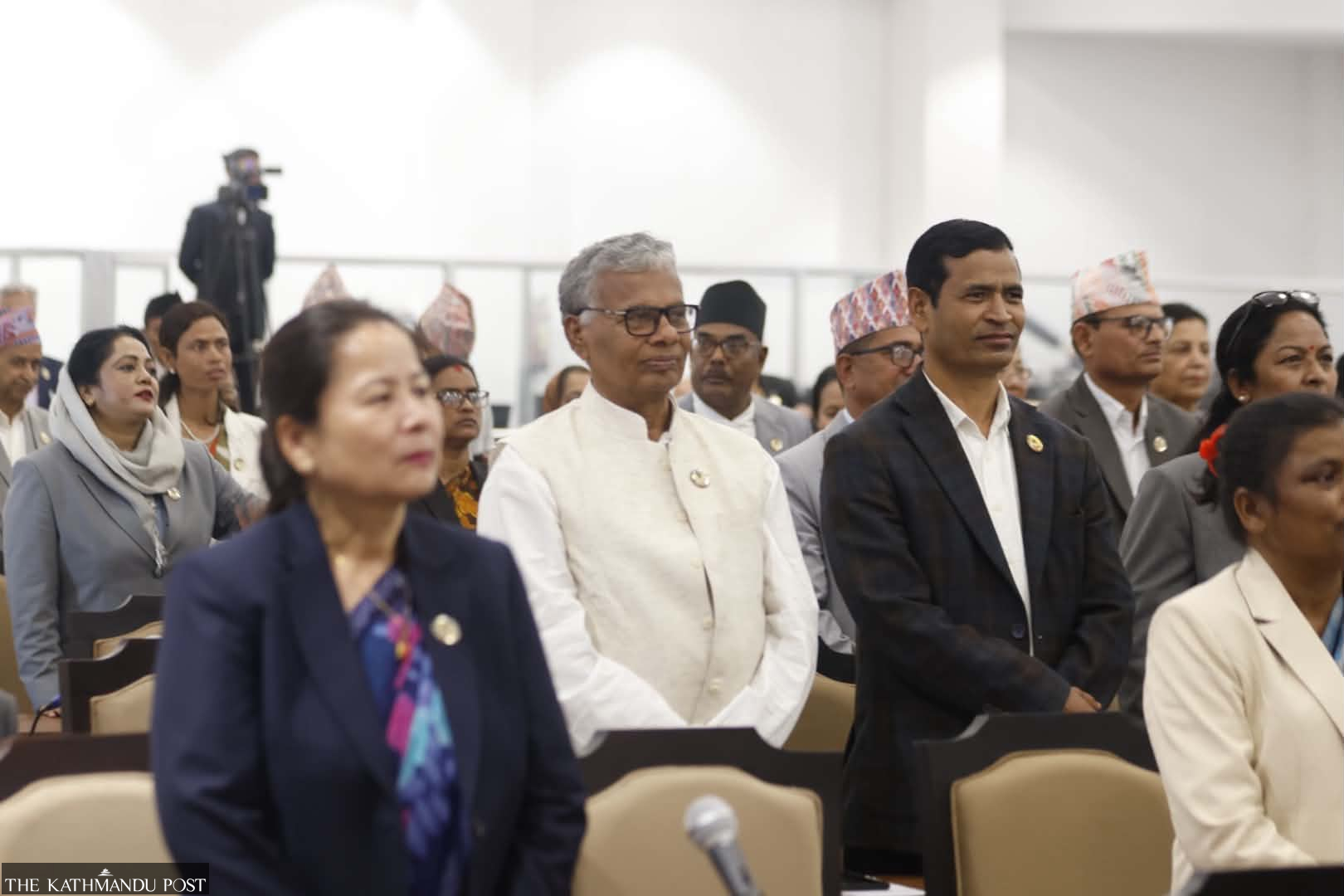
As soon as Wednesday’s House session moved into the agenda for debate on the policy and programme, opposition lawmakers demanded the prime minister’s presence. Members of the opposition parties — including the Nepali Congress, CPN-UML, Nepali Communist Party, Shram Sanskriti Party and Rastriya Prajatantra Party — stood in protest demanding mandatory attendance by the prime minister.
Leader of the main opposition Bhishmaraj Angdembe repeatedly urged the Speaker to direct Shah to attend the discussion and answer lawmakers’ questions. Similar demands were made by UML Chief Whip Ain Bahadur Mahar and CPN Chief Whip Yubaraj Dulal.
“I want to request the Speaker that the prime minister’s presence is a must. These are the policies and programmes designed by the government itself. Their political future depends on its success,” Angdembe said. “Why is it difficult for him to appear, express his views and answer questions? The Speaker should issue a ruling. We allowed the proposal to be tabled out of respect for both the prime minister and the Speaker, but he must attend the discussion.”
Speaker Aryal, however, refused to issue such a ruling, arguing that the House Regulations, 2022, do not explicitly require the prime minister to personally attend and respond during discussions on the policy and programme.
Ignoring repeated objections from opposition parties and demands for a ruling, Speaker Aryal adjourned the House session until 11 am Thursday. Wednesday’s sitting, which resumed for the third time after repeated disruptions, lasted only 14 minutes before being adjourned.
Harkaraj Rai, chairperson of the Shram Sanskriti Party, argued that the prime minister must be present in Parliament. Even after the Speaker denied him the microphone, Rai continued shouting in protest.
“The prime minister should resign. What kind of government functions without the prime minister? Are we simply supposed to accept whatever he says? Does this country belong to him alone?” Rai shouted, directing his anger at the Speaker as well. “Run Parliament according to procedure. If there is no prime minister in this country, then say so openly. Otherwise, ensure his mandatory attendance. Can there be a prime minister who never once addresses the nation or Parliament?”
Rai later walked out of the House session, along with all lawmakers from the Shram Sanskriti Party. Outside Parliament, the party’s chief whip, Aren Rai, said: “The prime minister prepared the policy and programme, and the President merely read it out. But now the prime minister has not come. Today, he should have answered all lawmakers, because responding to lawmakers means responding to the people. A prime minister who runs away from accountability sends the message that he is unfit to govern.”
The Shah government has already faced criticism and controversy over several recent decisions. Parliament has repeatedly raised concerns about the eviction of squatters from various parts of the country, including the Kathmandu Valley, without proper planning or alternatives. Informal settlers living along Kathmandu’s riverbanks were removed using security forces and bulldozers. Displaced families are now staying in temporary holding shelters, which lawmakers say lack proper living conditions and educational arrangements for children.
Shah has also been criticised over the recommendation for the chief justice. Instead of recommending the senior-most and acting Chief Justice Sapana Pradhan Malla, the Constitutional Council recommended fourth-ranked Justice Manoj Kumar Sharma. Critics have accused the prime minister of attempting to interfere in the judiciary through the decision.
The move to bypass judicial seniority and recommend a junior judge for chief justice has deeply unsettled the judiciary and the Nepal Bar Association. Acting Chief Justice Malla even publicly questioned whether the decision was intended to increase executive interference in the judiciary.
Analysts say it is worrying that the government appears to be provoking confrontation with the judiciary — one pillar of Nepal’s democratic system — while simultaneously avoiding accountability before Parliament, another constitutional institution.
Experts have expressed concern over what they see as the executive branch of the democratic system creating a “tussle” with the judiciary on one side, while also appearing unwilling to remain accountable to the legislature on the other.
Constitutional expert and senior advocate Bhimarjun Acharya said that a prime minister’s accountability to Parliament and adherence to parliamentary values are not optional but mandatory.
“It is unfortunate that the prime minister is not accountable to Parliament. A key feature of our parliamentary system is accountability. Since the prime minister is born in Parliament, he must be accountable to it. The prime minister does not have the luxury of saying he will not give answers,” Acharya said. “The policy and programme belong to the government, and the prime minister leads it. Walking out while the policy and programme is being read and refusing to respond is unusual and also disrespectful to Parliament.”
Acharya added that it is abnormal for the prime minister not to attend the debate on the policy and programme.
“In the entire history of parliamentary systems, such an incident may never have occurred. Let the 1950s era not be repeated. At that time, the Nepali Congress had received a two-thirds majority from the people, but internal conflicts and arrogance prevented it from being sustained,” he said.
Gen Z campaigner Rakshya Bam said Shah’s conduct raises concerns about weakening democracy.
“The prime minister’s actions appear suspiciously aimed at weakening democracy. His supporters keep defending him by saying his intentions are good, but this reflects authoritarian tendencies — an ‘I am the state’ mentality. That leads nowhere,” Bam said. “If you are in a parliamentary system but refuse to respect parliament itself, either the prime minister thinks he knows everything or understands nothing.”
She also urged RSP lawmakers to speak up if they want to protect democracy. “If the prime minister cannot govern properly, RSP lawmakers have the authority to challenge him. They reached parliament with a public mandate, just like Balen did. They should question him, challenge him and say, ‘If you won’t answer, we will.’”
Gyan Bahadur Shahi, RPP parliamentary party leader, recalled that the RSP itself had demanded mandatory prime ministerial attendance in Parliament during the previous House.
“The prime minister is sitting in Singha Durbar wearing dark glasses while we are in Parliament demanding answers,” Shahi said. He added that Shah should either declare that he is not a prime minister elected through Parliament or attend Parliament as required.
After criticism over Shah’s walkout during Monday’s presentation of the policy and programme, there had been widespread discussion on Tuesday about whether he would attend and address Wednesday’s House meeting. Routine of Nepal Banda, a social media platform considered close to Shah, even posted on Wednesday morning that “Prime Minister Balen Shah will respond to questions raised on the policy and programme in today’s House meeting.”
Prime Minister Shah arrived at his Singha Durbar office before 9 am on Wednesday and chaired a Cabinet meeting at 11 am. Even after the Cabinet meeting ended, he continued participating in meetings at the Prime Minister’s Office throughout the day. His official vehicle remained parked there. The prime minister had already left Singha Durbar for his residence in Baluwatar by the time the lower house meeting was adjourned at 5.30 pm.
RSP Chief Whip Kabindra Burlakoti argued that parliamentary regulations do not require the prime minister’s presence.
“The rules do not say the prime minister himself must attend. He can authorise a minister,” Burlakoti said. “Unless people merely want to see the prime minister’s face, the discussion should move forward once the proposal has been tabled.”
He also dismissed the opposition’s demand as unnecessary.
“The public has sent us here with huge expectations. Parliament should not be obstructed over such unnecessary issues. Which rule says the prime minister himself must come? We did not come here merely to follow old practices and emotions. We came to break with old traditions and create new ones,” he said.
RSP lawmakers have also defended Shah over criticism surrounding his exit from Monday’s parliamentary session. RSP lawmaker Rajani Shrestha said during Tuesday’s House meeting: “The criticism directed at our respected prime minister yesterday should stop.”
Like Burlakoti, other RSP lawmakers also defended the prime minister’s absence and accused opposition parties of unnecessarily obstructing Parliament while insisting that the Speaker had acted impartially.
“Whatever the prime minister did was within the House regulations and nothing beyond that,” said Ranju Darshana. “Even after the Speaker suspended the meeting, called them for discussion and proposed moving ahead with the policy and programme while promising to consult the prime minister about his future role, the opposition continued protesting simply for the sake of protest.”
But analysts warn that not every attempt to break conventions and create something new leads to positive change. In some cases, they say, it can endanger democracy itself.
Former lawmaker and senior advocate Khimlal Devkota said that, in a republican system as well, parliamentary leadership should be exercised by the head of the government, not only by the prime minister.
“The responsibility to respond to questions on the policy and programme document and to ensure its passage also lies with the prime minister. Questions on the budget are answered by the finance minister. Queries on the policy and programme document and the President’s address cannot be responded to by others. This is because if the policy and programme fail, the government fails. This is not a trivial matter. I have never seen such a serious issue being taken so lightly in parliamentary history,” Devkota said.
“Breaking with traditions and doing everything new does not mean walking on one’s head instead of one’s feet. Some practices must be allowed to evolve through established parliamentary practice,” he added.
Jaya Singh Mahara
Jaya Singh Mahara is a reporter with a decade of experience covering parliamentary affairs and political developments.

Most Read from Politics
Home Minister Sudan Gurung to visit India next week
Nepal’s climate diplomacy faces a test of delivery
Uproar in Nepal parliament over former chief justice’s unexplained detention
From the Himalayas to the islands, Nepal calls for a united climate response
Gagan Thapa wins Congress presidency with 94 percent of the vote
Editor's Picks

Constitutional Bench caught in seniority, ‘pick and choose’ dispute

A Dom boy’s long road to becoming a doctor

From blankets to handmade dolls, two foreign women bring comfort to flood survivors

News Analysis: When institutional defence exposes institutional fault lines

It’s a bird … it’s a plane … it’s the Indian ambassador’s farewell tweets
E-PAPER | October 11, 2026

×