Nepal ruling party lawmakers show no signs of holding their government to account
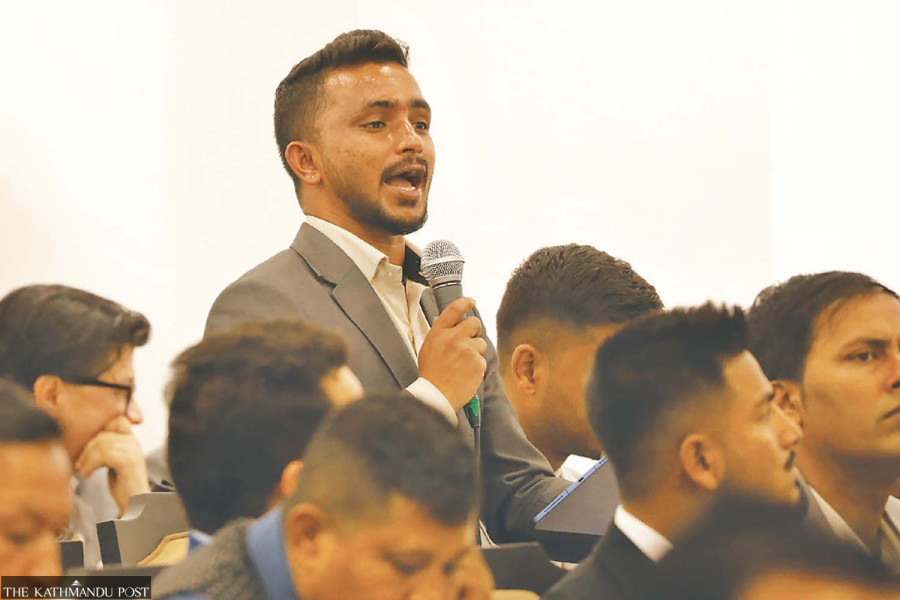
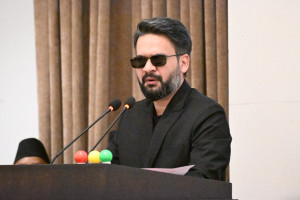
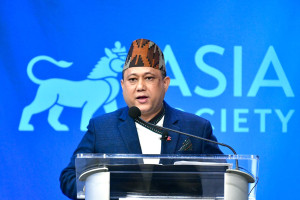
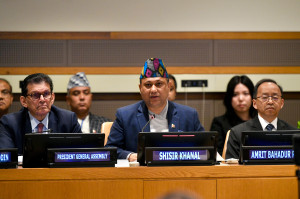
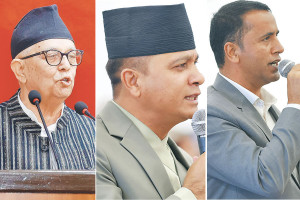
Once vocal critics from the opposition benches, RSP lawmakers are now facing questions over their silence on national issues. RSP lawmaker KP Khanal speaks in the House of Representatives in this recent photo. Hemanta Shrestha/TKP
On August 19, 2025, Rastriya Swatantra Party (RSP) lawmaker Ganesh Parajuli stood in the later-dissolved House of Representatives demanding a unified national position over the Lipulekh issue after India and China agreed to reopen the route for the Kailash Mansarovar pilgrimage without informing Nepal.
Calling the move a violation of Nepal’s sovereignty, Parajuli demanded that then-prime minister KP Sharma Oli address parliament and forge political consensus on the issue before his planned China visit.
“The agreement between India and China to use the Lipulekh route without Nepal’s involvement is against international law,” Parajuli said to make his case. “People are asking why the government is silent on such a sensitive issue. Parliament must arrive at a common national position.”
Eight months later, India’s Ministry of External Affairs announced on May 1 that the Kailash Mansarovar pilgrimage would resume in coordination with China. But when Parajuli, having been elected again in the March polls, addressed parliament on May 12, now as deputy leader of the ruling RSP parliamentary party, he did not mention Lipulekh.
Neither Parajuli nor other RSP lawmakers have raised the issue vocally in Parliament since the party came to power following the youth uprising of September last year.
The silence stands in sharp contrast to the party’s earlier parliamentary activism.
Beginning May 27, 2025, the RSP repeatedly obstructed House proceedings demanding a parliamentary or judicial probe into alleged involvement of then-home minister Ramesh Lekhak in a visit visa scam affecting outbound Nepalis. When then-Speaker Devraj Ghimire ignored the protests and continued House business from June 16, RSP lawmakers escalated their demonstrations by obstructing proceedings while wearing blue scarves from June 17 onwards.
At the time, Shyam Kumar Ghimire, then-chief whip of the Nepali Congress, accused the party of violating parliamentary decorum. RSP lawmakers occupied the well of the House, read books and newspapers, and shouted slogans demanding respect for parliamentary rules.
The political equation has now reversed.
The RSP currently leads the government with a near two-thirds majority. DP Aryal, who frequently joined protests in the well of the House after the 2022 elections, is now the Speaker. Despite continuous protests from opposition parties, Aryal has proceeded with the House business, passed bills and allowed the finance minister, rather than the prime minister, to respond to questions related to government policies and programmes.
During Thursday’s House meeting, lawmakers from the main opposition Nepali Congress protested from their seats, while members of the CPN-UML, the Nepali Communist Party, the Shram Sanskriti Party and the Rastriya Prajatantra Party entered the well.
Amid chants demanding enforcement of parliamentary rules and decorum, Speaker Aryal called Finance Minister Swarnim Wagle to present the proposal for the “Alternative Development Finance Mobilisation Bill, 2025”, which was subsequently endorsed by a majority vote.
The same day, Minister for Law, Justice and Parliamentary Affairs Sobita Gautam tabled proposals on behalf of the prime minister to consider three other bills: the House of Representatives Member Election (First Amendment) Bill, the Electoral Roll (First Amendment) Bill and the National Forensic Science Laboratory (Establishment and Operation) Bill, 2024.
Although time had been allocated for theoretical discussions, opposition protests prevented deliberations.
The RSP, which once accused the previous Congress-UML coalition of bulldozing parliamentary business, is now facing similar criticism from the opposition.
Speaker Aryal also warned Shram Sanskriti Party lawmaker Harka Sampang Rai after he demanded a ruling directing the prime minister to appear in Parliament and answer lawmakers’ questions.
During the May 12 meeting, RSP lawmaker Manish Khanal raised a point of order, objecting to the remarks made by UML parliamentary party leader Ram Bahadur Thapa. Khanal sought to have Thapa’s speech removed from parliamentary records, arguing that several remarks were objectionable.
Under parliamentary rules, however, only specific unparliamentary words or phrases can be expunged.
These episodes reflect the increasingly tense atmosphere in the budget session of the House of Representatives, which began on May 11.
The RSP, which secured 21 seats within months of its formation in 2022, now commands 182 seats in the 275-member House.
Yet, during the first eight days (from May 11 to May 21) of the session, RSP lawmakers appeared reluctant to raise broader national issues during emergency, zero and special hours, instead largely focusing on constituency matters.
Gen Z activist Rakshya Bam said many RSP lawmakers appeared hesitant to challenge the government after they became the ruling power.
“RSP lawmakers seem to have stepped back from raising national issues,” Bam said. “They avoided speaking clearly on several matters, including the squatter issue and the ordinances. The silence appears linked either to the allure of power or fear of losing political privileges.”
Opposition parties, meanwhile, have adopted an aggressive strategy.
On May 13, House proceedings were adjourned twice after opposition lawmakers protested Prime Minister Balendra Shah’s absence during discussions on the government’s policies and programmes. During the third sitting, opposition parties boycotted proceedings and obstructed the House after the finance minister answered questions on behalf of the prime minister.
The first meeting on May 14 was also adjourned due to obstruction. On May 19, proceedings were halted because the finance minister was absent during pre-budget discussions. On May 21, the House was adjourned again after opposition parties demanded a question-and-answer session with the prime minister.
Speaker Aryal later met Prime Minister Shah, but the uncertainty over his parliamentary appearance persisted. During the second sitting on May 21, bills were passed despite opposition protests in the well of the House.
The next meeting has been scheduled for May 26.
The Shram Sanskriti Party introduced a new form of protest by displaying placards criticising the prime minister’s absence from Parliament.
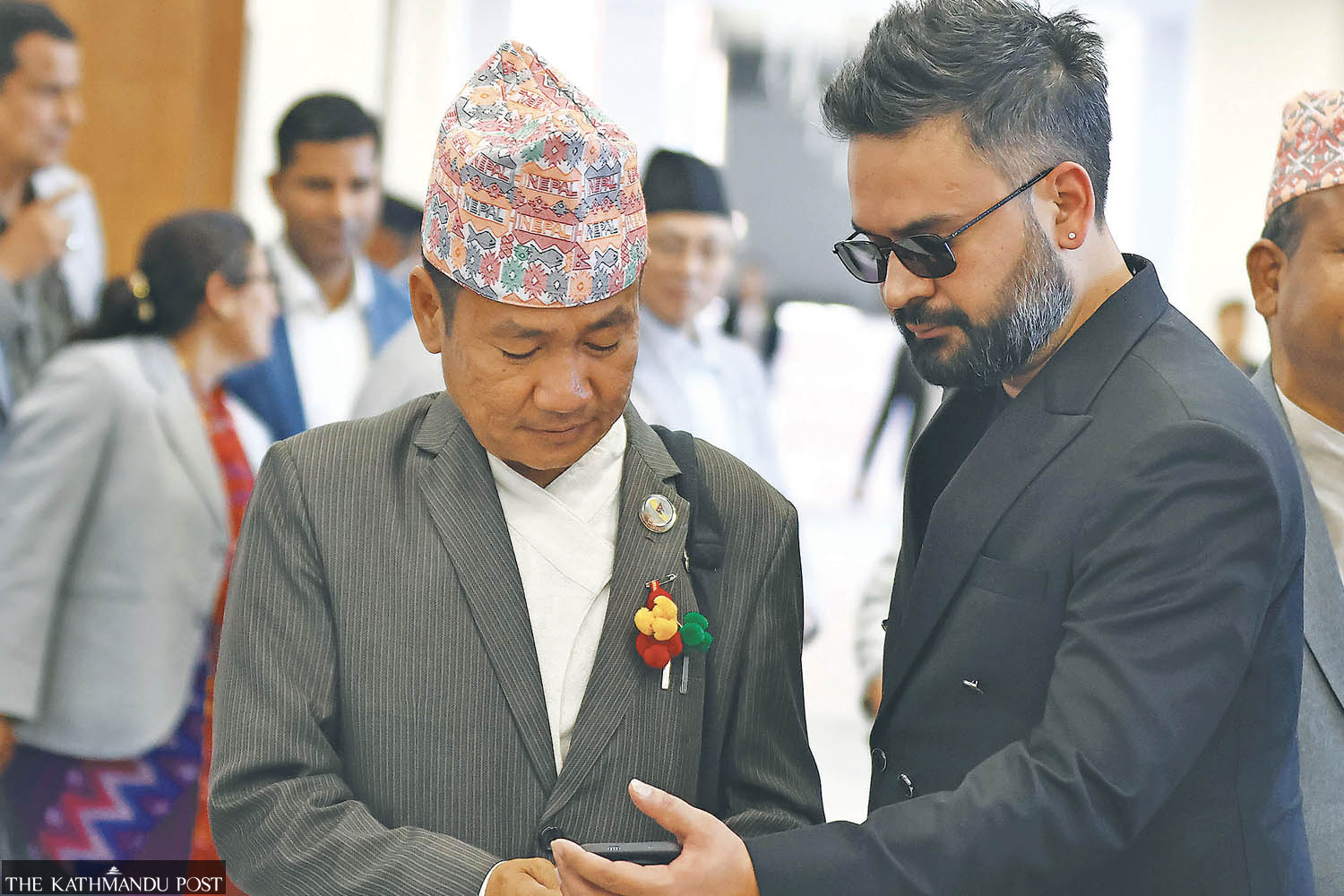
Prime Minister Balendra shah (right) and Shram Sanskriti Party leader Harka Raj Rai interact after a House meet at Singha Durbar last month. Hemanta Shrestha/TKP
Opposition parties have accused the government of avoiding accountability over issues ranging from the clearance of squatter settlements and controversial asset declarations by ministers to the case involving former home minister Sudan Gurung.
They have also criticised Prime Minister Shah for failing to respond to lawmakers’ questions on the government’s policies and programmes, recommending a chief justice while bypassing seniority, and proroguing parliament to issue ordinances.
RSP lawmakers, however, have mostly been silent on these national controversies.
Former lawmaker and senior advocate Khim Lal Devkota said the RSP risks adopting the same parliamentary culture that brought disrepute to the older parties.
“There is a deeply rooted tendency in Nepali politics to defend everything while in government and attack everything while in the opposition,” Devkota said. “People expected the RSP to create a different parliamentary culture, but that has not been seen so far.”
Former lawmaker and senior advocate Radheshyam Adhikari attributed the growing confrontation to the prime minister’s continued absence from Parliament and the Speaker’s reluctance to issue clear rulings.
“In a parliamentary system, the prime minister is accountable for the government’s policies and programmes,” Adhikari said. “Other ministers can table bills or perform administrative duties, but they cannot replace the prime minister when it comes to answering Parliament.”
He added that parliamentary rules grant the Speaker broad authority to direct the prime minister or ministers to appear in the House.
“Once someone occupies the Speaker’s chair, they must rise above party politics,” he said. “The Speaker has sufficient authority under parliamentary regulations to require the prime minister to appear.”
Speaker Aryal defended his handling of the House proceedings, arguing that obstructing legislation over political disputes would hamper governance.
“As Speaker, I believe opposition parties must be brought into dialogue and their rights respected,” Aryal told Kantipur. “But if the House is halted every time the opposition protests over external issues, the legislative process will suffer. The country urgently needs essential laws.”
He said opposition parties should use the Business Advisory Committee to raise concerns rather than disrupt proceedings.
“If the opposition shuns dialogue, the Speaker cannot keep Parliament indefinitely paralysed,” Aryal said.
RSP spokesperson and lawmaker Manish Jha argued that it was too early to judge the performance of either the government or parliamentarians.
“The House has not completed even ten sittings and the government is less than two months old,” Jha said. “Many RSP lawmakers are newcomers without long political careers. It will take time for the new political order to take shape.”
Likewise, RSP lawmaker Toshima Karki said ruling party lawmakers were raising concerns through parliamentary committees and internal channels.
“We have questioned ministers on national issues and sought commitments from them,” Karki said. “The government has not even completed 100 days. It is still responding to emerging challenges.”
Parajuli also defended the party, saying RSP lawmakers were engaging substantively rather than merely making speeches in Parliament.
“Instead of only discussing the squatter issue in Parliament, we also visited holding centres to understand the situation on the ground,” he said.
Despite such claims, critics say several RSP lawmakers appear unfamiliar with parliamentary traditions and procedures.
On May 12, lawmaker Sushant Vaidik demanded that references to “Hitler and gas chambers” made by an opposition member be removed from parliamentary records. The Speaker, however, did not act on the demand.
Rajendra Phuyal, former secretary of the National Assembly, said points of order must clearly identify which parliamentary rule has been violated.
“If remarks undermine parliamentary dignity or violate decorum, a point of order should be raised immediately with reference to the relevant rule,” Phuyal said. “There is always a public expectation that young and educated lawmakers will introduce a better parliamentary culture.”
Nepal’s parliamentary history contains several examples of remarks being expunged from official records. In 2019, then-Speaker Krishna Bahadur Mahara ordered the removal of the word “nimchharo”, meaning weak or feeble, after the prime minister of the day, KP Sharma Oli, used it during a parliamentary address.
Phuyal said concerns over language and decorum in Parliament remain unresolved.
“Parliament is a highly dignified institution, and public representatives are expected to maintain civility,” he said.
The government’s policies and programmes for the upcoming fiscal year were presented on the opening day of the budget session.
When the House reconvened on May 12, opposition lawmakers led by Nepali Congress Parliamentary Party leader Bhishma Raj Angdembe protested, accusing Prime Minister Shah of behaving in an “unparliamentary” manner during the President’s address.
While the prime minister faced criticism both inside and outside Parliament, RSP lawmakers largely avoided commenting on the issue. RSP lawmaker Rajani Shrestha instead defended the prime minister and objected to the criticism directed at him in Parliament.
Lawyer and Gen Z activist Arnab Chaudhary accused RSP lawmakers of acting more like government spokespersons than parliamentarians.
“Lawmakers are supposed to hold the government accountable, but many RSP members are defending it without even fully understanding the issues,” Chaudhary said. “They seem to forget that Parliament and the government are separate institutions.”
He said many RSP lawmakers spend most of their speaking time praising the government while barely addressing national concerns.
“Even during six-minute speeches, most of the time goes into defending the government,” Chaudhary said. “Their interventions on national issues appear weak and unclear.”
During emergency and zero hours, many RSP lawmakers focused mainly on local development demands and constituency issues.
Buddha Ratna Maharjan thanked voters and called for respect for the public mandate. Buddhi Prasad Panta criticised bulldozer-led demolitions in Birgunj. Bharat Prasad Parajuli demanded the reopening of the Arniko Highway and Tatopani customs point. Bhumika Shrestha called for greater representation of gender and sexual minorities in state institutions.
Other lawmakers raised concerns ranging from electricity shortages in Karnali and illegal river mining to river erosion, police custody deaths, industrial decline and budget allocations for local infrastructure.
Most interventions, however, were localised rather than addressing wider national political controversies.
Senior advocate Devkota said ruling party lawmakers should not treat parliamentary oversight as opposing the government.
“Whips should only apply to matters directly linked to the survival of the government, but in Nepal they are used far more broadly,” he said. “Lawmakers are elected to question, monitor and hold the executive accountable.”
Opposition to allow the budget presentation despite protests
Opposition parties demanding Prime Minister Shah’s appearance in Parliament have now adopted what they describe as a “wait-and-watch” approach.
Realising that the prime minister is unlikely to appear immediately and that the Speaker intends to continue House business despite protests, opposition parties have decided not to obstruct the presentation of the national budget.
The next House meeting is scheduled for May 26, while the Constitution requires the budget to be presented in a joint sitting on May 29.
Basana Thapa, chief whip of the main opposition Nepali Congress, said the party would continue demanding the prime minister’s appearance under Rule 56 of the House of Representatives Regulations.
“The prime minister must answer lawmakers during this session,” Thapa said. “But we are not in favour of obstructing the budget or the policies and programmes. These belong to the people, not just the government.”
Padma Aryal, deputy leader of the UML parliamentary party, said the opposition’s demand stemmed from the rule requiring the prime minister to appear once a month for a question-and-answer session.
“The issue is accountability to Parliament,” Aryal said. “The finance minister will present the budget on May 29, and the prime minister’s role there is not mandatory beyond attending.”
Yubaraj Dulal, chief whip of the Nepali Communist Party, said the opposition would seek a formal ruling compelling the prime minister to answer lawmakers’ questions.
Meanwhile, Shram Sanskriti Party whip Aaren Rai said the party would set its parliamentary strategy during a meeting on May 25.
Speaker Aryal confirmed that he met Prime Minister Shah on Thursday and said the prime minister had assured him of responding to lawmakers “at an appropriate time”.
Dialogue with the prime minister is ongoing, Aryal said. “Discussions will continue with both the ruling and opposition sides.”




 20.85°C Kathmandu