Monsoon threatens dengue surge as disease is already widespread across Nepal
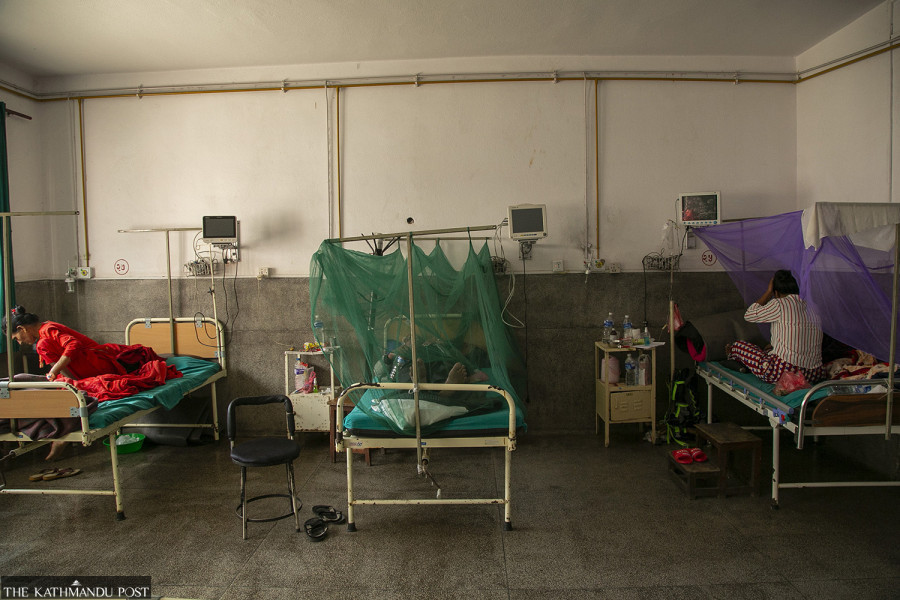
The mosquito-borne, potentially deadly disease has become endemic in Nepal. Over 900 infections have been reported since January in 68 districtsKathmandu, Jhapa, Chitwan, Kaski and Sankhuwasabha districts have reported the highest number of cases. Post file photo
The monsoon has yet to set in, but Nepal has already recorded over 900 dengue infections this year. The mosquito-borne disease has been reported in 68 of the country’s 77 districts.
What alarms health officials is that a high number of cases have been reported from densely populated areas, including the Kathmandu Valley, as well as Chitwan, Kaski, and Jhapa districts.
“Cases of dengue infection could surge after the monsoon rains start,” said Dr Gokarna Dahal, chief of Vector Control Section at the Epidemiology and Disease Control Division. “We have alerted health workers and other agencies concerned to the risk of a large-scale outbreak.”
Dengue is a viral disease transmitted by female Aedes aegypti and Aedes albopictus mosquitoes. According to the World Health Organisation, the same vectors also transmit chikungunya, yellow fever, and the Zika virus.
As the disease has already become endemic in the country, cases are reported throughout the year. Scores of people were infected even during the winter months. The disease control division’s data show 149 people were infected in January, 155 in February, and 152 in March.
In 2025, at least six people died, and around 9,000 were infected with the dengue virus. Entomologists say that the reported cases likely represent only a fraction of the actual number of infections, as around 90 percent of the infected people are asymptomatic, and many deaths and infections often go unreported.
All mountain districts except Humla had reported dengue virus infection. It was previously believed that dengue-spreading mosquitoes could not survive in very cold climates, and mountain districts faced little or no risk. However, the division’s data show otherwise.
This year also Sankhusabha, a mountain district, has also reported several cases. Officials say they have no immediate plans to study the causes behind the spread of the virus there, as several other mountain districts, including Mugu and Dolpa, have also reported infections.
“The coming days will be more challenging, as rainwater provides breeding grounds for dengue-spreading mosquitoes,” said Professor Murari Das, an entomologist at the BP Koirala Institute of Health Sciences in Dharan. “The time has come to launch an awareness drive against dengue and encourage people for behavioural changes.”
Experts warn that thousands of people could get infected if big cities turn into dengue hotspots. Multistorey buildings in densely populated cities also pose challenges, as it is difficult for authorities to monitor every corner of such buildings.
Dengue mosquitoes breed in clean stagnant water and bite during the daytime. Uncovered water tanks and discarded objects such as plastic cups, bottles and tyres can serve as breeding grounds.
Symptoms of dengue include mild to high fever, severe muscle pain, rashes, severe headache and pain behind the eyes. According to doctors, many people infected with dengue show mild symptoms, which do not need any treatment or can be managed with paracetamol at home, according to doctors.
While there is no specific cure for dengue, early detection and access to proper medical care on time can lower fatalities, doctors say. They urge people with symptoms to seek immediate treatment.
Nepal reported its first dengue case in a foreign visitor in Chitwan district in 2004. Since then, the country has recorded an increasing number of infections, including several major outbreaks.
Meanwhile, the Epidemiology and Disease Control Division said that it has been planning to carry out seroprevalence studies of the dengue virus to identify the strains currently circulating in Nepal.
There are five serotypes of dengue, numbered 1 through 5.
Nepal has reported four serotypes of dengue virus—DENV-1, DENV-2, DENV-3, DENV-4. In 2022, serotypes DENV-1, DENV-2, and DENV-3 were found responsible for the dengue epidemic.
“As the infection has been reported from almost every district, extensive study is needed to determine which serotypes are spreading,” said Dahal, chief of the Vector Control Section.
Arjun Poudel is a health reporter for The Kathmandu Post. Before joining the Post, he worked for Sagarmatha Television, Naya Patrika, Republica and The Himalayan Times.




 23.57°C Kathmandu