For Nepal’s maternity hospitals, this is the busiest time of year.
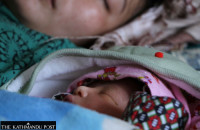
As many as 142 women gave birth through normal delivery at Thapathali-based Paropakar Maternity and Women’s Hospital on Tuesday, while another 42 delivered by caeserean section. On Wednesday 102 women had normal deliveries and 28 had caeserean section.
Both figures are more than double the hospital’s usual daily number of deliveries.
Doctors and health workers at the hospital say the rise is not unusual. Every year, from mid-June to mid-September, the delivery rate increases significantly.
“Come to our hospital to see the patient flow,” said Dr Shanti Shrestha, senior consultant gynaecologist and obstetrician at the hospital. “Deliveries have started, and we are very busy.”
Due to an increase in the number of pregnant women seeking delivery services, all beds at the hospital have been occupied, and the hospital administration has been accommodating two new mothers in a single bed.
“We can’t turn away women who are in labour,” said Dr Shree Prasad Adhikari, director at the hospital. “Adjusting two patients in a single bed is not our choice, but an initiative we have taken to save the lives of new mothers and their babies.”
Doctors say the hospital sees a seasonal rise in deliveries from mid-June to mid-September, a period health workers call the delivery season. Normally, around 50 women give birth at the hospital each day. In recent weeks, however, daily deliveries have more than doubled on some days, and exceeded 90 on other days.
According to hospital data, 1,540 women gave birth in Baisakh (mid April-mid May), and 1,569 women in Jestha (mid May-mid June). The number increased to 1,880 in Asar (mid June-mid July). Similarly, in Chaitra (mid March-mid April), 1,452 women gave birth at the hospital.
In the month of Shrawan (mid-July to mid-August) of the last fiscal year, 2025-26, a total of 1,948 women gave birth at the hospital, while the number was 2,141 in the fiscal year 2024-025.
Adhikari said that his hospital has set up a separate observation ward to accommodate the growing number of patients.
“Women in early stages of labour or those who are not yet ready to deliver, sometimes have to share a bed,” said Adhikari. “Once labour progresses and they are ready to give birth, they are moved to the delivery room.”
The surge is not limited to Kathmandu. Hospitals in the districts are also seeing a rise in the number of women seeking delivery services.
At the Chitwan-based Bharatpur Hospital, for example, the number of deliveries has risen significantly in recent days.
“Normally, around 25 women used to seek delivery services in our hospital a day,” said Professor Sunil Mani Pokhrel, head of the gynaecology department of the hospital. “These days the number has risen to more than 40. We have been struggling to manage the beds.”
Doctors expect the number of deliveries to remain high until October. They link the seasonal rise with Nepal’s main wedding season (Mangsir, Magh, Falgun) or December through February).
Those who conceive in December usually give birth in August, those who conceive in January give birth in September, and those who conceive in February give birth in October.
“Apart from that, migrant workers, especially youths, who are abroad for employment return home during the festive season, especially Dashain and Tihar, which falls in October,” said Dr Pawan Sharma, a consultant gynaecologist. “Many couples conceive babies during this period. These days, many youths also return home planning to have a baby.”
Doctors say the chances of conception increases when young couples spend more time together and do not use contraceptives. The festive season, when people tend to relax and spend more time together, can therefore contribute to an increase in conceptions, they say.
Arjun Poudel is a health reporter for The Kathmandu Post. Before joining the Post, he worked for Sagarmatha Television, Naya Patrika, Republica and The Himalayan Times.




 24.58°C Kathmandu