



 12.97°C Kathmandu
Sun, Oct 11, 2026
Politics
Opposition demands Speaker compel PM to attend parliament
As parties demanded the Prime Minister Shah’s presence, Speaker cited a rule that allows him to delegate another minister.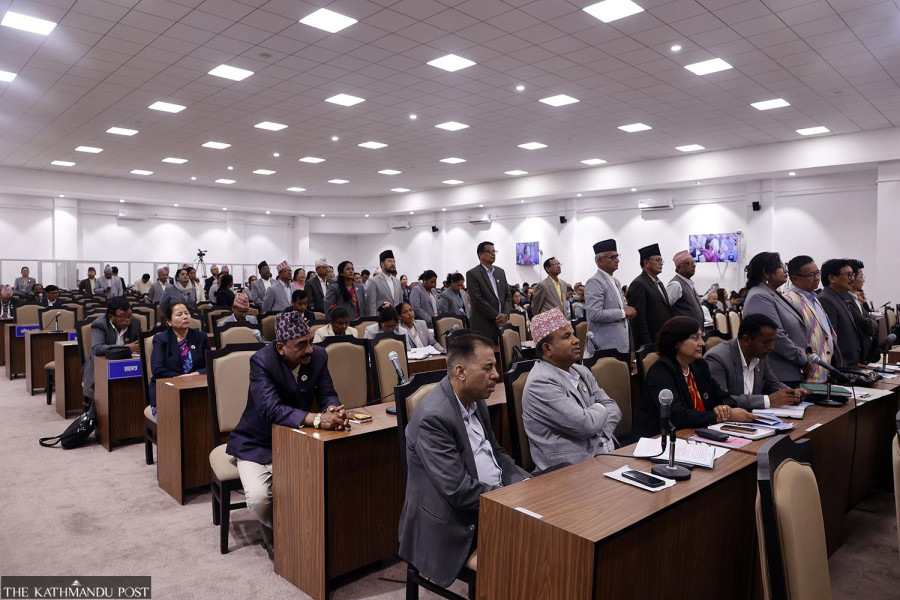
bookmark
Jaya Singh Mahara
Published at : May 15, 2026
Updated at : May 15, 2026 06:27
Kathmandu
A heated political dispute has erupted in the House of Representatives after Prime Minister Balendra Shah repeatedly skipped parliamentary deliberations on the government’s annual policies and programmes, prompting opposition parties and former parliamentary officials to demand that Speaker Dol Prasad Aryal issue a ruling compelling him to attend the House.
The controversy began after Shah authorised Finance Minister Swarnim Wagle to respond to lawmakers during debate on the government’s agenda for the upcoming fiscal year. Opposition parties argued that the prime minister himself must be present because the policy document represents the government’s central political and administrative agenda for the coming year.
Speaker Aryal, however, allowed the debate to proceed, citing Rule 38 of the House of Representatives Regulations 2022, which permits the prime minister to designate another minister in his absence. The issue has since paralysed several parliamentary meetings, with opposition lawmakers repeatedly obstructing proceedings and accusing the government of weakening parliamentary accountability. However, Thursday's sitting of the houses endorsed the government’s policies and programmes amid reservations by opposition lawmakers.
Experts on parliamentary affairs said the prime minister’s refusal to attend Parliament and participate in deliberations on the government’s policies and programmes, as well as his unwillingness to respond to lawmakers, amounted to a devaluation of the parliamentary system and warranted a ruling from the Speaker. They also said the Speaker must fulfil his institutional role and uphold established parliamentary practice.
Surya Kiran Gurung, former general secretary of the parliamentary secretariat, said Nepal’s parliamentary practice since the restoration of democracy in 1990 had never witnessed a prime minister remaining absent throughout deliberations on the government’s policy document.
“Until now, there has never been a situation where the prime minister remained absent during discussions on the policies and programmes,” said Gurung. “The prime minister usually attends the debate even if ministers remain in the House later. This time, the prime minister appears to have completely ignored Parliament. In such circumstances, the Speaker can issue a ruling asking the prime minister to attend.”
Gurung said the Speaker could even pave the way for a motion of regret if the prime minister continued to ignore parliamentary directives. He argued that the constitution explicitly requires the prime minister and ministers to remain accountable to the federal parliament.
Article 76(10) of the constitution states that the prime minister and ministers are collectively accountable to the federal parliament, while individual ministers remain accountable both to the prime minister and the parliament for the work of their ministries.
Opposition leaders repeatedly invoked the constitutional provision in the parliament. Bhishmaraj Angdembe, parliamentary party leader of the main opposition in the House, urged the Speaker to use his authority to ensure the prime minister’s presence.
“This is a matter of parliamentary dignity,” said Angdembe. “The policies and programmes determine the future direction of the government. What difficulty prevents the prime minister from coming to parliament, listening to concerns and responding to lawmakers?”
Nepal’s new House, formed after the March 5 elections, is currently functioning under the House Regulations 2022 until a revised rulebook is endorsed. The ruling party has relied heavily on Rule 38, which states that the Speaker may consult either the prime minister or a minister designated by him while scheduling discussions on the President’s address and the government’s policies and programmes.
The same provision allows the designated minister to answer questions raised during the debate. The ruling party leaders argue that the rule clearly permits the prime minister’s absence and that the opposition is hatching unnecessary controversy.
Speaker Aryal defended his position by saying he lacked the authority to dictate the movements of elected representatives, including the prime minister.
“You are asking me to guarantee the prime minister’s presence,” Aryal told lawmakers. “I don’t see any constitutional or legal basis allowing the Speaker to determine whether any member, including the prime minister, can attend the House on a particular day.”
His remarks were applauded by lawmakers from the ruling Rastriya Swatantra Party. Yet the opposition accused the Speaker of failing to protect parliamentary norms and behaving in a partisan manner.
Former Speaker Taranath Ranabhat said a prime minister has a moral and constitutional obligation to attend the parliament except in extraordinary circumstances.
“The prime minister is the leader of the House. He cannot ignore Parliament or avoid accountability," said Ranabhat. "International parliamentary practice, constitutional values and democratic norms all require the prime minister to face the House.”
Ranabhat also warned that the Speaker must rise above party loyalties once elected to the chair. “The Speaker is the guardian of Parliament,” he said. “The dignity of the office depends on protecting constitutional practice and parliamentary decorum.”
Opposition lawmakers intensified pressure on Wednesday after Speaker Aryal allowed ruling party lawmakers to counter opposition criticism inside the chamber. Leaders from the Nepali Congress and other opposition parties later met the Speaker privately and expressed dissatisfaction with his handling of proceedings.
Congress lawmaker Arjun Narsingh KC warned that the opposition could boycott deliberations if the prime minister continued to stay away during the government’s response.
“The proposal may be tabled by another minister,” KC said, “but the response must come from the prime minister himself.”
Rastriya Prajatantra Party leader Gyan Bahadur Shahi said Parliament, not public rallies, is the proper forum for government accountability.
“If this is truly the people’s government, accountability must be sought in Parliament,” Shahi said. “What could possibly demand the prime minister’s attention more than an issue as important as the annual policies and programmes?”
The dispute has also revived wider concerns over the relationship between the executive and Parliament.
The confrontation in Parliament reflected growing frustration among lawmakers who argue that Parliament is increasingly being reduced to a ceremonial body despite constitutional provisions guaranteeing accountability.
Nepali Communist Party chief whip Yubaraj Dulal questioned whether Rule 38 could be interpreted so broadly that lawmakers might never hear directly from the prime minister during the government’s five-year tenure. He argued that the regulation was originally intended for exceptional situations, such as foreign visits, illness or emergencies, rather than routine political convenience.
Rastriya Swatantra Party joint general secretary Bipin Acharya, however, said the prime minister’s absence from Parliament marked a break from established practice. “If opposition lawmakers believe that the Right Honourable Prime Minister, while exercising the authority granted by the House of Representatives Regulations, has failed to remain accountable to the sovereign Parliament, they should also know that Rule 56 of the House regulations provides a legal mechanism to question the prime minister directly in parliament,” said Acharya.
“Without using that provision, can the opposition really claim to be accountable to the sovereign Parliament and the people by creating circumstances that force the House to be adjourned through activities outside of established procedure?” he said.
Meanwhile, CPN-UML lawmaker Rajendra Rai criticised the ruling party itself, saying its inability to persuade the prime minister to appear before Parliament exposed internal weakness in the party. He said repeated justifications from the ruling leaders had only deepened public doubts about the government’s commitment to parliamentary accountability.
Jaya Singh Mahara
Jaya Singh Mahara is a reporter with a decade of experience covering parliamentary affairs and political developments.

Most Read from Politics
Home Minister Sudan Gurung to visit India next week
Nepal’s climate diplomacy faces a test of delivery
Uproar in Nepal parliament over former chief justice’s unexplained detention
From the Himalayas to the islands, Nepal calls for a united climate response
Gagan Thapa wins Congress presidency with 94 percent of the vote
Editor's Picks

Constitutional Bench caught in seniority, ‘pick and choose’ dispute

A Dom boy’s long road to becoming a doctor

From blankets to handmade dolls, two foreign women bring comfort to flood survivors

News Analysis: When institutional defence exposes institutional fault lines

It’s a bird … it’s a plane … it’s the Indian ambassador’s farewell tweets
E-PAPER | October 11, 2026

×