In the freed Kamaiya’s (bonded labourer) settlement on the edge of the forest under the Cotton Development Board area in Bijayanagar of Barbardiya Rural Municipality, Bardiya, most houses are roofed with thatch, sprinkled amid a few structures of brick and cement. The concrete houses appear to be recently built while the thatched dwellings have clearly weathered the years.
On the rooftops of both old thatched homes and new concrete buildings, signs of the House of Representatives election scheduled for March 5 are unmistakable—party flags bearing electoral symbols flutter in the breeze. On some houses, as many as four different party flags have been tied to a single roof.
One thatched house displayed the flags of the Nepali Congress, Nepali Communist Party, Rastriya Swatantra Party (RSP) and Nagarik Unmukti Party. On the roof of a nearby concrete house, four CPN-UML flags had been fastened, while a young woman stood at the edge fixing an RSP flag beside them.
These contrasting flags atop the same homes in the freed Kamaiyas and landless squatters symbolise not only political competition but also the striking similarity in the agendas of parties vying for votes in Bardiya, a Tarai district of Lumbini Province.
Bardiya has two electoral constituencies for the House of Representatives. In Bardiya-1, 21 candidates are in the fray, while 15 candidates are contesting in Bardiya-2. Constituency 1 has a total of 168,034 registered voters while Constituency 2 has 155,232.
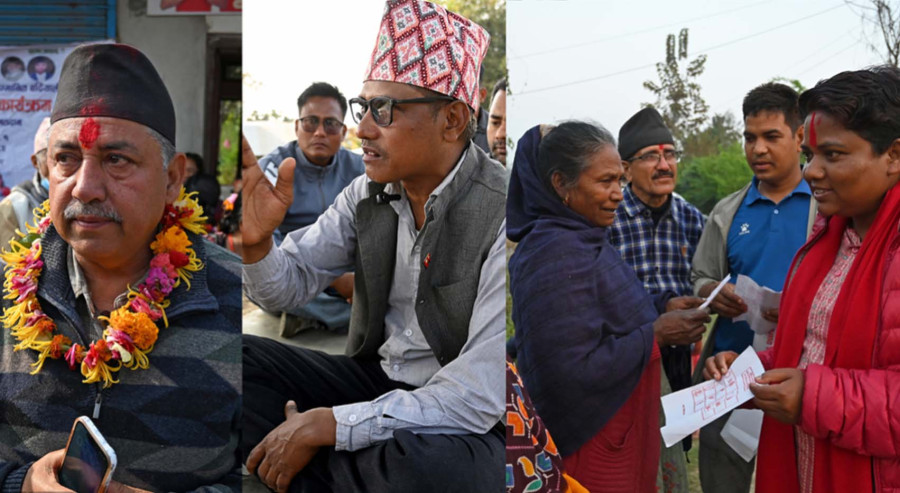
Despite the many contenders, the major candidates share largely overlapping agendas. Their campaign pledges centre on mitigating human-wildlife conflict, distributing land titles, constructing bridges and road infrastructure, opening a customs point with India, expanding health services and addressing other longstanding development concerns. By contrast, the core responsibility of a member of the House of Representatives, lawmaking, has become a secondary issue among voters.
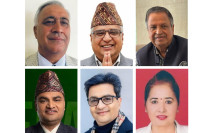
Nepali Congress candidate Sanjay Gautam, victorious in the 2013 Constituent Assembly election and the 2017 and 2022 parliamentary polls, is campaigning as a “development-oriented leader”.
“Those were the foundations,” he told a gathering, referring to blacktopped roads, bridges and irrigation schemes initiated during his tenure. “Now is the time to build a mansion of prosperity.”
He promises fertiliser and seed supply, flood control and a durable solution to human-wildlife conflict. His six-point commitment includes irrigation expansion, technology-friendly education, agro-based industry, a managed customs point, improved hospitals and inclusive lawmaking.
UML’s Shalikram Adhikari echoes similar priorities. A former mayor of Bansgadhi Municipality elected in 2017, he says projects initiated during his mayoral stint must be completed at the federal level.
“The road connecting Rajanuwa to Karnali must be finished to drive home economic prosperity,” he said, highlighting the long-discussed Jabdighat bridge and border infrastructure as pillars of growth. “Human-wildlife conflict has become acute and must be addressed legally and administratively.”
Adhikari also lists landless settlers and freed bonded labourers among his top priorities.
Meanwhile, RSP candidate Thakur Singh Tharu, contesting for a second time, presents himself as a new-generation leader. “I am here as a new face,” he said. In his policy document for Bardiya’s transformation, he proposes smart fencing, sensors and early-warning systems along forest boundaries, with compensation for wildlife damage delivered digitally within 72 hours.
Tharu claims that he has entered the race as a new candidate under the RSP as the party he ran for in the 2022 election, along with its electoral symbol, is no longer active this time. He contested the 2022 polls as the candidate of Nagarak Unmukti Party, which has recently merged with Nepali Communist Party.
He vows to distribute land titles to temporary certificate holders and to upgrade Gulariya Hospital into a regional sickle-cell anaemia treatment and research centre offering free testing and data systems. He also promises digital service centres, free Wi-Fi zones and coding bootcamps to connect youth with global markets, alongside full operation of the Babai and Karnali irrigation schemes and revised tourism regulations ensuring local participation.
Bishnu Prasad Chaudhary, who was elected to the Constituent Assembly-I as the CPN (Maoist) candidate and once chaired the National Tharu Commission, also seeks to return to parliament. He argues that voters rarely discuss lawmaking and instead demand infrastructure. He promises relief from wildlife conflict, specialist doctors at the district hospital, health insurance expansion and reforms in governance and agriculture.
In Bardiya-2, Congress candidate Kishor Singh Rathor pledges to make Gulariya “better than Nepalgunj”, citing his role in major bridge works and the Postal Highway. He now promises a four-lane Gulariya-Rajapur road, customs infrastructure and an end to patients travelling to Nepalgunj for treatment. UML candidate Bimala BK has distributed a four-page commitment letter promising legal resolution of landlessness, integrated forest legislation, roads and bridges, student support packages and even helipads in every local unit.
Yet long-delayed projects cloud these pledges. The Babai Irrigation Project, listed as a national pride project, has been under construction for 33 years. It aims to irrigate 21,000 hectares of land in the east and 15,000 hectares in the west. Although around 72 percent progress is reported, funding gaps persist. Project chief Gopal Sharma said 34.5 km of the eastern main canal and 28 km in the west are complete, but further work depends on budget clearance.
Mangal Tharu, a farmer in Barbardiya-4, complains that even in irrigated zones, insufficient water disrupts paddy and wheat cultivation.
The Bheri Diversion Project, intended to serve Bardiya and Banke, stands roughly 60 percent complete. Another recurring demand is a transport management office in Gulariya. Without one, residents travel up to 80 km to Nepalgunj in Banke for licence renewals and vehicle registration.
“Every election they promise it, but nothing happens,” said Baburam Poudel, a local businessman. District traffic police estimate around 60,000 two-wheelers and 5,000 four-wheelers operate in Bardiya.
The business community is also frustrated. Devendra Pandey, president of the Gulariya Chamber of Commerce and Industry, said projects stall due to weak political follow-up and inadequate budget. “Tenders are opened without assured funds. Contractors mobilise advances elsewhere. Agreements were once signed to open six border points with India, but Bardiya’s never materialised,” he said.
For voters, daily survival outweighs high-sounding promises. “Fertiliser shortages hit us every planting season,” said Pramesh Yadav of Gulariya-7. “When the government fails to supply it, smuggling from India increases and we pay more.”
Sunita Chaudhary, a landless resident, lamented that temporary land certificates have not translated into ownership. “They promise land titles during elections, but we still have none,” she said.
Wildlife threats compound anxieties. Bharatmani Tharu of Balapur recounted how a leopard seriously injured his nine-year-old grandson while irrigating fields last spring. He asks for control of human-wildlife conflict and protection of people and their properties.
As campaign posters multiply and promises stretch from land titles to helipads, Bardiya’s electorate appears united in one demand: tangible delivery. Decades of unfinished irrigation canals, unbuilt bridges and unopened customs points have fostered deep scepticism.




 24.2°C Kathmandu