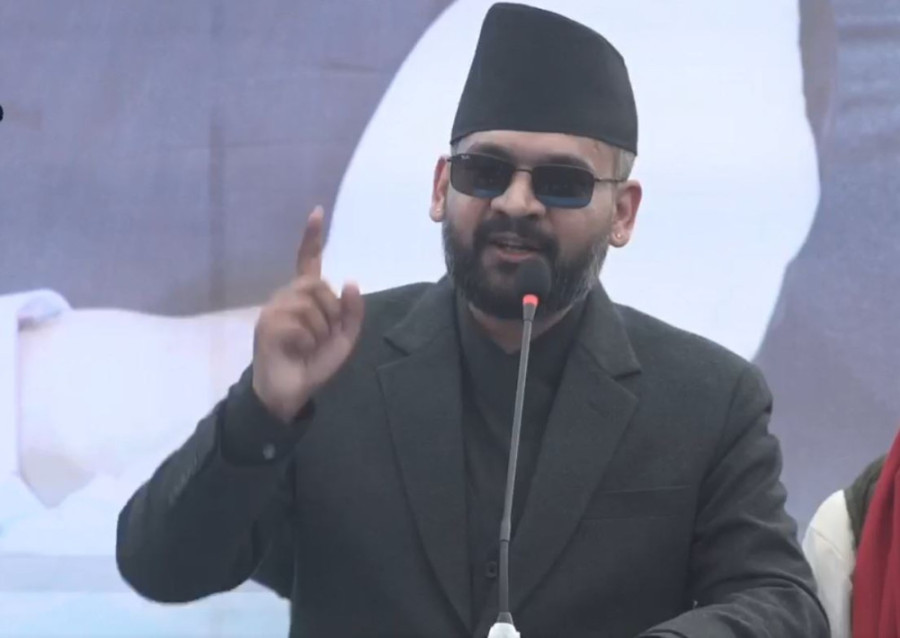
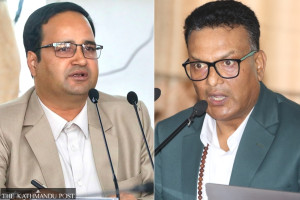
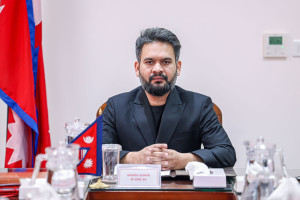
The multi-billion-rupee Damak Industrial Park in Jhapa, which was later renamed the Nepal-China Friendship Industrial Park, is in the spotlight after former Kathmandu mayor Balen Shah, who is contesting against CPN-UML chairman and former prime minister KP Oli, dropped it from his election manifesto released on Monday.
The project is part of the Belt and Road Initiative (BRI), an ambitious multi-continent infrastructure programme initiated by Chinese President Xi Jinping. In February 2021, Oli laid the foundation stone of the project in the district’s Kamal Rural Municipality.
The mega project falls within the Jhapa-5, Oli’s own electoral constituency, which has become the centre of attention both in and outside Nepal since Shah decided to challenge him there. Shah is a senior party leader of the Rastriya Swatantra Party and one of the most popular and well-followed Nepali youth leaders.
As the electoral battle heats up ahead of the March 5 election, both leaders have unveiled their respective plans if elected.
Oli has listed the construction and completion of the industrial park in his 41-point ‘commitment paper’ released last Tuesday and pledged to take initiatives to complete the project. Shah, however, omitted the project from his manifesto, which has raised questions.
“We know about the project and the controversy around it, so we decided to exclude it,” said one of Shah’s aides in a brief remark.
Shah, however, has promised to put the controversial Damak View Tower to use. The 18-storey tower, a flagship initiative launched by Oli, has remained idle for over 15 months despite being completed. Announced in 2019 as part of a national initiative to build view towers in every district, the Damak tower—located in Jhapa-5—was intended to be a highlight of the undertaking. Originally estimated to cost Rs1.38 billion, construction expenses rose to approximately Rs1.45 billion due to delays caused by the Covid pandemic. Situated in Dapgachhi village, about three km northwest of Damak Bazar, the tower sprawls over five bigha (3.39 hectares) of land.
During Oli’s China visit in December 2024, Nepal and China signed Framework for Belt and Road Cooperation and listed 10 projects including the Nepal-China Friendship Industrial Park.
“China-Nepal Friendship Industrial Park is a mega industrial park to be constructed in Damak, Jhapa as a gesture of true friendship between Nepal and China. The park is expected to promote the growth of industries in eastern Nepal and qualitatively enhance the economy and livelihood of the local people. The two sides have agreed on the Project Development Agreement of the Park Project,” said the statement issued after signing of the BRI framework agreement on December 4, 2024.
After Shah excluded the project, Govinda Thapa, who is the chair of the industrial park project, wrote a long comment on Facebook on Monday.
“It’s time to speak seriously about the industrial park. The delay in constructing the China-Nepal Friendship Industrial Park, which is to be built across a large area in Kamal, Damak, and Gauradaha in Jhapa, is widely understood to be due to foreign obstacles, not because of any issues within Nepal.”
“As this is a diplomatic matter, I have not been able to speak about it until now, but I now feel compelled to do so. When Chinese investment comes to Nepal, we, the people of Jhapa and the entire Nepali public, see no reason why any other country should object. The industrial park is intended to produce goods for the general public, not weapons or missiles. It is being built to provide excellent employment opportunities for thousands in this region, not to train soldiers. Therefore, we see no reason for other countries to object.”
As the project is located near Nepal-India border, particularly the sensitive Siliguri Corridor or the “chicken’s neck”—the narrow strip of land joining Northeast India with the rest of the country—government officials told the Post that there are external concerns, including from India.
“Why is the government of Nepal permitting the Chinese to build such a big project near the Nepal-India border, which has now become sensitive for multiple reasons?” two government officials privy to the development told the Post. “They [Indian officials] have been advising us not to permit the project if possible, and their anxieties are very much there.”
During an interview with the Post in April last year, former finance and foreign minister Prakash Sharan Mahat had articulated Indian anxieties and reservations over the project.
Responding to a query, Mahat said that India has become more sensitive following developments in Bangladesh, which likely heightened its awareness around the Siliguri Corridor.
“India doesn’t want any activities that raise security concerns for it along Nepal’s eastern border. Just as we’ve reassured China that Nepal’s territory won’t be used against them, we must also offer similar assurances to India. Without compromising our sovereignty, territorial integrity, and independence, we need to be mindful of their security sensitivities.”
When asked specifically about India’s sensitivity over the Siliguri Corridor, in relation to Nepal’s agreement with China to build an industrial park close to the corridor, in Damak, Mahat responded that India has not explicitly raised concerns nor officially said anything, but New Delhi could be concerned.
“If that’s the case, then we should ask ourselves—must the park be built in that precise location? If it could be relocated, said Mahat, there’s no objection from the Nepali people to Chinese investment in Nepal.
“And thus, there should be no reason for India to object either. However, if there is suspicion about other activities in that location, why create an environment that fuels doubt?” Mahat asked.
Thapa, on the other hand, stated that if an advanced and high-tech industrial park in South Asia is built in Jhapa, it will benefit all Nepalis.
“Why is the Rastritya Swatantra Party openly opposing such a project? The candidate for this region, Balen Shah, did not even mention the industrial park in his manifesto. They are campaigning to block Chinese investment in Nepal and have adopted the same policy in Jhapa. The people of Jhapa understand which foreign powers are opposing the park. Is it just a coincidence that Shah has adopted the same policies as those foreign powers? Definitely not,” Thapa wrote on Facebook.
“Allowing investments from certain countries while restricting Chinese investment, and bringing those countries’ military forces into Nepal under the guise of investment, is not in Nepal's best interest,” Thapa said, adding, “adopting such a policy would mean turning Nepal into a Ukraine.”
The government had entrusted the Office of the Investment Board Nepal (IBN) to carry out the project negotiations with the Chinese side. The 55th meeting of the IBN had formed a committee headed by Sushil Bhatta, IBN’s former CEO, to start negotiations with a Lhasa-based developer and prepare the final draft.
The Lhasa Economic and Technology Development Zone Jingping Joint Construction Company is the developer of the project, and both IBN and the Lhasa-based company were instructed to complete the project development agreement (PDA). The 47th meeting of the IBN had sanctioned Rs64 billion in investment from the Chinese company for the park’s construction.
According to a joint statement issued during the official visit of former Prime Minister Pushpa Kamal Dahal to China in September 2023, both the IBN and the Lhasa company agreed to accelerate negotiations and complete the signing of the PDA as soon as possible to commence construction and operations.
The envisioned industrial park is slated to span 2,200 bigha [1489.98 hectares] between the Ratuwa and Mawa rivers in Damak, Jhapa, encompassing regions within Kamal Rural Municipality, Damak Municipality, and Gauradaha Municipality.
The IBN has already approved foreign investment of over Rs64 billion to set up diverse industries including white goods manufacturing, transportation materials, textiles and garments, food processing, and electronic information technology products.
The project will be developed under the Public-Private Partnership (PPP) model and a total 26 companies have already committed to setting up operations in the park, with an additional 98 companies in various stages of consideration.
Anil Giri is a Chief Sub Editor covering diplomacy, international relations and national politics for The Kathmandu Post. Giri has been working as a journalist for more than two decades, contributing to numerous national and international media outlets.




 20.58°C Kathmandu