Balen’s presence may not be enough for RSP to do well in Madhesh
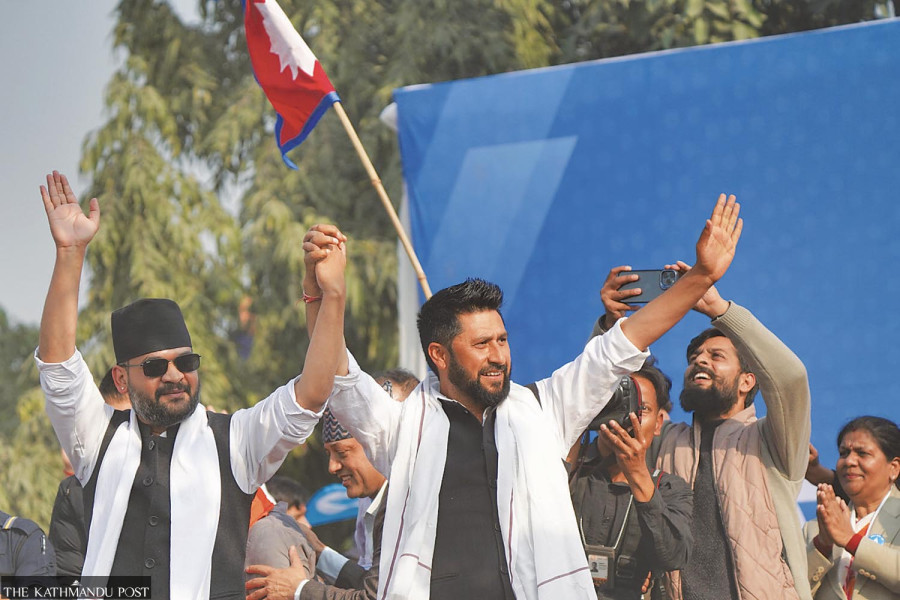
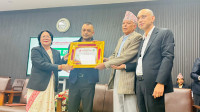
Province, keenly watched for steep competition among parties, is important for the high number of House seats it holds. RSP leaders Balen Shah (left) and Rabi Lamichhane at the party’s rally in Janakpur. Post file photo
Even as the Jhapa-5 constituency seems to be dominating the conversation around the March 5 House of Representatives election in anticipation of the face-off between heavyweights Balendra (Balen) Shah and KP Sharma Oli, Madhesh Province is a bigger and more crucial battleground for the number of parliamentary seats it offers—including for Shah’s Rastriya Swatantra Party (RSP).
With all major political parties, national and regional forces alike, trying to win as many of the 32 seats in the province, Madhesh as a whole has emerged as the central arena of electoral competition.
Gagan Kumar Thapa, president of the country’s oldest political party, the Nepali Congress, is running from Siraha-4. To show the importance the Congress attaches to Madhesh, its traditional bastion, the party will unveil its election manifesto in Janakpur on Wednesday.
The Congress’s earlier plan was to unveil its manifesto at the party headquarters in Sanepa on Monday.
Of the 165 first-past-the-post (FPTP) House seats, Madhesh Province’s share is second only to Bagmati Province’s 33. A province’s political significance is determined also by the number of voters, who factor in the 110 proportional representation seats.
Soon after resigning as Kathmandu mayor, Shah made his political debut through the RSP—which reckons it can emerge as the country’s largest party from the election—at a rally in Janakpur on January 19.
In order to give its campaign a boost, the RSP presented Balen Shah—who was born in Mahottari district and raised in Kathmandu—as its prime ministerial candidate. The posturing came despite the fact that during his three-and-a-half years as Kathmandu mayor, Shah did little to identify himself as a Madheshi.
Madhesh had remained the Congress stronghold until the 2008 Madhesh movement. Congress, by fielding its candidate from Sarlahi-4 and choosing Janakpur to unveil its manifesto, wants to appease voters in its one-time stronghold. The RSP, on the otherhand is eyeing the country’s most densely populated province, presenting Shah as the son of Madhesh.
Journalist and Madhesh politics analyst Roshan Janakpuri says that Madhesh-based parties had clear political agendas after the first Madhesh movement and during the second Madhesh movement (around the constitution’s promulgation in 2015). In this light, politics was easier for them in Madhesh compared to other parties.
However, Janakpuri argues that Madhesh-based parties are now in a spot of bother after being unable to fulfil the promises made to the public and becoming increasingly power-centric. With the regional parties’ agendas losing focus, national parties have placed greater emphasis on Madhesh to regain the territory they lost starting in 2008, he says.
It’s not just the 32 FPTP seats in the House that makes Madhesh politically significant, Janakpuri says. “With regional parties weakening, other political forces have turned their attention to Madhesh for the upcoming election.”
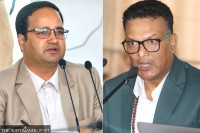
With elections only 18 days away, there is growing curiosity about the prospects in Madhesh of the RSP, because of Shah’s entry. However, Madhesh affairs analyst Chandrakishore says “this curiosity represents passing excitement rather than a deeper trust in the party”. But Chandrakishore does acknowledge that Madhesh is looking for a change.
He explains that people in Madhesh hold two different views of Shah’s election rallies. On the one hand, there is a belief that the assertive and confrontational style Balen has displayed on electoral roadshows is necessary to challenge established parties and the structures they have built.
On the other hand, some people are uncomfortable with what they call Shah’s “arrogance”. Chandrakishore says people did not respond positively when he failed to engage in conversation with voters from Madhesh and other regions who came to meet him on the campaign trail.
Chandrakishore believes that although there may be an undercurrent of support for the RSP in Madhesh, there will be many factors at play. Parties’ outreach is important particularly among those with limited voter education, he suggests. He argues that the RSP, which lacks a strong organisational base, “will find it difficult to compete with well-organised parties such as the Congress, the CPN-UML, and some Madhesh-based parties”.
Observers who have closely followed developments in Madhesh say that in some constituencies, RSP candidates are waiting for Balen Shah to visit their areas, believing that his presence could be their trump card.
As a result, “while it may seem that the RSP has electoral momentum in Madhesh, that is not actually the case on the ground,” according to Chandrakishore.
Sohan Shah, former vice-chair of the Madhes Province Policy and Planning Commission, claims that the wave in favour of the RSP seen during the party’s Janakpur rally, ahead of candidacy filing, has not been sustained.
Yet Shah believes that even if the RSP does not win many direct seats, it could still do better than other parties in the proportional representation election.
“The RSP is currently engaging in ‘noise politics’ in the province, while the Congress is presenting itself in a more mature and measured manner,” Shah said. “Likewise, if the UML manages to secure a consolidated vote base [cluster vote] similar to the previous election, its position will not be significantly weakened either.”
Broadly, Shah anticipates a four-way competition between the Congress, UML, the RSP, and Madhesh-based parties in the province.
Like Chandrakishore, Shah also argues that the RSP will find it difficult to get the expected results in the FPTP races in the province due to its weak organisational structure.
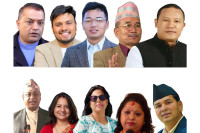
Notably, of the 32 direct seats in the province, 21 of the RSP’s candidates have previously contested elections for other parties, according to Shah. This makes it increasingly difficult for the RSP to market itself as an entirely ‘new’ political force.




 24.48°C Kathmandu