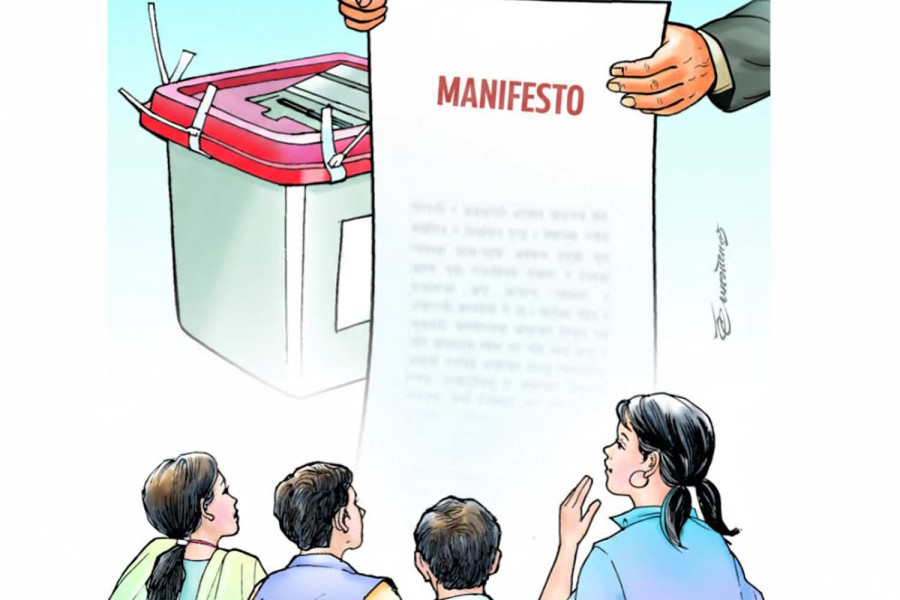
Three weeks before the House of Representatives election, Nepal’s political parties are unveiling their manifestos, with the Nepali Communist Party (NCP) releasing its ‘commitment document’ on Tuesday.
The Nepali Congress is preparing its electoral promises (pratiyaga patra) while other parties are also finalising their plans.
Likewise, the Rastriya Swatantra Party (RSP) says its ‘pledge document’ (bacha patra) will serve as a contract with the people, adding that there should be clear provisions for penalties if the promises are not fulfilled. The CPN-UML has yet to decide whether the report it plans to publish—incorporating the party’s electoral promises—will be called a manifesto or it will be given another name.
Political analysts say that while parties may use different names instead of calling their documents manifestos, making it easier to distinguish one party’s document from another, what ultimately matters is the agenda political parties present in them.
They note that these papers—whatever their name—later become the basis for questioning political parties about their performance. For example, parties can be held accountable for the economic growth targets they promise in their manifestos should they form a government after election.
Sociologist and political analyst Uddhab Pyakurel says that in Nepal, even parties that have no clear prospect of reaching government often publish manifestos promising what they would do if they came to power. This, in his view, reflects a largely ritualistic approach to manifesto-making.
“During their election campaigns, when political parties reach out to people at their doorsteps, two questions should not be overlooked,” Pyakurel told the Post. “What role will the candidate fulfil as a lawmaker? And, if their party comes to power, what will be the government’s main priorities?”
Pyakurel believes that since voters have stopped using party manifestos as a basis to question political leaders, candidates such as Balen Shah, the former mayor of Kathmandu Metropolitan City, have been able to campaign without presenting a clear agenda.
A party manifesto represents the institutional position of the party. However, analysts say that in the upcoming election, Nepali politics appears to be moving increasingly towards personality-centred leadership.
As major parties project particular individuals as their prime ministerial candidates, questions can be raised about the influence of such institutional documents.
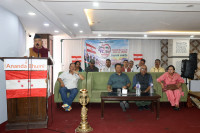
The NCP’s commitment paper, unveiled on Tuesday at the party headquarters in Perisdanda, Kathmandu, prioritises several key agendas. These include ending linguistic discrimination and allowing “a hundred flowers to bloom”, developing a self-reliant national economy, practising socialism right from local level, and advancing socialism with Nepali characteristics.
The document also emphasises “quality service delivery to people’s doorsteps as the foundation of democratic governance”, while giving priority to good governance, transparency, and frugality as the basis for economic development and prosperity.
It further pledges to improve education and health infrastructure, promote entrepreneurship as a foundation of prosperity, support entrepreneurial families, and create jobs in every village and town, reaching households across the country.
The Congress is publishing its manifesto as ‘Vision–10’ in the next few days. Party spokesperson Devaraj Chalise said the document will reflect the country’s realities, and focus on good governance, development, and practical action plans.
Chalise added that the manifesto will go beyond aspirations, clearly outlining resources and methods for implementing plans. The party earlier collected suggestions from the districts, to be aligned with national priorities.
The manifesto will present practical programmes and speak for all citizens, regions, and communities, Chalise said. “It will also seek to address the youths’ concerns expressed during the September Gen Z uprising.”
UML Deputy General Secretary Lekhraj Bhatta says his party’s manifesto will prioritise addressing the problems the country is facing. Following the Gen Z movement, Nepali society has seen two clear divisions.
While one group supports the uprising, the UML interprets it as a conspiracy against the nation. Party Deputy General Secretary Bhatta says his party will highlight this issue prominently in its manifesto, alongside other key topics.
“In addition to economic development, good governance, and service delivery, the manifesto will focus on protecting national sovereignty and unity, using the destruction on the second day of the Gen Z movement, September 9, as a reference for the harm caused to the country,” Bhatta told the Post.
The RSP, on its official social media, has said it will first publish the “contract” document, followed by the pledge paper outlining its commitments in clear terms.
“We will clearly present our agenda to citizens and enter into a contract with them. We will promise only what we can deliver—and deliver what we promise,” the party says.
With only 22 days until the House of Representatives vote, the Election Commission has instructed political parties to publish their manifestos by February 15.
According to the commission’s timetable, official campaigning will begin on February 16, and all political parties are required to make their manifestos public a day in advance.
The parties must submit the manifestos to the Election Commission, while candidates are required to submit them to their respective election offices, as per Section 57 of the Political Parties Act, 2017.




 15.34°C Kathmandu