For ex-premier Deuba, Dadeldhura’s electoral landscape is changing
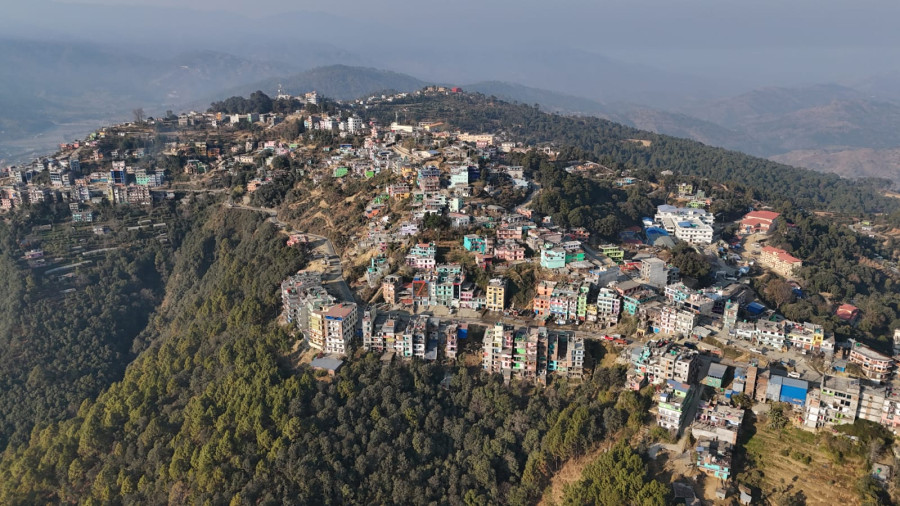
Voters in the Congress stronghold considering if it is time to send someone other than five-time PM to parliament. The district headquarters of Dadeldhura. Photo: Jagat Saud/KTV
With the Election Commission on Friday formally recognising the Gagan Thapa-led Nepali Congress as the legitimate party, an unusual stillness has gripped Dadeldhura, the home district and long-time electoral fortress of Sher Bahadur Deuba.
Tea shops and eateries that once buzzed with debates over Deuba, Thapa and the party’s future are quiet. Congress activists close to Deuba are reluctant to speak openly, their faces visibly downcast, as uncertainty grips a district that has for decades been synonymous with one man and one party’s symbol.
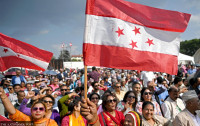
Among grassroots cadres, some questions dominate private conversations—will Deuba contest again with the Congress’ tree symbol and the four-star flag?
Will he fight from a different platform, or will he reconcile with the Thapa camp and return as the party’s official candidate?
Bhim Bahadur Saud, the Congress district president, has no clear answer. “I don’t know anything yet, and I don’t want to say anything,” he said, adding that there might be some clarity by Sunday.
For many long-serving Congress leaders in the district, a party split is painful. “Trying to separate Deuba from the Congress at what could be his final moments in politics is deeply distressing. He is a leader who has devoted his entire life to the party. Such leaders must be properly valued,” said Kailash Kumar Pandey, an area chair for the party.
Congress general convention representative Kalawati Devi Bohara shares similar sentiments. She warned any attempt to sideline Deuba in the name of generational change was unacceptable to Dadeldhura voters.
Yet beyond party offices, a different mood is slowly emerging. In villages and market centres, people speak less about internal Congress rivalries and more about roads, hospitals, jobs and the fatigue of voting for the same face—election after election.
With the government having already announced March 5 as the election date, leaving just over six weeks, Dadeldhura still lacks any visible festive atmosphere associated with an election campaign. Most aspiring candidates remain in Kathmandu, and local party offices are largely deserted.
In Ghatal, four kilometres from the district headquarters, octogenarian Ratan Singh Bista sat warming himself in the winter sun when asked about the coming election. A lifelong voter who has never missed a chance to cast a ballot, Bista said three generations in his family were ready to vote again. “I won’t stop voting but those who win never come back to listen to our problems,” said Bista, hinting that if a new face appeared, he would gladly consider it.
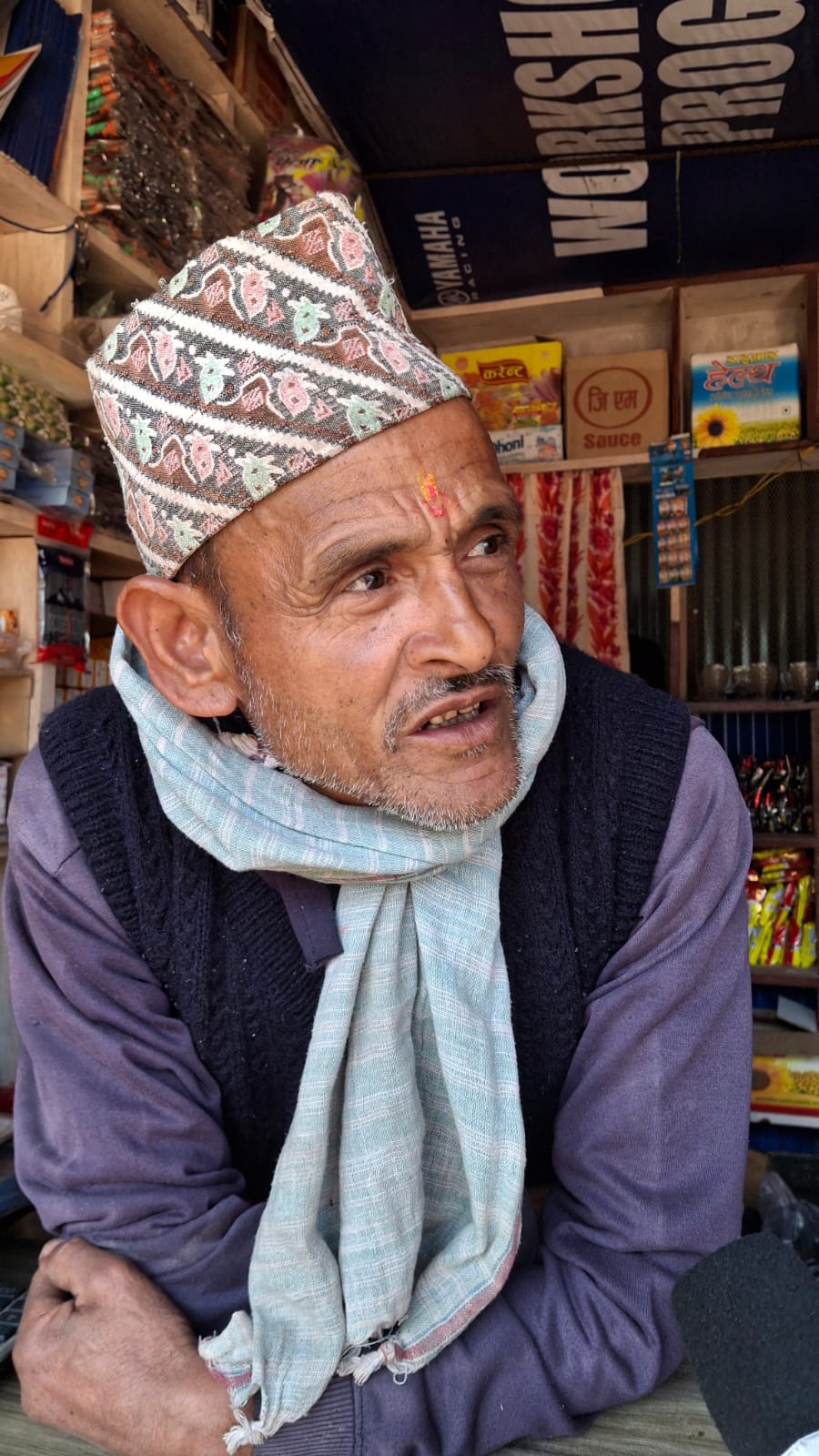
Chet Bahadur Bista, a voter in Amargadhi Photo: Jagat Saud/KTV
His son Chet Bahadur, who runs a small grocery shop, was even more blunt. “Whether we vote or not, the village remains the same. We are tired of seeing leaders tilt one way today and another tomorrow,” he said.
Like many in Dadeldhura, his frustration is all about poor infrastructure and livelihoods. Despite Deuba having won seven elections and preparing for an eighth, the Bhimdatta Highway linking Dadeldhura with Dhangadhi remains in poor condition. Villagers still migrate to India through the Parshuram border point in search of work.
Health care is another common grievance. Dadeldhura hosts a 300-bed federal hospital that serves seven hill districts of Sudurpaschim Province. Yet, according to hospital spokesperson Tanka Panta, none of the 19 approved posts of specialist doctors are permanently filled. Patients routinely spend hours travelling to Dhangadhi for even basic specialist care. “We have a federal hospital,” said local resident Tejraj Bohara, “but even for a minor injury or illness, we must go to Dhangadhi.”
Deuba, who has won elections from here seven times and has already served as prime minister five times, “should understand the problems of our district and come to our own villages to listen to us,” said Bohara, aged 40. “He has never done that. This time, we will be looking for a new candidate.”
Among younger voters, impatience is palpable. Twenty-five-year-old Ashok Tamrakar, chatting with friends near the Ugratara Temple, said he would not automatically follow his parents’ voting choice this time. “The older generation keeps voting for the same person. Our generation wants an option,” he said.
Such views are also common among first-time and urban youth voters, many of whom supported independent candidate Sagar Dhakal in 2022.
Not everyone agrees that replacing Deuba would automatically transform Dadeldhura. Deepak Mahatara, senior vice-president of the Dadeldhura Chamber of Commerce and Industry, cautioned against equating new parties with new outcomes.
“People think changing flags will change destiny. But when the same faces reappear under different banners, how does anything change?” said Mahatara. He pointed to improvements in local roads, irrigation, electricity and internet access over the years, while acknowledging that outmigration continues.
Political analysts see this tension as the defining feature of the coming elections. Professor Yuvraj Joshi of Dadeldhura Multiple Campus noted that dissatisfaction peaks before polling day but rarely alters final outcomes.
“Voters criticise the same candidate fiercely until the last moment,” he said. “Yet on election day, the familiar face often wins.”
According to Joshi, sympathy for Deuba remains strongest among voters over 60, while Gen Z voters are more inclined towards his alternatives.
Poverty remains a big problem in Dadeldhura, a hill district of Sudurpaschim Province. A recent report of the National Statistics Office shows that 33.26 percent of the district’s population lives below the poverty line. Local people complain that Deuba ignored the problem despite winning every election after the restoration of democracy in 1990.
Deuba’s supporters, however, argue that some promises have been fulfilled. Bhageshwar Rural Municipality chair Hemraj Chataut cited the establishment of a medical college, road blacktopping in several local units and ongoing construction of a multipurpose hall and a bus park. Sudurpaschim University officials confirm that health science programmes are expanding in Dadeldhura.
Electorally, Deuba’s dominance is undisputed. He won every parliamentary election from the district, sometimes by large margins, sometimes narrowly. In 2022, facing the independent Sagar Dhakal and rebel Congress leader Karna Malla, Deuba still secured victory, albeit by reduced margins. Deuba emerged victorious with 25,534 votes while his nearest rival Dhakal garnered 13,042 votes, while Malla got 7,535.
Once again, the contest is shaping up to be between Deuba and Dhakal. If Malla joins the Gagan Thapa-Bishwa Prakash Sharma group, this election could turn into a three-way race. This time, Dhakal is not contesting as an independent but entering the race as a candidate of the Rastriya Swatantra Party (RSP). However, several leaders from within the district have also expressed interest in securing the party’s ticket. Although the RSP has yet to formally decide its candidate, Dhakal, district party chair Surendra Awasthi and Provincial Assembly member Tara Joshi are among the aspirants.
“Yes, I will be contesting the election from Dadeldhura this time as well. I will be in Dadeldhura in the next few days to launch my campaign,” Dhakal told the Post. “I am in touch with the Dadeldhura Contact Committee in Kathmandu, and we are mobilising young people. We have already started work to create an election atmosphere. Although there is no official decision yet, I am almost sure to be the candidate.”
Dadeldhura has 93,403 registered voters, including 1,892 new ones enrolled after the announcement of March 5 elections.




 14.81°C Kathmandu