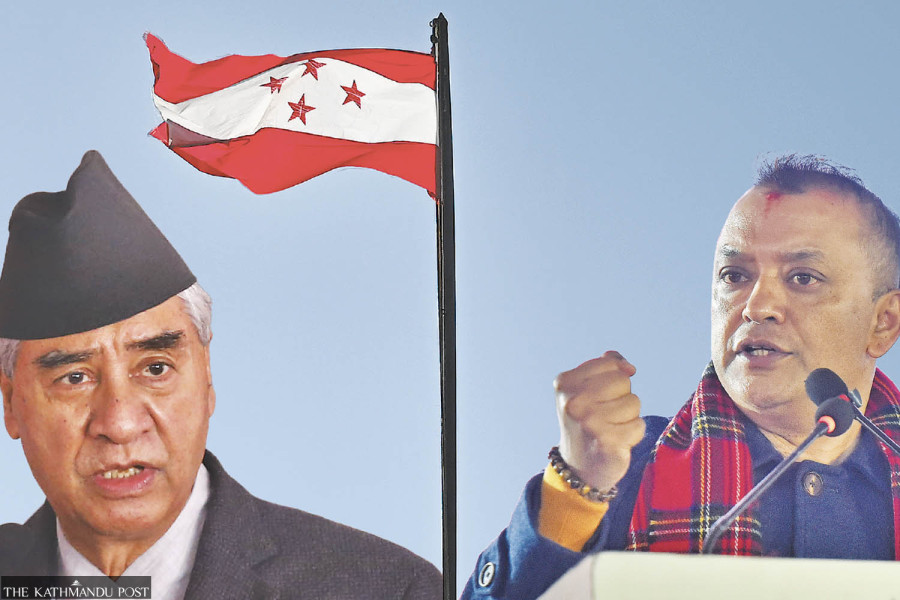
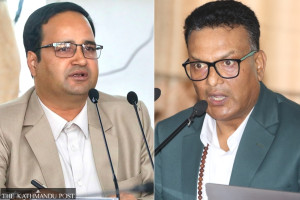
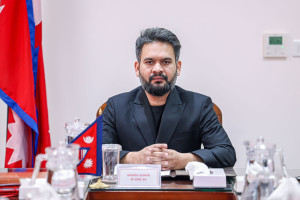
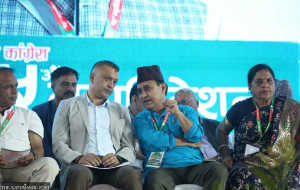
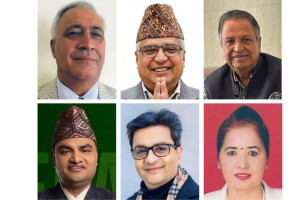
Third division in the party since 1950. March 5 elections could be affected. Both factions claim legitimacy from Election Commission. Sher Bahadur Deuba resisted the calls for reform proposed by the special general convention organising side led by Gagan Thapa (right), ultimately leading to a split in the Nepali Congress. Post Photos
Nepal’s grand old party, the Nepali Congress, has split for the third time since its formation in 1950.
The first split happened in 1953 due to the tussle between Bishweshwar Prasad Koirala and Matrika Prasad Koirala. The party split again in 2002, during the height of the Maoist insurgency, after then prime minister Sher Bahadur Deuba dissolved the House of Representatives, announced elections, and extended the state of emergency to quell the rebellion.
On Wednesday, the party split for a third time after an internal power struggle between the party president Deuba and two general secretaries—Gagan Thapa and Bishwa Prakash Sharma—reached a tipping point.
After 54 percent of elected representatives to the general convention demanded a special general convention and submitted a petition at the party office in Sanepa on October 15, the actual power struggle had begun, leading to the eventual party split ahead of the March elections.
When Deuba’s establishment faction had refused to call the special convention and convene the party’s 15th general convention ahead of March elections, Thapa and Sharma initiated the call themselves.
After repeated talks and efforts to find a “win-win” solution failed, Thapa and Sharma called for the special convention on Sunday to elect new party leadership. When backchannel negotiations, including a meeting between Deuba, Thapa and Sharma, collapsed on Wednesday, both sides decided to stick to their respective positions.
After Thapa and Sharma pressed ahead with the process to elect new leadership—reaching a point of no return—the Deuba faction called a meeting of the party’s central working committee on Wednesday to take action against them.
Sharma had sent an eight-point proposal to the committee, offering reconciliation if certain points, including Deuba stepping down, were addressed. However, out of five points considered, the central working committee declined three, including Deuba’s resignation. At the meeting chaired by acting party president Purna Bahadur Khadka, the committee decided to take disciplinary action against Thapa and Sharma, which included stripping them of their party membership.
With Thapa, Sharma and joint general secretary Farmullah Munsur removed from party membership for five years, Nepali Congress has split for the third time.
A new political and legal battle has also begun, and it casts doubt over the March 5 parliamentary elections.
The Thapa-Sharma camp has approached the Election Commission claiming that with the support of the majority of elected representatives, their special general convention grants them official party status. Meanwhile, the Deuba faction has also informed the commission of the central working committee’s decision to remove Thapa, Sharma and Mansoor.
Thapa has claimed that the central working committee led by Deuba has already been dissolved, so the committee’s decision is invalid.
Addressing the special general convention shortly after news of the “disciplinary action” against him became public, Thapa said that the election committee would now form a new central working committee. He stressed that the Congress is not someone’s “private company.”
Meanwhile, the special convention has begun the process of selecting Thapa as the new president. Supporters of the special convention had repeatedly demanded this, arguing that the party could not move forward under Deuba’s leadership.
Urging people not to worry about his and Sharma’s political future, Thapa said, “There is no need to be concerned about us. We are ready to take risks to bring reforms to the party.”
Thapa said that the party flag and the tree symbol would remain with the Nepali Congress, under the control of the central working committee to be formed by the special general convention. He added that the constitution and the law recognise the central working committee elected through the special general convention.
With both sides having approached the Election Commission—which is under pressure due to the March elections—any decision is likely to be challenged in the Supreme Court by the camp who fails to get the commission’s recognition.
“This special general convention has been held on the basis of faith in the constitution and the law. Whatever decision this special convention makes, the constitution will recognise it. The Election Commission will recognise it as well,” Thapa said while addressing the convention hall.
Likewise, General Secretary Sharma commented that this was the first time in his life he had faced disciplinary action. Reacting to the Deuba faction’s decision, Sharma claimed that he was punished for trying to run the Congress in line with changing times.
“What kind of action is this for a position I have already left?” he asked. “I haven’t held the post of general secretary since this morning, so there is no question of taking action [against me].”
He further claimed that, according to the party statute, BP Koirala had assumed leadership through a special general convention in 1950, and the current convention was being held with the aim of bringing about a similar change.
Political analyst Shri Krishna Anirudh Gautam said that a legal battle has begun inside Congress from Wednesday. “Each side will seek legitimacy,” he said. “Those who do not get recognition will go to court. So the process will linger and it can affect the March elections.”
He said he did not believe the Election Commission would resolve the Congress dispute within a week. The commission has fixed January 19 for filing nominations for the first-past-the-post election system.
Action but no clarification
Deuba’s central committee took the disciplinary action against Thapa, Sharma and Mansoor without completing the procedures mandated by the party statute. Prior to taking action, no one was given the opportunity to present a clarification or defense as required by the party statute.
The committee stated that the action was taken under Article 34(1) of the party statute, which pertains to disciplinary measures. Article 34 contains provisions related to discipline, listing four clauses that define what constitutes a breach of discipline.
According to the article, engaging in any activity contrary to the party’s ideals, principles, and policies; acting against the party’s statute or regulations; or violating the party’s code of conduct is considered a breach of discipline.
Similarly, standing as a candidate against the party’s official candidate or a candidate supported by the party, proposing or supporting such a candidate, or directly or indirectly opposing or failing to cooperate with the party’s candidate during an election is also deemed a disciplinary violation.
Likewise, causing direct or indirect harm or loss to the party, engaging in any activity, behavior, conduct, or expression that damages someone’s character, undermines personal or social dignity, harms reputation, spreads hatred or resentment, or adversely affects communal harmony is also considered a breach of discipline under the statute.
Anil Giri is a Chief Sub Editor covering diplomacy, international relations and national politics for The Kathmandu Post. Giri has been working as a journalist for more than two decades, contributing to numerous national and international media outlets.




 18.34°C Kathmandu