Convention turnout hints at leadership change in Congress
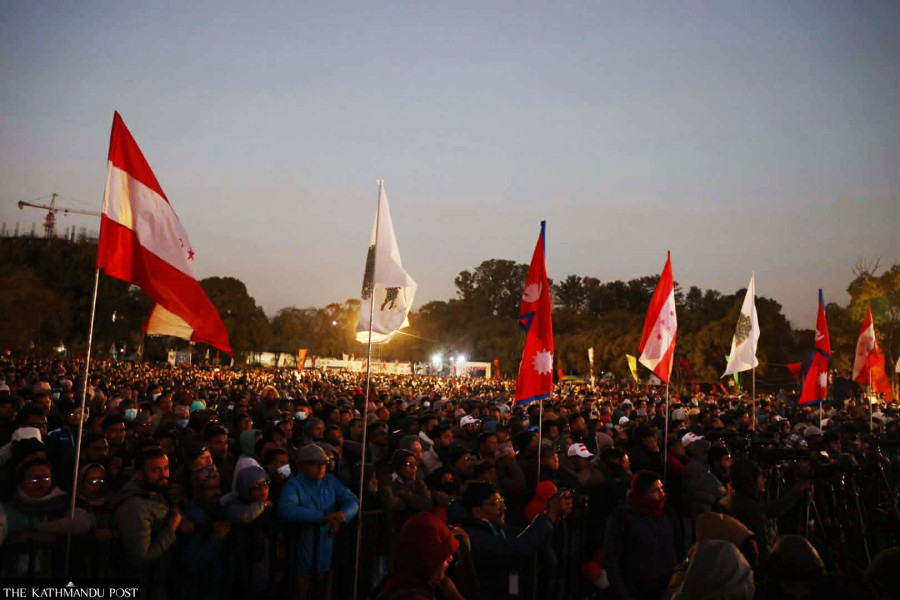
If organisers’ claim of over 56 percent general convention delegates is true, Deuba will be pushed into a minority. Participants of the Nepali Congress’ second special general convention pictured at Bhrikutimandap in Kathmandu on Sunday evening. Hemanta Shrestha/TKP
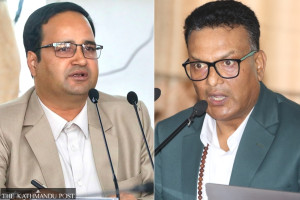
The special general convention called by Nepali Congress general secretaries Gagan Kumar Thapa and Bishwa Prakash Sharma in Kathmandu saw an enthusiastic participation of representatives on Sunday, the opening day.
While the turnout reflects the depth of support for the Conventionwithin the Congress, uncertainty still lingers over the party’s shape at the end of the special convention.
Following the Gen Z movement of September 8 and 9, Thapa and Sharma, backed by the signatures of a majority of the 14th general convention representatives, demanded organisational reforms and a special general convention. Their argument was that the party needed fundamental leadership transformation following the Gen Z uprising that ousted the Congress-UML government.
The group advocating a special general convention had asked for it in accordance with Article 17(2) of the party statute, submitting signatures of over 54 percent of the 14th general convention delegates. However, the party establishment continued to stonewall the demand, deepening the rift in the party.
The Central Committee meeting held on December 1 deferred the demand for a special convention and instead decided to hold a regular general convention from December 31. Yet the party failed to remain firm on its own decision. As the Central Committee later decided to defer the regular general convention to May, the faction rallying behind a special convention was compelled to revert to its earlier commitment.
As a result, on Sunday, the Congress saw its second special general convention in its history.
The organisers claimed the participation of over 56 percent of the party’s total general convention delegates in the special general convention. This number could further increase to 70 percent on Monday, said the leaders of the special convention faction. Out of the 4,743 delegates, 2,662 had verified their presence in the special convention until Sunday evening.
Political analysts say that the scale of participation by the convention delegates, despite the Congress establishment desperately seeking to deter them, demonstrates a clear call for leadership change in the party.
With more than a majority of delegates taking part, analysts argue that fears of a possible party split have subsided.
Congress leaders, along with independent observers, had been doubting that the party could emerge whole from the special convention.
“This level of participation suggests that the demand for change is legitimate. It also minimises suspicions that the party might fracture after the convention,” said Chandra Dev Bhatta, a political analyst.
With around 60 percent of the party’s convention delegates participating in the two-day event, splitting the party has become increasingly difficult, said Bhatt. As a result, he adds, there is low likelihood of an outright party split.
Congress leader Shekhar Koirala, in a video statement on Sunday, vowed to keep the party intact.
With a majority of general convention delegates openly backing the special general convention, Deuba, who was elected president from the 14th general convention, has fallen into the minority in the party, said Arun Kumar Subedi, a political analyst who also was the foreign policy adviser to Deuba during his premiership in 2022.
“The Congress now has the two possible paths. One is to accept the special general convention,” Subedi told the Post. “The other is for the Deuba faction to concede its minority position and seek a different symbol from the Election Commission to contest the upcoming polls.”
Pointing to the election announced by the Sushila Karki-led interim government for March 5, leaders from the party establishment argued that a special general convention was not possible due to time constraints. They argued that the party should focus on the election process instead.
They also questioned the rationale for the special convention citing the Election Commission’s January 20 deadline for submitting the list of first-past-the-post candidates. Therefore, there was no time for a major organisational exercise, supporters of Congress President Sher Bahadur Deuba argued.
Amid this tussle, key Congress figures have stayed away from the special convention. Party chief Deuba, acting president Purna Bahadur Khadka, and most senior leaders from the Deuba camp were absent on Sunday.
Meanwhile, General Secretary Thapa said he expects the party president and other senior leaders to attend the closed-door session of the convention on Monday.
Addressing the convention at Bhrikutimandap on Sunday evening, Thapa said that even though leaders from the establishment side were absent, the closed session hall’s decision would be final.
“The Nepali Congress statute clearly states that nothing is beyond the ambit of the general convention,” he said. “It is the convention that chooses leaders, and it is the convention that can also change them.”
He further stressed that the convention has the authority to amend not only party policies but even the statute itself. “The general convention can change policy, and it can change the statute as well,” Thapa said, hinting at a major transformation in the party’s policies and statute.
In the closed-door session on Monday, General Secretary Sharma is set to present the organisational report, while Thapa will present the political report.
According to leaders close to Sharma, the organisational report will reintroduce several proposals that he earlier raised in party meetings but were then rejected. The report is said to propose term limits within the party: a person would be eligible to be the national president only once, prime minister twice, minister three times, and a member of parliament four times.
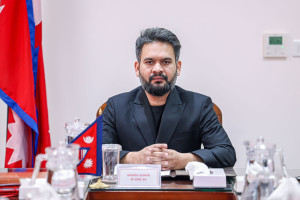
Addressing the convention, Sharma said his proposal will be about term limits for the prime minister.
According to party leaders, Sharma’s report also proposes ensuring representation of Gen Z-ers throughout the party structure, from the central level down to the wards. It further suggests reserving 20 seats in the central committee for members under 30 years of age, and another 20 seats for those in the 30–40 age group.
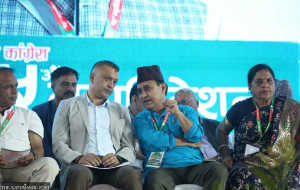
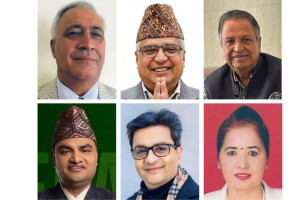
At the special convention inauguration session, apart from the two general secretaries, joint general secretary Pharmulla Mansoor and some familiar faces such as Arjun Narsingh KC, Mahesh Acharya, Pradeep Paudel, Chandra Bhandari and Sunil Sharma were also present.
At least 30 central committee members who were earlier with Deuba camp participated in the special convention inauguration session.
Former Koshi chief minister Kedar Karki, known to be close to Shekhar Koirala, was also in attendance.
Addressing the special convention, Gopal Man Shrestha, who spent a long time in the Deuba camp, said he had devoted 70 years to building the Congress. He warned that the country is facing a crisis and stressed that no one should act stubbornly.
“The entire rank and file of the party should fully comply with the decision of the special convention,” Shrestha said.
General Secretary Sharma said the party is now in a mood for a forward march.
Addressing the inaugural session, Sharma said both the party and the country need a fresh approach. “We are in the mood to move ahead in a new way, by igniting new hope,” he said.
However, Sharma did not specify what the ‘new way’ was, leaving room for interpretation and debate in the party.
The party’s first special general convention did result in a leadership change. Ahead of the country’s first general election held in 1959, Congress president Subarna Shamsher concluded that “dynamic leadership” was needed for electoral politics. On that basis, he had organised the first special general convention in May 1957. The convention re-elected BP Koirala party president.




 14.81°C Kathmandu