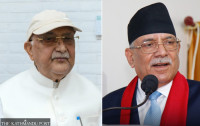
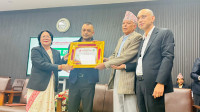
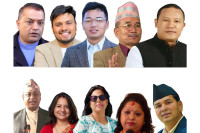
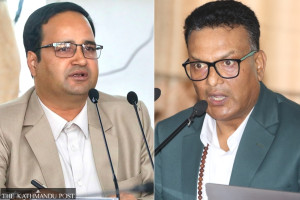
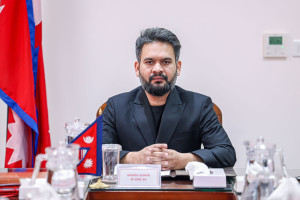
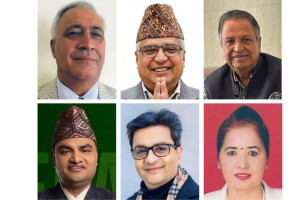
Talks break down allegedly after Ghising places demands on the party’s ideology, name and positions. From left: Rabi Lamichhane, Balendra Shah, Kulman Ghising after signing the seven-point deal on December 29.
The agreement between Rastriya Swatantra Party (RSP) and Ujyalo Nepal Party (UNP) has collapsed in just 12 days of signing the agreement between the two parties.
Ghising, who was supposed to contest the upcoming election as an RSP vice-chair as per the two-party deal, withdrew from the unity process allegedly after putting forth demands that went against the understanding reached on December 29, according to RSP leaders.
Being a minister in the election government, Ghising did not take any executive position in the UNP and was active as the patron of the party.
Then energy minister Ghising resigned from the ministerial position on January 7 with a plan to be formally active in the party.
Sources said Ghising and RSP chair Rabi Lamichhane held extensive negotiations on Friday and Saturday with the aim of reaching “an agreement”. However, the talks failed after Ghising put forward a set of conditions that the RSP leadership found unacceptable.
“Ghising demanded that the RSP change its ideology, hand over the positions of senior vice-chair and general secretary to his faction, change the party’s name, and appoint 30 people from his side as central committee members,” an RSP leader claimed. “He also demanded that the number of candidates to be fielded under the first-past-the-post (FPTP) be fixed in advance and he be mandated to select them himself, and asked that specific posts for his side in a post-election government be guaranteed.” After such demands, there was no ground left to move the agreement forward, the leader added.
RSP spokesperson Manish Jha confirmed that unity failed for now, though he said the door for future cooperation remained open. “It was not possible to commit to a fixed number of candidates at this stage and allow one side to decide candidates on its own,” Jha said. “As a party that follows democratic principles, we do not need to adopt other ideologies. Changing the party’s name is also not possible now.”
Jha said the RSP had chosen to move ahead while keeping open the possibility of collaboration in the future.
Attempts to seek a response from Ghising and leaders close to him were unsuccessful.
The NUP leaders were unhappy when the RSP submitted the joint list of PR candidates to the Election Commission on December 29 subsequently after the unity deal between the two sides.
Ghising had submitted a list of 18 names for the PR category, but only 14 were included, that too not on the top in the priority order. Only those who are on the top in the priority order in the list are likely to be elected under the PR category. Sources said Ghising was dissatisfied with this and had demanded at least 20 central committee positions in the party. Lamichhane, however, reportedly told him that only eight to 12 positions could be accommodated in the unified RSP.
Ujyalo Nepal and the RSP had announced a seven-point unity agreement on December 29, just before the deadline to submit PR lists to the Election Commission.
Ghising, who had been serving as Minister for Energy, Water Resources and Irrigation as well as Physical Infrastructure and Urban Development, submitted his resignation to Prime Minister Sushila Karki on Wednesday evening.
The collapse of the RSP-UNP deal within days has reminded Nepalis of the traditional parties’ tendency of bargaining for power and positions in the party and government seats.
After the rise of the Gen Z-driven political uprising, there was widespread expectation that newer parties would avoid repeating the old mistakes. Yet there are growing signs that these habits refuse to go.
Political analysts say the expectation that new parties would avoid repeating the mistakes of the old has not been met, as the newer forces too have struggled to live up to that promise.




 18.17°C Kathmandu