Thapa and Sharma formally call Congress special convention
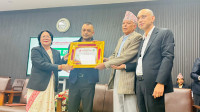
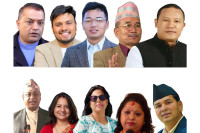
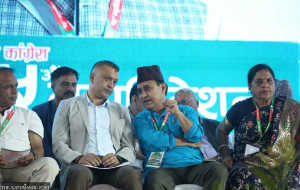
Wednesday announcement sets stage for a factional clash ahead of polls. Deuba asks leaders to shun Jan 11-12 event. Congress leaders announce the party’s special general convention for next week at a press conference in Kathmandu on Wednesday. Dipen Shrestha/TKP
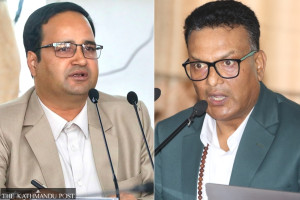
A dissident faction of Nepali Congress led by party general secretaries Gagan Thapa and Bishwa Prakash Sharma, has decided to press ahead with a special general convention of the party, as demanded by 54 percent of elected representatives of the general convention.
After backchannel negotiations between the establishment faction, led by party chief Sher Bahadur Deuba, and the Thapa-Sharma camp failed, supporters of the special general convention decided to go ahead on their own. The two general secretaries on Wednesday evening officially called for the special convention, stating it has become a political and legal necessity.
At a press conference on Wednesday, the Special Convention Communication and Publicity Committee announced the formation of 18 thematic committees to organise and manage the special convention, scheduled for January 11-12 in Kathmandu. Supporters of the special convention stressed that they have no intent of splitting the party.
Leaders from the establishment faction, however, remain hopeful that the special convention will turn out to be no more than a “special gathering.”
In response, party chief secretary Krishna Prasad Poudel issued a statement on Wednesday evening, urging the party’s elected representatives to refrain from participating in the special convention and instead focus on March elections.
The statement said that, as per the party charter, the authority to convene a convention at any level, including a special one, rests solely with the party’s central working committee, and any activities organised individually by office bearers or members would be contrary to the charter.
“The Nepali Congress earnestly appeals to office bearers and members at all levels of the party, members of the general convention representatives, sister and well-wisher organizations, as well as office-bearers and members of the party outside the country, not to engage in such activities,” the statement says.
Thapa and Sharma, however, argued they were compelled to call the special convention in line with the party charter and to respect the will of thousands of party leaders and cadres. “The party had earlier made public a schedule to complete the 15th general convention by January 12, but it did not happen within the designated time,” said a statement issued on behalf of the special convention organisers.
“In such a situation, the special convention as per our demand has automatically become an inescapable alternative,” it added.
“While fully respecting the spirit and intent of the party’s charter, we sincerely urge active and enthusiastic participation of all elected representatives of the general convention at the upcoming special convention to be held in Kathmandu,” the press statement said.
The Secretariat has already communicated with the local administration for arrangements related to security for the special convention, which will be held at Bhirkutimandap in Kathmandu.
After the September 8-9 Gen Z movement, the Congress, Nepal’s grand old party, has been in turbulence, with growing calls for leadership change.
The establishment faction had signalled willingness to address these demands. On October 14, Deuba entrusted the responsibility of acting party president to Purna Bahadur Khadka. Before that, a group of party leaders, including Thapa, Sharma and Shekhar Koirala had started collecting signatures in favour of a special convention.
On October 15, 54 percent of elected general convention representatives submitted a memo to the party’s acting president, Khadka, demanding that a special general convention be convened in line with the party statute.
The party subsequently held a series of meetings, including sittings of the central working committee and central work execution committee, to find a way to address the demand.
Meanwhile, a central working committee meeting on December 1 had scheduled a regular general convention of the party for January 10-12 in Kathmandu, but later citing time constraints and disputes, it was postponed. And at a recent meeting of the party’s central work execution committee, new dates for the general convention were set for May 11-14.
The four-year terms of all elected bodies of the Nepali Congress expired in mid-December. As per the party charter, the central committee extended the term and mandate of the current central committee and other elected bodies until June 15.
On January 2, during a meeting of the central working committee, Thapa wrote a note of dissent, stating that as the party failed to hold the convention by mid-January, the proposal to organise a special convention had been automatically activated.
There has been a debate over whether the general secretaries can call a special convention without the consent of the central working committee. The establishment faction insists that only the central working committee has this authority, as the party charter is not clear about how to proceed if elected representatives demand a special convention. This will be the second special convention of the party, which was formed in 1947.
The special convention issue has intensified the crisis in the Congress. On Wednesday, Sharma boycotted a meeting of the central work execution committee over the selection of the party’s candidates for the National Assembly elections, which are scheduled for January 25.
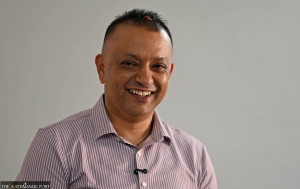
Another general secretary, Thapa, accused the leadership of favouring individuals close to party leaders. Speaking to journalists at the party office in Sanepa, Thapa criticised the electoral alliance between the Congress and the CPN-UML for the upper house elections, claiming it was driven by the personal interests of the leaders.
Later in the afternoon, Thapa held consultations with public intellectuals to explain why the special convention was necessary.
“We did not call the special convention to be party president, unlike what some people are claiming,” he said. “I have no interest in becoming party president… Those who are interested in becoming party president, like Shekhar Koirala and others, can do so. Our aim is to end ritualistic politics and position the party in the right place.”
Thapa stated that after the Gen Z movement, two perspectives have emerged in Nepal’s major parties.
“One, that we were right and we still are right. Two, that everyone else is wrong. This was another perspective. Before the Gen Z movement, we said we were not right, our approach wasn’t right, and the public was angry. We need to correct our course. Accusations that we tried to be [party] president by sidelining others are false,” said Thapa.
“Questions should not be allowed to die within political parties. That’s why we are holding a special convention. There is no turning back now.”
Devraj Chalise, a leader favouring special general convention, said there had been doubts about whether the special convention would take place, but it is now certain to go ahead.
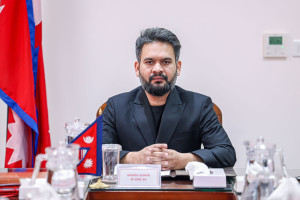
Meanwhile, the establishment faction is trying to downplay the special convention. “The special convention will likely become a special gathering, and we expect a low turnout of elected representatives,” said Prakash Sharan Mahat, party spokesperson and Deuba aide.
Mahat added: “We will not split the party. They are also saying the same. But it is unfortunate to have this scenario play out ahead of the March elections. The general secretaries should respect and adhere to the decisions taken by the central committee.”
According to the party's constitution, the special convention must be convened within three months of the petition’s registration. The deadline for this is January 11.
Anil Giri is a Chief Sub Editor covering diplomacy, international relations and national politics for The Kathmandu Post. Giri has been working as a journalist for more than two decades, contributing to numerous national and international media outlets.




 14.81°C Kathmandu