Week after four Madheshi parties announced unity, they are yet to name the new party
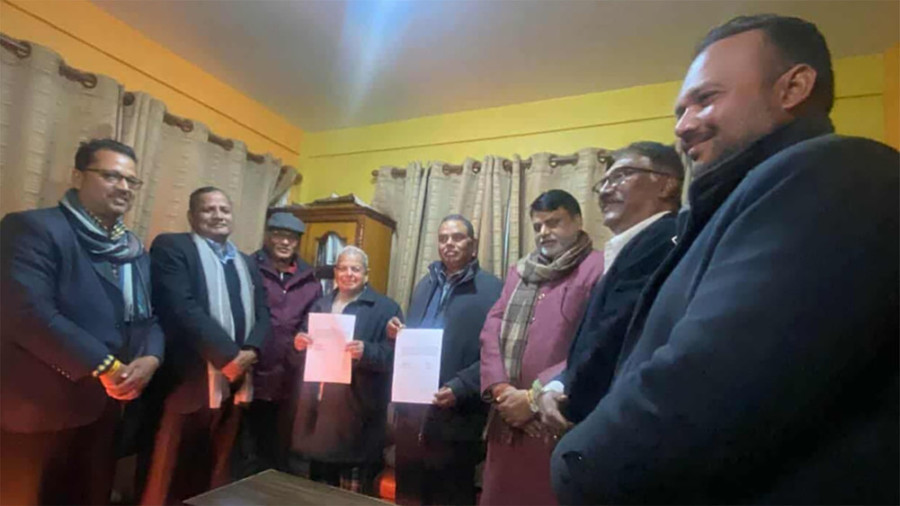
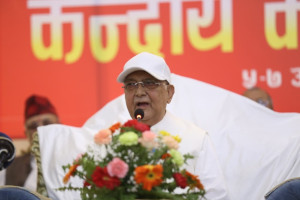
JSP-N and LSP-N, among others, agreed to unify but are yet to fix the party’s name, its leadership and election symbol, among other things, raising questions on the merger’s sustainability. Mahantha Thakur and Upendra Yadav (fourth and fifth from left) display the agreement papers after signing the deal on December 29. Handout photo
On December 28, Leaders from the Janata Samajbadi Party, Nepal (JSP-N), led by Upendra Yadav, and the Loktantrik Samajbadi Party, Nepal (LSP-N), of Mahantha Thakur, announced they had reunified their parties—the two major political forces in the Madhesh.
The announcement came hours after Rastriya Swatantra Party chair Rabi Lamichhane and Kathmandu Metropolitan City Mayor Balendra Shah signed a unity deal in the wee hours of that day.
The parties had come together just a day before the deadline for submitting the proportional representation (PR) candidates for the March 5 elections of the House of Representatives.
It’s been over a week since the announcement of their reunification. But they are yet to make a formal announcement. They have not even finalised the name, leadership and the election symbol of the to-be-formed unified party, let alone other nitty-gritties. On December 28, they only reached a broader agreement to unify the parties while agreeing to finalise other things “immediately”.
This apparent ambiguity has cast doubts on the sustainability of the merger, leading many to wonder if the latest unity is just another episode in the cycles of mergers and splits that these parties have undergone in the past.
Terai Madhesh Loktantrik Party and Janata Pragatisheel Party also have decided to join forces with the unified party. Later, a group of some leaders from Janata Samajbadi Party-led by Ashok Rai, a splinter faction of JSP-N, also decided to join in the unification process.
Party leaders the Post talked to said they are yet to make a formal announcement due to some political and technical issues.
“We will make a formal announcement after resolving some minor issues,” said Manish Kumar Suman, spokesperson of the JSP-N who is also Labour and Transportation Minister in Madhesh provincial government. “We are still discussing the name of the unified party and distribution of the key responsibilities of the party leaders along with working on party statute, which will be finalised soon.”
Raj Kishor Yadav, another leader of JSP-N, echoed Suman.
There appears to be a difference of opinion among party leaders over whether the party unification has been formally announced or not.
Unlike Yadav and Suman, Hridayesh Tirpathi, chair of Janata Pragatisheel Party, claimed that the unification between the four Madhesi parties has already happened.
According to Tripathi, the announcement was made in two stages. First, the LSP-N, the Terai Madhes Loktantrik Party and the Janata Pragatisheel Party declared their unity. “Following this, we jointly decided to move towards unification with JSP-N as well,” he said.
However, as the deadline for registering political parties with the Election Commission for the March 5 election has already expired, the law does not allow parties to formally merge and proceed together at this stage.
Therefore, they agreed to contest the election under a single election symbol and to submit a joint PR list, in line with the understanding reached among the parties, according to Tripathi.
“There are still a few technical matters that need to be sorted out in line with the law, but we have already signed the unification agreement,” Tripathi added. “It is on the basis of this unification that we jointly submitted the PR list.”
Party mergers and splits have become a common phenomenon in Nepal and more so in the case of Madhesh-based parties.
Yadav and Thakur had parted ways in 2021.
In August 2021, Thakur split the Janata Samajbadi Party and registered Janata Samajbadi Party Nepal (Loktantrik).
Thakur’s Rastriya Janata Party had earlier merged with Upendra Yadav’s Sanghiya Samajbadi Party in April 2020.
This time, it is not difficult to see that Madheshi parties have announced unity in an attempt to salvage their political relevance in a changed political landscape after the September Gen Z movement. However, given their repeated cycles of mergers and divisions in the past, on what grounds will these parties convince the people of Madhesh that this latest unification will be sustainable?
Raj Kishor Yadav of JSP-Nepal acknowledges that the people of Madhesh have been upset with them because their previous party unifications failed to last. However, Yadav says that their political roots lie in movements rather than in governance, and that while exercising state power, they earlier made some emotional decisions which led to party split.
“Learning from those mistakes, the party is now committed to practising more mature politics and believes the errors of the past will not be repeated,” Yadav claimed.
Tripathi, too, recalls that during King Gyanendra’s direct rule, when Sadbhavana Party leader Badri Prasad Mandal welcomed the king’s move and joined the Cabinet formed under the king’s leadership, another faction of the party chose to participate in the movement led by the seven political parties. He says the split at that time was driven by ideological differences.
Since then, however, Tripathi argues divisions among Madhesh-based parties have been less about ideology and more about political interests. “That is why we have no option but to apologise to the Madhesi people for the mistakes of the past and move forward with a clear commitment not to repeat them,” Tripathi told the Post.




 20.85°C Kathmandu