Parties submit PR lists, clearing the path for March polls
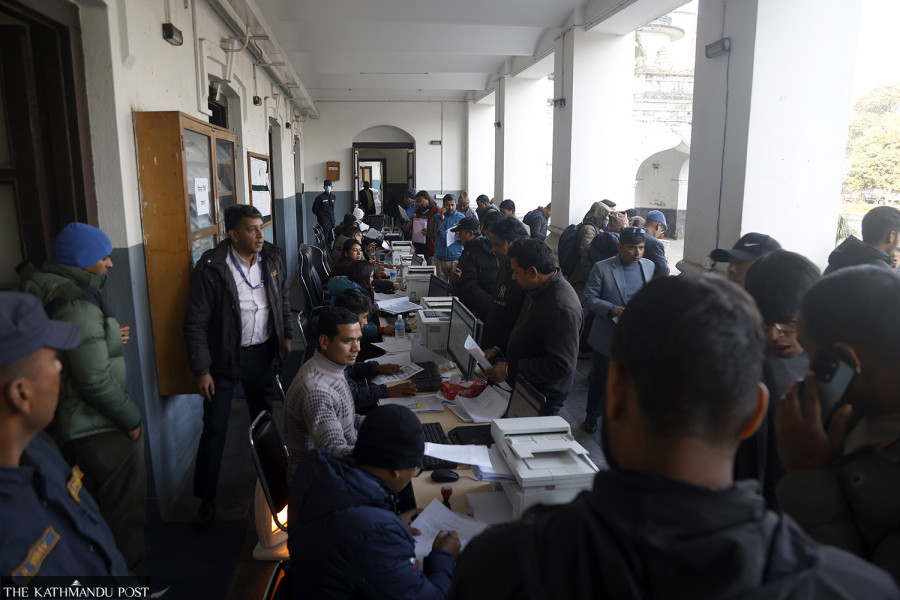
Congress and NCP have prioritised new faces but UML repeated old ones. RSP made its picks through a primary. Representatives of various political parties submitting their closed lists of proportional representation candidates for the upcoming lowerhouse elections at the Election Commission on Monday, the final day for submissions. Suryams Upreti/TKP
On the final day set by the Election Commission for the submission of closed lists of Proportional Representation (PR) candidates for the House of Representatives election, dozens of political parties, including new ones, submitted their lists on Monday.
Although the interim government, formed in the wake of the Gen Z uprising in September, dissolved the House of Representatives and announced fresh elections for March 5, uncertainty had persisted.
Several major political parties had questioned whether the Sushila Karki administration is capable of creating a conducive environment for elections and had expressed doubts about whether polls would be held on the scheduled date.
The submission of PR lists on Monday has significantly strengthened the likelihood of timely elections.
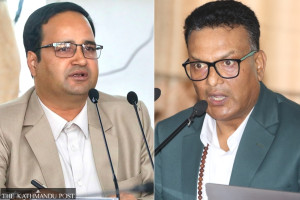
Nepali Congress spokesperson Prakash Sharan Mahat said his party has joined the electoral process in line with the interim government’s call. Mahat, however, stressed that it remains the government’s responsibility to ensure a safe electoral environment, including allowing political leaders to take part in campaign activities freely and without obstruction.
“As we have already entered the election process, we are confident that the polls will be held on the scheduled date,” Mahat told the Post. “That said, creating the necessary environment is the government’s responsibility.”
But leaders from the CPN-UML, which has been the most doubtful of the Karki government’s ability to conduct elections, argued that just the submissions of PR lists do not guarantee timely polls. The party, however, has been quietly preparing for the elections.
The UML Secretariat meeting on Sunday entrusted party chair KP Sharma Oli with finalising the names of PR candidates from the party. Party leaders submitted their PR list to the Election Commission on Monday.
Nevertheless, UML Vice-chair Prithvi Subba Gurung said that participation in the electoral process is not enough.
“Elections are a democratic process, and political parties cannot avoid them. That is why we have taken part in it,” Gurung told the Post. “But the government has yet to create the right environment, and under these circumstances, we are not fully confident that elections will happen.”
Gurung also claimed that there is still “80 percent” chances of the dissolved House of Representative being reinstated.
Former chief election commissioner Ayodhi Prasad Yadav said that the country has now formally entered the election phase, as almost all political parties have submitted their PR closed lists within the deadline set by the commission for Sunday and Monday.
Yadav noted that it is difficult to predict how the case at the Supreme Court seeking reinstatement of the dissolved House will unfold. He believed that, setting that uncertainty aside, the country has effectively moved into full election mode.
“With political parties submitting their PR closed lists to the Election Commission, there is no longer a reason to doubt that elections will be held,” Yadav said.
The PR closed lists filed by political parties with the commission suggest the emergence of some new trends.
For the House of Representatives PR seats, the Congress has given priority to new faces this time.
The party finalised its PR list at a meeting of the Central Working Committee held on Monday. According to party spokesperson Mahat, the meeting approved the names of 110 PR candidates.
Mahat said the Congress included new candidates on its PR list.
“Those who have been elected through the PR from the Constituent Assembly period [2008] up to the present have not been included on the current PR list,” he said.
From among the party’s office bearers, only Joint General Secretary Bhishmaraj Angdembe has been included on the PR list. From the Indigenous Nationalities category, the list also features former minister Romi Gauchan, Seteman Tamang, and Gopal Man Singh Rajbhandari.
In the women’s category, the closed list includes Urmila Thapaliya, Premika Ranamagar, Rukmini Koirala, Goma Bhattarai and Devaki Gautam, among others. Party leaders also said that film director Min Bahadur Bham has been included on the list.
Former defence minister Bhimsen Das Pradhan, among others, has also been named on the Congress’s PR list.
The CPN-UML, however, appears not much bothered about including fresh faces. The party, which had decided not to repeat those who had already been given opportunity under the PR category in the second CA, has selected many incumbent office bearers and other leaders who were picked under the inclusion category.
The party has proposed names ranging from party secretary Padma Aryal to Gen Z leader Nita Ghatani.
According to a party leader, names include former deputy chair Guru Baral, secretary Aryal, All Nepal Women’s Association chair Tuka Hamal, former Youth Federation president Niru Pal, Shanta Chaudhary, who was chair of the Natural Resources and Means Committee during the Constituent Assembly era, and former urban development minister Manju Chaudhary.
A glance at the preliminary list suggests that individuals close to party chair Oli have been given priority.
Also, the Pushpa Kamal Dahal-led Nepali Communist Party (NCP), which was formed after a merger of multiple communist parties in the wake of the Gen Z revolt, has decided not to include anyone who previously served as lawmaker or minister on its PR list.
According to the party, individuals elected either through the first-past-the-post (FPTP) or through PR in the past will not be nominated for the upcoming March elections.
The party for the same reason has submitted a list of 110 PR candidates, including fresh faces such as Pramesh Hamal and Mitra Pariyar, who have not previously held parliamentary positions. Pariyar, a columnist at the Post, joined the party just a few days ago after quitting the Shram Sanskriti Party led by Harka Sampang, the mayor of Dharan sub-metropolitan city. Pariyar defected to the communist party after Sampang took disciplinary action against him.
Meanwhile, the Rastriya Swatantra Party (RSP) selected its candidates through intra-party competition.
RSP repeated its practice of holding a primary to select PR candidates this time as well.
Following Sunday’s decision to forge unity with Kathmandu mayor Balendra Shah, the RSP submitted its PR list to the Election Commission after accommodating Mayor Shah’s nominees.
According to the results of the RSP’s intra-party competition for PR candidates, Ramesh Prasai secured the top position. Pramod Neupane ranked second, while Ranju Darshana was third.
Tika Sangraula finished fourth, Lima Adhikari fifth, Samikchya Baskota sixth, Bipin Kumar Acharya seventh, and Krantishikha Dhital eighth.
Baskota and Darshana were previously the chair and general secretary, respectively, of Bibeksheel Sajha Party, which recently merged with the RSP.
Meanwhile, following the unification between the RSP and Kulman Ghising’s Ujyalo Nepal Party (UNP) on Monday approximately 18 members from UNP, have been included on RSP’s PR list. Party leaders said the list includes Dr Abhishek Singh and Rima Bishowkarma, among others.




 14.82°C Kathmandu