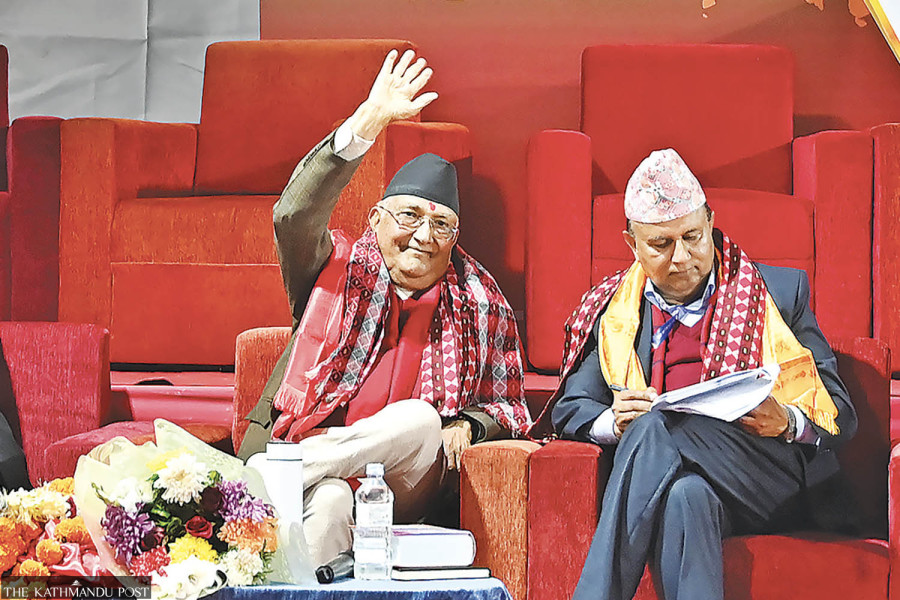
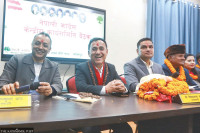
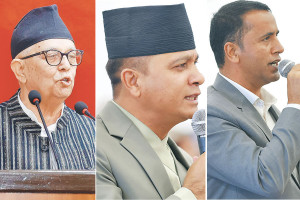
Pokhrel fails to mount serious challenge against the 4-time prime minister who was in the eye of the Gen Z storm. CPN-UML chair KP Sharma Oli (left) pictured with party general secretary Shankar Pokhrel after their re-election, in Kathmandu on Thursday. Angad Dhakal/TKP
The CPN-UML elected KP Sharma Oli its chair for a third consecutive term as his panel swept clean the results of the 11th general convention held in Kathmandu starting Tuesday.
Hastened by the September Gen Z revolt, the general convention gave Oli a sweeping majority in the central committee and a command in the 19-member office bearers.
In spite of a clarion call for change in the party leadership and the removal of the old guard following the Gen Z movement, Oli, who was swept out of power by the youth uprising, retained the top party post. The party camp led by Ishwar Pokhrel and supported by former President Bidya Devi Bhandari suffered a crushing defeat.
In the party chair, Pokhrel lost to Oli by a huge margin, according to the election results. Oli received 1,663 votes while Pokhrel got 564.
Oli’s third term as the chief of one of the country’s oldest and largest parties will be filled with challenges. Oli has to testify before an inquiry commission headed by Gauri Bahadur Karki for the state’s use of deadly force to quell the Gen Z protests.
According to Karki, the commission will summon him next week while Oli has refused to recognise the panel. The UML has also dismissed the elections scheduled for March 5 as unlikely to happen. Oli’s party has petitioned the Supreme Court against the House dissolution by President Ramchandra Paudel on the recommendation of the Sushila Karki-led interim government.
Now a fresh challenge for Oli is to keep the party intact by managing internal rivalry and dissatisfaction, UML leaders say. The Pokhrel camp’s win is marginal but the votes received by the candidates on his side have made their strength clear in the party.
Soon after his reelection, Oli announced that the country could be brought to a standstill if his leadership is targeted.
“Various kinds of conspiracies and plots have been carried out against the UML leadership—attempts at physical attacks and rumour-mongering about false and fabricated cases,” Oli said. “I want to say this: the day the UML leadership is touched, the country should be brought to a standstill. This government must be brought down.”
In an apparent reference to the inquiry commission’s potential recommendation of action against him for leading the government at the time of the Gen Z uprising, Oli asked leaders and cadres to prepare for an agitation and warned any forces against provoking the UML.
The desire for an UML without Oli has been defeated, the four-time prime minister said in his first speech after taking the oath. “There were attempts not to reelect me but the love and affection of thousands of party cadres has foiled the plot.”
“All kinds of forces have been spreading rumors about me—there have been psychological intimidation, fear, and all sorts of plots, conspiracies, and manipulations. Even so, you have responded to all those rumors, all those conspiracies, and all their ill intentions. You have crushed the reactionaries’ attempt to create a UML without Oli. I want to thank you all.”
Oli was first elected party chief from the 9th general convention held in Kathmandu and re-elected at the 10th in Sauraha, Chitwan.
After being ousted from power during the Gen-Z movement, questions were raised within the UML about his leadership, style of his functioning, and the party’s future direction. Pokhrel, Oli’s longtime lieutenant, turned against the chair, particularly over the issue of the party denying ex-President Bhandari the UML membership while a section of leaders critical of Oli’s approach joined forces to form a rival panel.
The 11th general convention has given him a new lease of life in the party and ended the crisis of legitimacy over his leadership. For Oli, this was not only a fight to win an election, but also a final chance to justify his own political relevance.
Political analyst Keshav Dahal says the UML is divided into various camps and groups but the party is guided by preset democratic norms.
“After the Gen Z movement, there were calls for reform in political parties in all aspects such as policy, ideology, organisation, working style, and political culture but the UML cadres did not heed the message,” he observed. “The UML leaders and cadres did not honour the spirit of the Gen Z movement. This is due to a guided democracy prevailing in the UML.”
After being sworn in, Oli administered the oath to office bearers and central committee members at the Bhrikutimandap convention venue. The newly elected committee is set to meet on Friday.
Pokhrel and some of those who won seats from his camp, including Yogesh Bhattarai and Gokarna Bista, have called for greater unity in the party following the elections.
Oli had been carefully preparing for this. He blocked former President Bhandari’s aspiration to return to the UML and to eventually lead it after renewing her party membership. Bhandari had given up her party membership to ascend to the country’s presidency but had claimed to have renewed it, ruffling Oli’s feathers.
The party’s statute convention, on the eve of the September 8–9 Gen Z uprising, unanimously endorsed the proposal to remove the two-term limit and 70-year age bar for holding executive positions in the party forwarded by the party’s central committee. The decision clearly favoured septuagenarian Oli, who eyed a third term.
The Pokhrel faction accused Oli of rigging the selection of representatives, who have a vote in the general assembly, bypassing and sidelining their camp in many districts as well as in sister organisations.
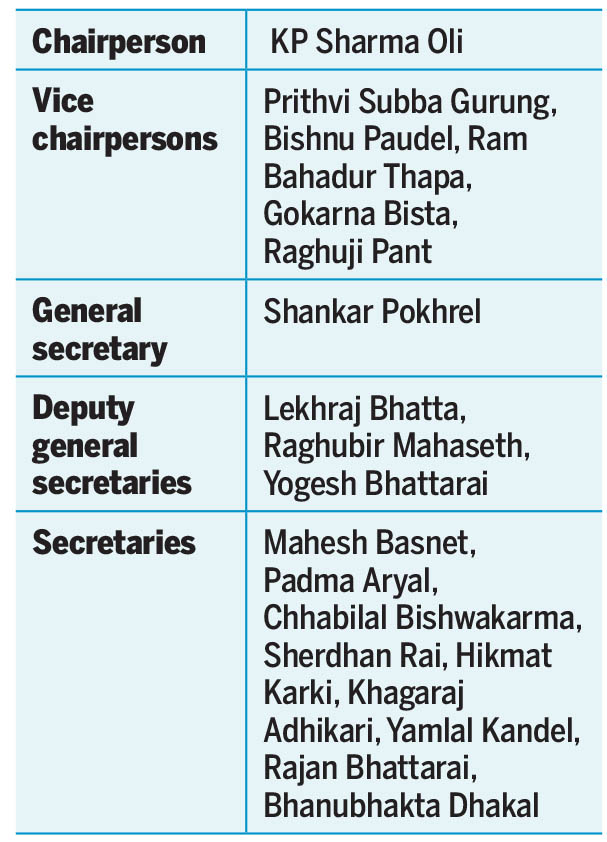
Shankar Pokharel has been re-elected the party’s general secretary for a second term, with 1,228 votes. His competitor, Surendra Prasad Pandey from the rival panel, got 999 votes.
Four candidates from the Oli-led panel were elected vice-chairpersons. One candidate from Pokhrel’s camp also won the vice-chair position.
From Oli’s panel, Bishnu Paudel and Ram Bahadur Thapa have been re-elected vice-chairs. Paudel secured 1,675 votes while Thapa received 1,516. Former deputy general secretary Prithvi Subba Gurung won the vice-chair post with the highest number of votes—1,737. Raghuji Pant was also elected vice-chair with 1,258 votes.
Former secretary Gokarna Bista from the Pokhrel group was elected vice-chair with 1,368 votes.
All nine candidates from Oli’s panel won secretary posts. Mahesh Basnet secured the highest number of votes among them.
According to the final results, Basnet received 1,544 votes. Padma Kumari Aryal finished second with 1,530 votes. Chhabilal Bishwakarma secured 1,506 votes, Sherdhan Rai 1,503, Hikmat Kumar Karki 1,337, Khagraj Adhikari 1,231, Yamlal Kandel 1,185, and Rajan Bhattarai 1,181 votes. Bhanubhakta Dhakal was also elected secretary with 1,108 votes.
Lekhraj Bhatta, Raghubir Mahaseth and Yogesh Bhattarai have been elected deputy general secretaries. Bhatta secured 1,452 votes, Mahaseth received 1,368, and Bhattarai won with 1,348 votes. Bhatta and Mahaseth were elected from Oli’s panel, while Bhattarai was on Pokhrel’s side.
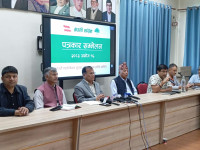
Vote counting began on Thursday morning after gathering all 80 electronic voting machines, with representatives from both panels and the party’s central election commission members overseeing the process.
Polling began at 9:12am on Wednesday, continued overnight and ended early Thursday. A total of 2,227 delegates cast ballots, while 36 were absent.
Anil Giri is a Chief Sub Editor covering diplomacy, international relations and national politics for The Kathmandu Post. Giri has been working as a journalist for more than two decades, contributing to numerous national and international media outlets.




 18.68°C Kathmandu