UML statute changes reverted in just three months to suit Oli
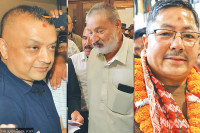
As consensus efforts continue, the general convention could be prolonged, according to representatives. UML chair KP Sharma Oli (right) and senior vice-chair Ishwar Pokhrel Dipen Shrestha/TKP
CPN-UML chair KP Sharma Oli has done it again. He has made changes in the party statute to serve his interest, three months after a statute convention framed it, despite strong objection by leaders from the dissident camp.
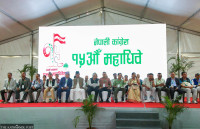
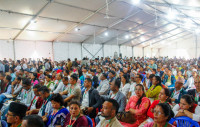
A central committee meeting on Sunday passed a proposal to increase the number of the party’s office bearers from 15 to 19, and it was subsequently endorsed by a meeting attended by over 2,200 general convention delegates gathered in Kathmandu from across the country.
The party’s statute convention, held especially to make changes in party policies, had decided to cut down the positions of office bearers from 19 to 15 in the first week of September.
Under pressure to manage dozens of his trusted lieutenants who lobbied hard to be office bearers, Oli felt the need to increase the number again.
The proposal was presented on Friday at a party’s central secretariat meeting—the last meeting of the office bearers elected from the party’s 10th convention in 2021. The meeting however could not pass it, owing to strong objection from the dissident faction led by Ishwar Pokhrel, who has challenged Oli for the post of party chair.
Then, the Oli faction chose to put the proposal on hold.
However, it was presented at the party’s central committee that swiftly passed it to be endorsed by the plenum of over 2,200 convention representatives.
The statute convention that concluded on September 7 had finalised the numbers of various party committees—15 office bearer positions, and a 251-member central committee.
But, with Sunday’s changes, there will be a 301-member central committee, 99-member politburo, 33-member standing committee and 19-member office bearers. When it comes to finalising the size of the politburo and the standing committee, the UML usually applies the rule of third—the politburo’s strength is a third of the central committee and the standing committee is a third of the politburo.
Although the rival faction opposed the proposal to increase office bearer numbers, the closed-door session passed it by a voice vote.
Senior vice-chairman Pokhrel, vice-chairs Ashta Laxmi Shakya, Yubaraj Gyawali and Surendra Pandey, and secretaries Gokarna Bista and Yogesh Bhattarai opposed Oli’s proposal.
According to a party leader, one of the five vice-chairs will later be designated as a senior vice-chair. Although the post does not exist at present, such a provision will be introduced later, the leader told the Post. Previously, the 10th general convention held in November 2021 had also elected 19 office bearers, who constitute the party’s central secretariat, along with a senior vice-chair position.
The statute convention in September had removed the two-term and 70-year age limits to hold the party’s executive posts at the behest of the septuagenarian Oli, who is set to contest the top party post for the third term.
This general convention is likely to see the contest between incumbent chair Oli and Senior Vice-chair Pokhrel for the party chair, and the two sides are likely to field their own panels.
While Pokhrel is believed to be in a relatively comfortable position to manage the aspirants for the top positions, it appears more challenging for Oli as a large number of leaders loyal to him have been lobbying for the positions. For the same reason, Oli’s side insisted on increasing the number of office bearers despite strong objection from the rival faction.
According to a leader, the closed-door session has also endorsed a proposal on cluster-based arrangements for selecting central committee members.
According to the proposal passed by the session, one member under 40 will be selected from each of the seven provinces and one from Kathmandu Valley, which is accorded equal status to a province. Likewise, six members will be selected from the open category and three from the women’s category.
A total of 73 central members will be selected from among women. Of them, 52 will be chosen through open competition, two from the Janajati category and 17 from the youth category.
Likewise, from Madhesh, two youths in the central committee, eight from the open category and four women are to be selected for the central committee. From the Dalit category, the provision requires the selection of one youth, eight from the open category and four women.
Similarly, one central member will be selected from the Nepali diaspora in India and one from other countries to represent the Nepalis living abroad. One central member will also be selected from among persons with disabilities, the leader said.
Meanwhile, an election schedule to choose the UML’s new leadership was released on Sunday evening. The Central Election Commission said the convention-related programme starts at 7 pm on Sunday and will run until Tuesday.
But the party leaders doubt the election schedule to be followed. The convention, which began on December 13 with the aim of concluding on December 15, could last a few more days, said Ramji Sapkota, a representative from Kaski.
Efforts at consensus are likely to take time, said Sapkota. “So the convention is unlikely to end on schedule.”
Some other party leaders seconded Sapkota. They said leaders are trying to select the leadership based on mutual understanding between Oli and Pokhrel.
Many party delegates the Post talked to at the convention venue said that the post of general secretary may go to the Pokhrel faction if leadership positions are selected based on an agreement between the two sides.
Devi Gyawali, a UML leader from Chitwan who is on the establishment side, did not deny such possibility.
However, there is intense competition within the Oli faction for the post of general secretary, a powerful position for running the party organisation. Incumbent general secretary Shankar Pokhrel and deputy general secretaries Pradeep Gyawali and Prithvi Subba Gurung have been lobbying hard for the position.
“Even if Oli is elected chair in the event of an election, the results for other office bearer positions are likely to be mixed,” said several party leaders and cadres the Post met at the Bhrikutimandap venue.
The two sides have yet to disclose any candidates for top positions, except for the party chair.
Sanjay Kumar Paswan, a convention delegate from Saptari, said there should be continuation of Oli’s leadership. Paswan claims that the majority of convention delegates from Madhesh Province support Oli.
However, another delegate from Madhesh, who hesitated to speak openly, argued that 40 percent of the general convention delegates have yet to pick a side, and so it is not easy to predict the outcome of the leadership contest.
Delegates from the dissident camp accused the party establishment of creating an environment of electing only the representatives loyal to Oli.
“Even so, 40 percent of delegates are fence sitters and they will influence the outcome if the leaders are voted in,” several delegates from Madhesh said.
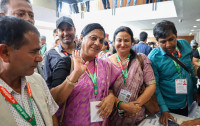
On Sunday afternoon, UML leaders and cadres were busy forming groups based on regions and holding informal discussions.
The Gen Z uprising overthrew the Oli-led government in early September and a large section of the society blamed him for mishandling the youths’ revolt.
However, most party cadres interviewed at the venue defended Oli.
Many of them openly said that Oli should lead the party for a third term. They argued that the party’s core leadership needs to be protected against the attacks the UML currently faces from all sides. The best way to protect Oli would be his continuation as the party chief, they argue.




 15.26°C Kathmandu