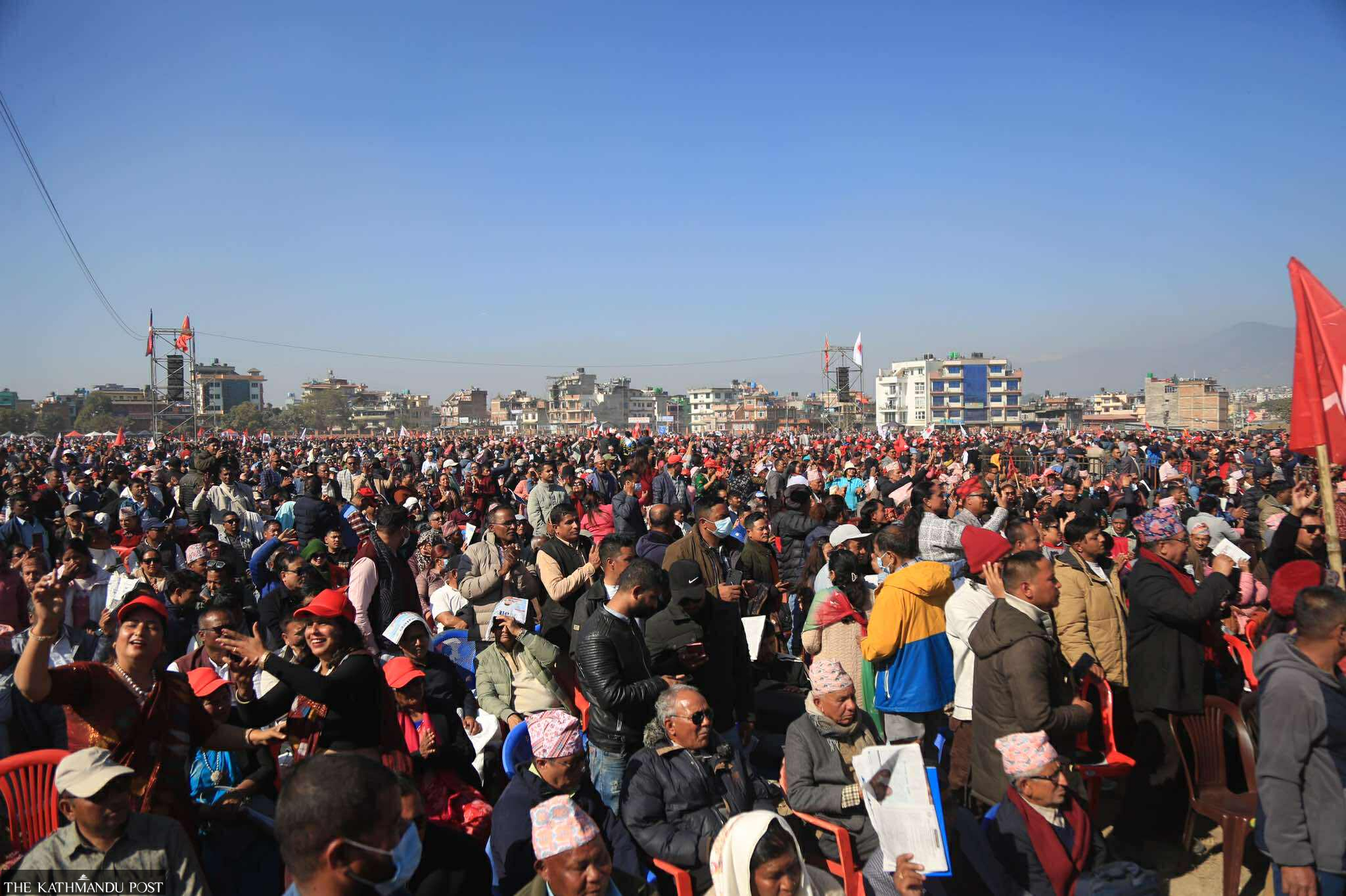
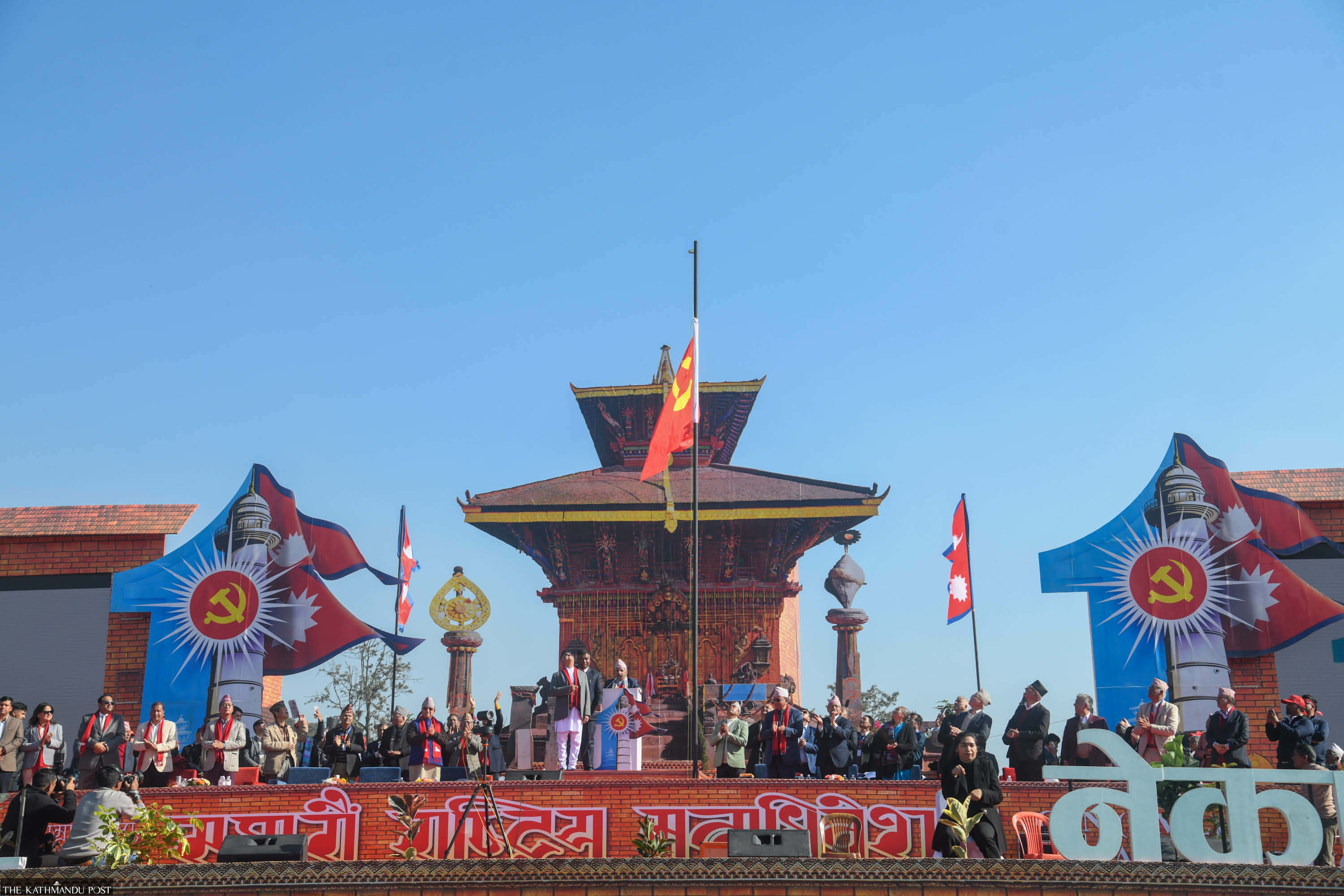
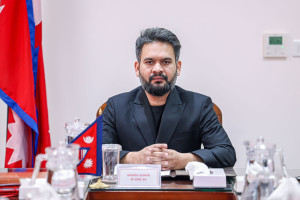
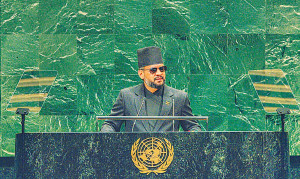
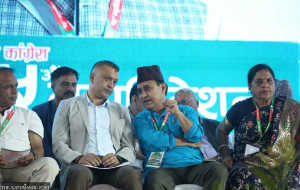
The CPN-UML opened its 11th general convention at Sallaghari, Bhaktapur to a mass of leaders and cadres on Saturday.
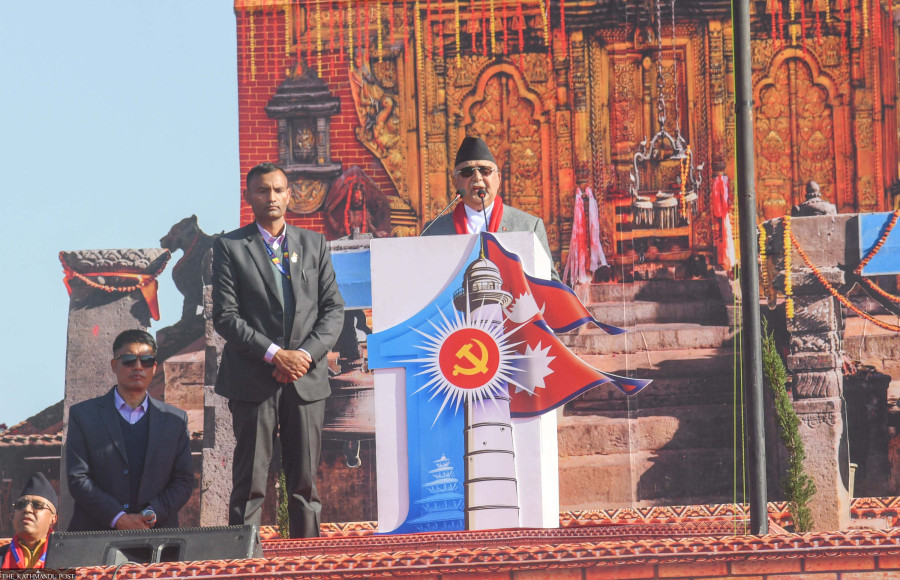
Party chair and former prime minister KP Sharma Oli inaugurated the convention by hoisting the party flag.
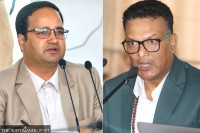
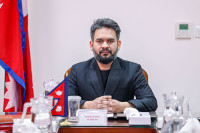
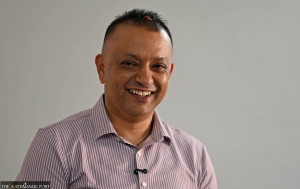
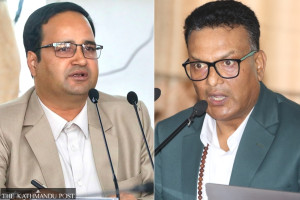
Leaders from various parties including acting president Purna Bahadur Khadka of Nepali Congress, Nepali Communist Party leader Dev Gurung, Rastriya Prajatantra Party chair Rajendra Lingden, Nepal Communist Party General Secretary Netra Bikram Chand, and Nagarik Unmukti Party chair Ranjita Shrestha attended the inaugural event to extend their greetings on the UML’s biggest event.
The party claims the gathering to be its largest so far, bringing in cadres from across the country on reserved vehicles. Over 2,200 delegates, including elected and nominated representatives, and 309 observers are taking part in the convention, which will elect the party’s new leadership.
Around 10,000 volunteers have been mobilised for management, according to the organiser. The convention will elect 15 office-bearers including the party chair and 251 central committee members.
Another 10 percent of members were nominated on Saturday but the rival faction led by Ishwar Pokhrel objected to the nomination of 108 representatives. Although the party statute mandates a general convention every five years, this one has been convened a year early citing special circumstances.
The party’s general convention comes after the Oli-led coalition government was overthrown by the Gen Z revolt.
The UML’s 10th convention was held in Chitwan in December 2021. As the statute and policy convention concluded in September, the Bhaktapur gathering is focused mainly on leadership selection.
Addressing the inaugural session, Oli talked about the September 8–9 Gen Z movement, cast doubt on the March 5 elections, laid out UML’s position for the restoration of the dissolved House of Representatives, spoke on issues of national sovereignty and territorial integrity, and took up alleged national and foreign conspiracies against the party.
In his address, Oli, known for his nationalist posturing, said that the UML faces attacks when it stresses Nepal’s rights as an independent and sovereign nation.
He claimed that some entities believe that weakening the UML will weaken the sovereignty of the Nepali people. Both external and internal forces are working to weaken the UML, Oli alleged.
“Countries may be small or large in geography, they may be small or large in population, but the sovereignty of all is equal and equally respected. Some people feel, how dare a small country seek parity with us? And then there is an attack,” the four-time prime minister said.
“We say that diversity and plurality are our assets, not matters of division. We said that unity in diversity is our core mantra, and then we are attacked.
“We say the right to draft a constitution as a sovereign country is ours, the right to amend the constitution is ours. We say we will exercise, utilise, and make good use of our freedom. We say the right to choose the path for our country and its political system is ours. Some people don’t like this, and then we are attacked,” Oli rued.
Claiming that the country is making progress despite challenges like armed conflict, transition, and an earthquake, Oli said the country could not make the desired progress but the changes are visible.
Oli said that the forces working against the UML appear in various colours. “They sometimes appear expressing dissatisfaction, sometimes carrying the slogan of change… in different colours, calling it a colour revolution, but their goal is the same: to divide us and render us aimless.”
Elaborating on this, Oli said that the group which reacted intensely when the UML stood firm while promulgating the constitution was not happy.
CPN-UML leaders and cadres gather for the party’s 11th general convention opening ceremony at Sallaghari in Bhaktapur on Saturday. Deepak KC/TKP
He took up the pitch that his party had become the target of attacks when it pursued a transit agreement with China, making Nepal a land-linked rather than a landlocked country, and boosting north-south connectivity, border defence while asserting the country’s territorial claims.
When he was the prime minister in 2016, Oli signed a trade and transit deal with China, proposed to open north-south road corridors, expressed the need to extend Chinese rail to Nepal, and invited Chinese investments in various sectors of Nepal.
Arguing that scheduled parliamentary elections won’t happen in March, Oli rooted for restoring the dissolved House of Representatives.
But Oli said the UML is not going to escape from the elections.
“If there is no fear, pressure and vendetta against us, we will gain a majority. But some people are trying to mislead the country that an election is going to happen.
“The election won’t happen. It is only to mislead the county. That is why our firm position is for House restoration,” the UML chief said.
Freezing the passports of party leaders, restricting their movement and issuing prohibitory orders do not create the environment for elections, Oli said as he objected to the government’s moves. “Is this how you build an election climate?”
The mandate of the Sushila Karki-led interim government is to hold the elections on March 5 but the government has failed to create the right environment, he added.
Addressing the convention on behalf of Nepali Congress, acting president Purna Bahadur Khadka said that the incidents of September 8 and 9 should be impartially investigated.
Political parties must stand together to bring the country back on track, Khadka said, questioning why “everything from the nation’s national heritage sites to the ashram of Saint Leader Krishna Prasad Bhattarai was turned into ashes”.
“On these matters, all political parties… must unite against the attack on the state system for reconstruction, to build trust, to bring the derailed constitution back on track, and to protect the rights of the people.”
The Congress leader said they await the Supreme Court’s order for a constitutional solution [on the question of House restoration] but the party is also ready to take part in the elections.
Top leaders join the inauguration of the UML general convention, in Bhaktapur on Saturday. Dipen Shrestha/TKP
Nepali Communist Party leader Dev Gurung stressed that there is no alternative for the communists but to unite and move forward.
“History has shown that only communists are patriotic,” said Gurung. “Only communists are nationalists. The power that can protect the sovereignty of the nation is communist.”
Gurung stated that it is difficult to establish a socialist system without the unity of communists.
Netra Bikram Chand, General Secretary of the CPN (Maoist), said his party is in the same front with the UML in the struggle for sovereignty.
Addressing the inaugural ceremony of the UML’s National Convention on Saturday, Chand said that in the face of a fierce attack on the UML, his Maoist party joins the struggle for sovereignty.
“The UML has been subjected to an attack. There is only one reason for this attack. The UML has consistently taken a stand in favour of national sovereignty,” Chand said. “Because of that, wherever we are, whether we are under restriction or operating openly, we feel that we stand together for the struggle for sovereignty.”
He also supported the idea of an all-party government for holding the elections, as proposed by the UML, following the restoration of the House of Representatives.
Speaking at the same function, Rastriya Prajatantra Party Chairman Rajendra Lingden said that a new understanding must be reached between the political parties by safeguarding the key achievements of the past.
“We must safeguard three significant achievements of the three changes—the establishment of democracy of 2007 BS (1950 AD), the multi-party system of 2046 BS (19990 AD), and the inclusiveness and proportional representation of 2063 BS (2006 AD)—and establish a new understanding in the country,” Lingden said.
“All parties must stand together to save and rebuild the nation by addressing the issues of the traditional powers, the political parties, and the new generation of youth.”
Surendra Jha, general secretary of the Democratic Socialist Party (LSP), urged the UML to take the lead in amending the constitution.
“If this constitution is to be made dynamic, an amendment is a must,” he said at the Saturday event.
Alleging that the constitution promulgated in 2015 lies dead, Jha said, “There are many things to be proud of in this constitution, but there are also things that need to be fixed. We were not even able to sign this constitution,” said Jha, referring to the decision of some Constituent Assembly members to walk out of the statute writing process in 2015.
The UML has called on its cadres to “wake up” for the restoration of Parliament. At the inaugural ceremony of the general convention, the UML appealed to its leaders and cadres to rise up for the reinstatement of the dissolved House. In a video shown at the inaugural ceremony, the UML’s appeal was to “wake up for the restoration of Parliament”.
In the video, scenes of government structures that were set on fire during the Gen Z protest were shown. The UML would never forget that day, it declared. “Comrades, close your eyes for a moment. Remember the temple of our justice that was burned; remember our Parliament building that was set ablaze, our Singha Durbar reduced to ashes. Say it—we have not forgotten the burning of Singha Durbar,” it thundered.
The video also showed other structures burned during the protest. “We will not forget those who carried fire in their hands, we will not forget those who snatched police guns, and we will not forget the prison escapees.” Calling on the people to wake up for the nation, the video said that one must rise to restore their faith under attack, work for the reinstatement of Parliament, and “awaken to repair the torn constitution”.
As the March House elections inch closer and the country’s political atmosphere remains hot, the UML convention has drawn significant attention, particularly regarding the election of its new leadership.
The convention, running from Saturday to Monday, will see 2,262 participating delegates elect the party’s central leadership for the next five years. The race for the UML chair is its central focus.
Both Oli and his deputy, Senior Vice-chairman Ishwar Pokharel, are likely to contest by forming separate panels for 15 office bearers. Both sides are engaging in intense meetings and lobbying with the delegates to strengthen their respective camps.
Both Oli and Pokhrel factions have been busy preparing their panels. Starting Sunday, after the closed door session is over, the leadership election process will kick in. Aspirants for office bearer positions and central committee members have already started their campaigns through social media.
Anil Giri is a Chief Sub Editor covering diplomacy, international relations and national politics for The Kathmandu Post. Giri has been working as a journalist for more than two decades, contributing to numerous national and international media outlets.




 14.7°C Kathmandu