Gen Z movement lifts youth presence in UML convention. But their prospect for top positions remains dim
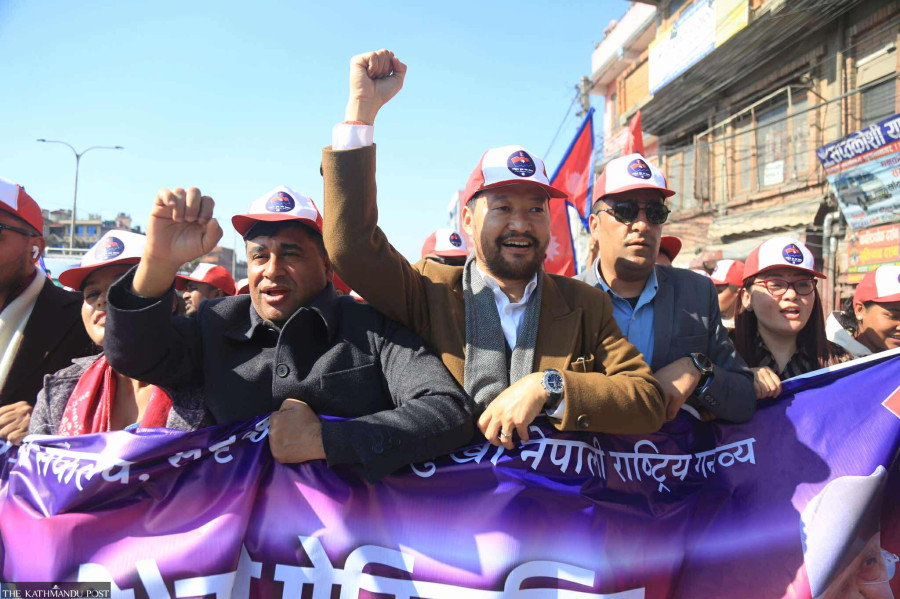
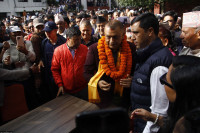
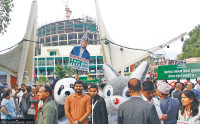
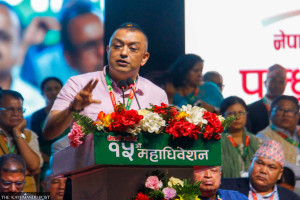
A clause in the UML statute bars fresh faces from even contesting an office bearer position. UML youth leaders join a rally during the inauguration of the party’s eleventh general convention that kicked off in Bhaktapur on Saturday. Dipen Shrestha/TKP
The Gen Z uprising in September demanded generational change in the leadership of Nepal’s political parties.
The youth protests of September 8 and 9 led to the collapse of the KP Sharma Oli-led government, in which the Nepali Congress was a major coalition partner.
The movement triggered a debate in the UML over the need for leadership handover, and a decision was made to hold the party’s 11th general convention a year ahead of schedule. The convention, which was due in around a year’s time, kicked off on Saturday.
Despite an early convention, youth leaders in the party aren’t optimistic about having meaningful youth representation in the party’s top positions.
While youth representation among convention delegates can be considered satisfactory, no separate youth cluster has been allocated for party office-bearer positions, said Rachana Khadka, a young UML central committee member from Dolakha. Nevertheless, there is confidence in the party rank and file that this general convention will break traditional notions of party leadership, Khadka argued.
“The delegates who have come to the general convention must exercise better judgement to ensure that young leaders are brought into the party’s office-bearer positions,” Khadka, who briefly led the finance ministry in the Bagmati provincial government, said.
The UML has witnessed low participation of youths in its programmes of late.
The party that used to have a strong youth constituency until some years ago now appears to rely more on senior figures, several young UML leaders lamented.
Immediately after the 2022 general elections, the party launched its Mission Grassroots campaign, but the weak participation of young people in the campaign highlighted the need to bring youngsters into the party even through special provisions.
A subsequent decision mandated the inclusion of people under 40 in various party committees—33 percent at the ward, 20 percent at the municipal, 15 percent at the district, and 10 percent at the provincial levels.
The Gen Z movement in September further reinforced the necessity of youth presence in the party.
Thereafter, arrangements were made to ensure representation at the convention of at least one delegate under the age of 40 from each of the 165 electoral constituencies and from the party’s special committees.
As a result, youth participation in this convention has been strong. Representation of those under 40 stands at around 16 percent, while those aged between 40 and 50 account for about 20 percent of the UML convention delegates, according to central member Khadka. Still youth leaders in the party see slim chances of youngsters’ election to top positions.
Mahesh Bartaula, who was the chief whip of the party in the dissolved House of Representatives, is not optimistic either.
Chances of youth leaders getting elected to any office bearers’ positions is slim as there are many leaders in the party who, despite being active in politics for long, have been denied top positions, Bartaula said.
“Except in the positions of party chair, vice-chairs and general secretary, there is nonetheless a chance that new faces will become deputy general secretaries and secretaries,” Bartaula said. “But the new faces may not necessarily be youth leaders.”
The party statute provisions the election of 15 office-bearers that include a chair, three vice-chairs, a general secretary, three deputy general secretaries and seven secretaries.
Another youth leader, Menaka Pachhai, who has been elected for the second time as a general convention representative from Karnali Province, echoed Khadka. Pachhai, however, reckons that the party this time is more serious about ensuring youth participation while selecting convention representatives.
She believes the new arrangement of a separate youth cluster of convention delegates will help boost youth representation at least in the party’s central committee.
A candidate for central committee membership from the establishment faction, Pachhai claims that there is excitement among young people regarding the new structure of the party’s leadership.
She is hopeful of new faces making it to the party’s office-bearer positions, particularly in the posts of secretary.
However, she adds that those likely to come forward may not necessarily fall within the formal definition of “youth”, but rather individuals capable of representing the sentiments of young people.
“It is unlikely that leaders under 40 will win office-bearer positions. Being a large organisation, only those having political maturity and experience will be given key positions, which should not be viewed as unnatural,” Pachhai said.
The party’s general convention, which was inaugurated on Saturday, will enter its closed-door session from Sunday. If there are no last-minute changes, two panels are likely to compete for the party’s leadership.
Oli, 74, who is seeking a third term as UML chairman, is being challenged by the party’s senior vice-chair, Ishwar Pokhrel, 71. The two factions however have yet to disclose their panels.
While the establishment faction is likely to repeat many old faces in top positions, the rival faction led by Pokhrel is quietly planning to accommodate young faces in its panel to contest office bearer positions as well, according to sources privy to the developments.
Rachana Khadka, who was the youngest UML member to be elected to the central committee from the ninth general convention in 2014, is running for party secretary from Pokhrel’s side. Khadka, in her early 40s, is likely to be among the youngest faces to contest an office bearer position.
Another youth leader preparing to contest a central committee position is Prakash Poudel. Elected a general convention representative from Myagdi district, Poudel was defeated in the race for the chair of the party-affiliated student organisation held a few months ago.
Poudel also blamed the party’s flawed structure for keeping leaders under 40 from reaching a top position.
He pointed out a clause in the party statute that bars fresh faces from even contesting an office bearer position. He said the party statute allows only those who have served at least once in the central committee to contest for office bearer positions, making it difficult for younger leaders to aim for a senior position.
“As young leaders have limited chances of meeting the criteria set out in the party statute, the prospects of those under 40 being elected as office-bearers this time are dim,” Poudel said. “However, youth representation in the central committee can still be expected to be fairly strong.”




 16.49°C Kathmandu