Boom mics and provocative questions: MPs feel the heat of viral journalism
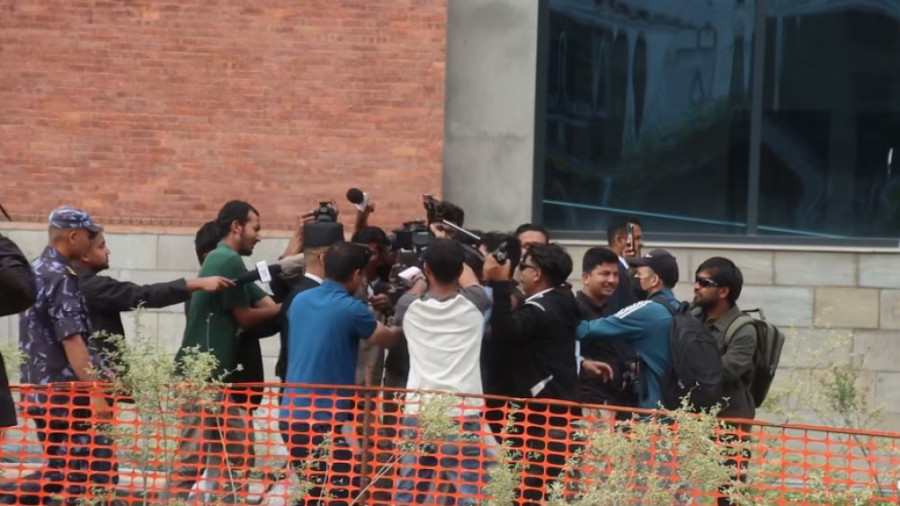
Unregulated content creators outside Parliament are blurring the line between reporting and provocation. A crowd of reporters gathers to question then home minister Sudan Gurung on the Parliament premises. Photo: Screenshot from a video posted on Facebook by Keshav Raj Joshi.
On Thursday evening, a video went viral on social media. In the 38-second clip, a group of people surrounds Finance Minister Swarnim Wagle, making it difficult for him to walk.
At first glance, it is hard to identify the minister. A closer look reveals nine individuals holding cameras, microphones, boom poles, and mobile phones. Wagle maintains a brisk walk, struggling to navigate through the crowd while being bombarded with questions: “Everyone is looking for the prime minister. What do you have to say?”
Wagle responds briefly: “The proceedings of the House of Representatives are conducted according to its rules. We are following those procedures.” He then enters through the gate, leaving those holding boom poles visibly disappointed.
The group claims to be journalists. They reach the Parliament building complex at Singha Durbar regularly, record activities, and upload the videos on platforms such as YouTube and Facebook.
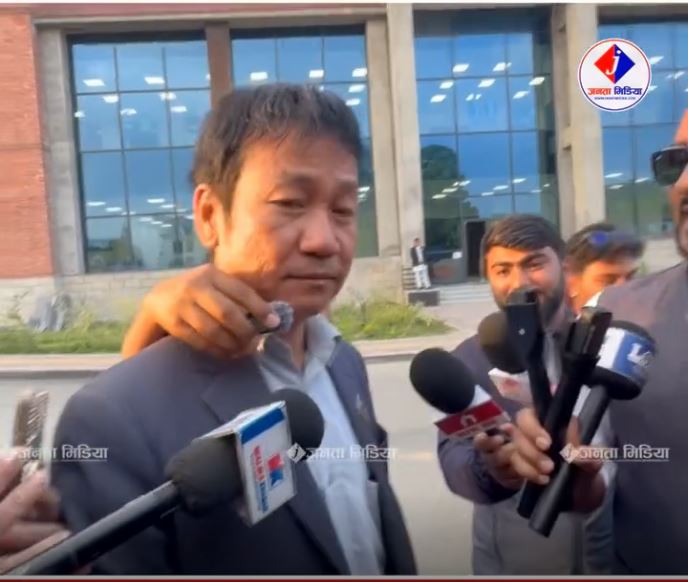
Later that day, at 6:08 pm, a 2-minute 38-second video was posted from a Facebook page called “Janata Media”. In it, Shram Sanskriti Party Chairperson Harka Raj Rai (Sampang) is surrounded by microphones and boom poles.
One member of the crowd asks, “Could you tell us what is happening?” Rai responds, “Discussion.” The person repeats impatiently: “Discussion… look over here, towards the camera.” Rai glances at the camera, then back at the person, adding, “Discussion on policies and programmes is ongoing.”
Meanwhile, another person pushes a microphone forward from behind Rai’s shoulder. Rai, visibly uncomfortable, looks at it. Another asks, “The prime minister isn’t coming, right? We’ve already received information.” Rai, uncertain, replies, “Oh really? He is supposed to come.” The video shows questions coming from all directions, leaving Rai flustered.
This has become a common scenario on the Parliament premises. Today, nearly anyone can claim to be a journalist, equipped with a mobile phone, microphone, or boom pole. Gone are the days when reporters paused, observed, and asked questions with calm discretion. The new wave of content creators often asks questions not to elicit answers, but to provoke controversy. The tone frequently borders on hostility.
Consider the questions directed at Rai: “Look over here,” “Is the prime minister coming or not?” “Yesterday you were energetic; why so subdued today?” Rai barely escapes the crowd and enters his vehicle.
Manoj Satyal, president of the Journalists' Society for Parliamentary Affairs, says this trend has placed traditional journalists, who have long covered parliamentary affairs, in a difficult position.
“Recently, the influx of content creators who ignore editorial judgment has become a major challenge. They post whatever they see immediately,” Satyal told Kantipur. “This undermines genuine journalists and may even push the Parliamentary Secretariat to restrict media access in the future.”
"However, Chakra Dani, who runs the YouTube channel Janata Media, argues that crowding around lawmakers to question them is just part of the job. “The hustle and bustle and getting jostled around in the field is completely normal. Even during our conversation with the finance minister, we were just walking and talking, which is standard practice,” he said. “At the end of the day, our main goal is simply to hold ministers and lawmakers accountable by asking them questions.”
Nepal has seen a surge in content creators. Easy internet access and affordable technology have turned content production into an economy. But experts caution: not every content creator is a journalist, and not all content constitutes journalism.
The line between reporting and provocation is increasingly blurred. Unverified content posted without editorial oversight threatens the credibility of journalism, experts say.
The impact of this behaviour is more than anecdotal; experts warn it is reshaping parliamentary reporting.
Last Wednesday (May 13) at 3:25 pm, lawmaker Indira Ranamagar was surrounded and questioned. Even when she explained she was physically unwell, the crowd persisted. “I am walking here while sick; please tell the [RSP] deputy leader. I have been walking here since morning without even eating,” she said, yet they did not leave her alone.
On May 9 and 10, during the Rastriya Swatantra Party’s training programme, a video and photo of lawmakers Shraddha Kunwar and KP Khanal went viral. Outside Parliament, YouTubers asked them unnecessary questions.
Shram Sanskiriti Party Chairperson Harka Raj Rai (Sampang) is surrounded by microphones and boom poles. Photo: Courtesy of Janata Media
On a Facebook page called “Pahilo Aawaj” on Thursday at 2:28 pm, a 1-minute 2-second video shows Khanal surrounded by a crowd. He says, “My car has arrived, I’m leaving,” but one boom pole holder approaches and asks, “Can you give a brief reaction to the photo?” He replies, “The photo might have been edited,” and hurriedly enters her car.
Later that day, at 4:18 pm, they ask again: “Your photo is currently viral on social media. Can you comment a little on that?” She responds, “I am currently busy with something; we’ll talk later, please.”
Kunwar says she feels seriously harassed. “Instead of asking about what was discussed in the House, policies, programmes, or your opinion on the budget, the media comes with microphones asking, ‘Your photo is viral, how do you feel about it?’ How appropriate is it to thrust a mic at someone’s chest?” she told Kantipur. “Chasing views and virality by intruding into someone’s personal life is harmful to both family and society.”
Similarly, lawmaker Krantishikha Dhital vented on Facebook on April 11 over what she described as persistently personal questions. “I see a pattern of starting conversations with young female MPs with comments like, ‘You look beautiful, you’ve come perfectly dressed.’ These may seem personal and harmless, but structurally, they shift attention away from substance to reduce women to their appearance,” she wrote.
“The mic you hold is for ideas, not for judging beauty. There are other platforms for that. Be mindful and responsible about how and where you ask questions.”
She later told Kantipur that such questions have largely stopped. “These days they say, ‘You shouldn’t even be asked questions.’ I’m not against questions; I just want them to be relevant and respectful,” she clarified.
An RSP lawmaker added that personal and unnecessary questions from crowds have left lawmakers mentally strained. “We go to Parliament to speak on national issues, but on the way, we worry about being stopped or harassed. If we don’t speak, the crowd gets views; if we do, they still get the views,” the lawmaker said.
Satyal says such practices of encircling lawmakers and ministers and bombarding them with unnecessary questions overshadow critical parliamentary issues.
“The trend of turning MPs exiting vehicles, walking, talking, or casual discussions into content with cheap captions has grown,” he told Kantipur. “Previously, journalists focused on policies and issues; now, ordinary and trivial activities are turned into content.”
The problem is compounded by some MPs themselves. Many prioritise social media and YouTubers to avoid scrutiny from mainstream media.
“Some MPs even allow content creators into Parliament in their own cars. Certain political leaders favour social media for one-sided messaging to bypass objective criticism,” Satyal said.
Dhital acknowledges that some MPs enjoy cheap content for popularity. “Some MPs clearly revel in views and attention. Instead of serious debate, they are pleased when their appearance or attire is praised. Even if journalists are blamed, this culture persists from the top,” she told Kantipur.
Dhital stresses that both journalists and MPs must act responsibly to correct this trend. “Both sides must be conscious. Asking questions is a journalist’s right, but they must also be mindful and responsible about what they ask, when, and how they ask. This blind race for views and TRPs must stop immediately.”
Jagat Nepal, a lecturer and veteran parliamentary reporter, does not consider this to be dignified journalism. “Right now, there are more content creators in parliament than journalists from established media outlets. They corner and harass lawmakers with overly personal questions, and even churn out AI-generated content,” he said. 'Harassing and demoralising lawmakers just for viral views and humiliating them is an insult to both the state and the public. Instead of studying the parliamentary system, many claim they want to build something new, yet they don't even know its history or how it came to be.”
Kunwar also notes that the new generation producing digital content should learn from senior journalists. “Just as seniors guide juniors in classrooms, responsible media houses should mentor new colleagues in proper journalism,” she said.
Satyal recommends that the Parliamentary Secretariat issue temporary or six-month trial passes to content creators working primarily for social media or YouTube, rather than permanent passes.
“Before granting access, the Secretariat should provide mandatory training on journalism principles, parliamentary conduct, and reporting rules," he said. "Like in the UK Parliament, Nepal should designate a press zone for cameras and interviews so MPs are not harassed while walking or obstructed unnecessarily."
Even Dani of Janata Media admits that the methods YouTubers use to question lawmakers and ministers are problematic. “On more than one occasion, I’ve felt that the way questions are being asked just isn't right. True, sometimes the approach misses the mark, but even if the delivery is clumsy, we won't stop asking questions,” he says.




 14.69°C Kathmandu