Monkey menace pushing farmers out of Nepal’s hill villages
From Tehrathum to Salyan, farmers say relentless crop destruction by monkeys and other wild animals is forcing families to abandon farming, guard fields day and night, and leave villages in search of safer livelihoods. Post file photo
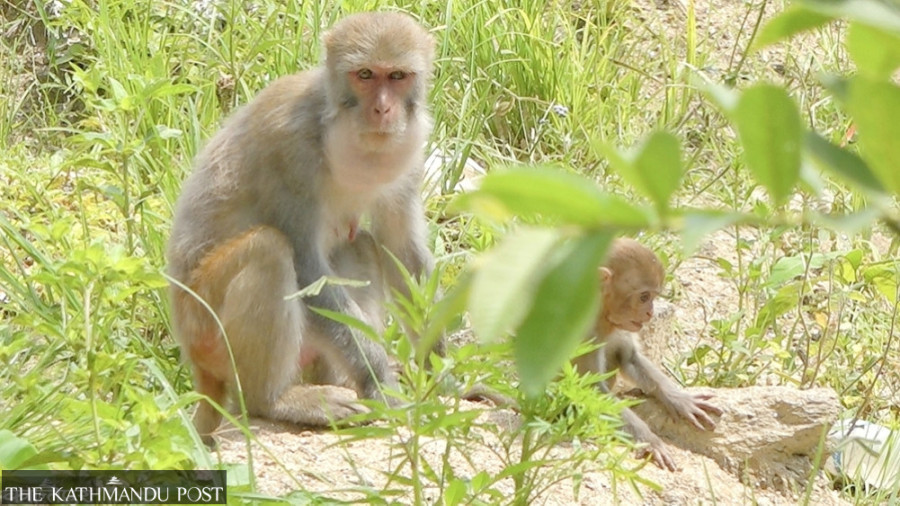
From east to west, monkey menace on farms has become a growing crisis across Nepal’s mid-hill region, driving farmers to despair, emptying granaries and, in some places, forcing entire settlements to abandon agriculture and migrate elsewhere.
The problem has become so severe that migration caused by monkey attacks is now seen as almost routine in many rural communities.
Farmers and local governments have tried a range of measures to protect crops, from planting fruit trees in forests to divert monkeys away from villages, to cutting down trees near fields, firing guns to scare animals and guarding farms throughout the day.
Last Friday, Laligurans Municipality in Tehrathum district even declared a public holiday so residents could focus on driving monkeys away from farms.
Frustrated locals say they now demand monkey-control programmes from municipalities instead of development projects. While local governments are typically expected to address education, healthcare, employment and infrastructure, farmers increasingly ask authorities for budgets to protect crops from wildlife.
But residents say the government has neither a long-term plan nor an effective solution.
Punam Magar, a farmer from Kintang in Bhirgaun, Dhankuta, said wild monkeys searching for food have made life increasingly difficult for villagers. Similar problems have been reported in Teliya of Chhathar Jorpati Rural Municipality, Kurule of Chaubise Rural Municipality and Thoka settlement near the district headquarters.
In these sparsely populated areas, farmers say they have little choice but to spend the five monsoon months guarding fields from monkeys and other wild animals. In many places, cultivation itself has declined because of repeated crop destruction.
Some local governments in Dhankuta now reportedly place monkey control at the top of their annual planning priorities. But residents say the measures have brought little relief.
Surya Bahadur Athpahariya, a resident of Thoka in ward 4 of Dhankuta Municipality, said farmers’ suffering has not eased despite repeated discussions and plans.
Bishesh Adhikari of Dhankuta, who researches monkeys, said rhesus monkeys are responsible for much of the crop damage. Studies, he said, show monkeys now depend on forests for only about 45 percent of their food, while 55 percent comes from human cultivation.
In Panchthar district, residents of ward 4 in Phidim Municipality have begun organised patrols after monkeys increasingly destroyed crops. Villagers now take turns guarding fields, with at least one member from each household participating.
Somnath Dhakal, a resident, said monkeys have become a major problem in Salghari, Thakle, Thapatar, Tiratire, Saranta and areas around the Hewa river.
Residents say monkeys no longer target only ripe crops. They also eat newly sprouted plants, young shoots and even stored grain such as maize kept inside homes.
Ward offices have begun allocating small budgets for protection efforts. Phidim-4, for instance, set aside Rs100,000 this fiscal year for monkey management. The money is being used mainly to provide snacks for villagers guarding fields.
Likewise, ward 1 of Kummayak Rural Municipality in Panchthar has hired nine guards to protect maize from monkeys. The guards receive about Rs16,000 each through daily wage payments, while the ward office has supplied equipment used to chase monkeys away.
In western hill districts such as Arghakhanchi and Gulmi, residents say monkey and wild boar attacks are increasingly forcing people to leave farming and migrate elsewhere.
Kul Bahadur Pariyar of Shitganga, Arghakhanchi, said repeated destruction of maize, millet and potato crops by monkeys and wild boars has accelerated the abandonment of agriculture.
Leela Pokharel of Panini Rural Municipality said people from all eight local units in Arghakhanchi are migrating every year in search of jobs and safer livelihoods because they can no longer protect crops from wildlife. According to him, around 1,700 people leave the district annually.
The crisis is particularly severe in settlements near forests in Shitganga, Bhumikastan, Malarani, Chhatradev, Panini and Sandhikharka.
Farmers in these areas have increasingly demanded compensation. Between the fiscal years 2022-23 and 2025-26, nearly 600 applications seeking relief for wildlife-related crop losses were filed at the Division Forest Office in Arghakhanchi.
Although forest authorities coordinated with local governments to hire 20 guards last year, locals say the effort was largely ineffective.
Hari Prasad Basyal, a federal lawmaker elected from Arghakhanchi, has also raised the issue with the government.
In Salyan, attacks by monkeys and wild boars have also intensified. Farmers say the animals destroy maize, wheat and other crops, while incidents involving attacks on people and livestock are also increasing.
Many farmers now spend entire nights awake in fields to protect crops. In some places, recurring losses have led farmers to stop cultivation altogether.
According to the Division Forest Office in Salyan, 114 applications seeking relief for wildlife-related losses to crops, livestock and humans were filed in the previous fiscal year. Office chief Tek Bahadur Rawal said 129 applications have already been submitted this fiscal year. One person was killed in a tiger attack during the period.
Farmers in Palpa say they have struggled with monkey attacks for more than a decade.
Krishna Prasad Pandey of Ribdikot said troops of monkeys can destroy a season’s crops within minutes, rendering farmers’ efforts futile.
Although all 10 local governments in Palpa mention wildlife control in their annual policies and programmes, residents say little or no budget is allocated.
“With people migrating to cities, monkeys now rule the villages,” said Mukti Aryal of Rampur.
Ribdikot Rural Municipality-1 hired nine guards last year and plans to continue the programme this year. The Division Forest Office in Palpa also plans to install 160 metres of barbed-wire fencing this year.
Khil Bahadur Tamang, information officer at the office, said promoting crops less attractive to wildlife, such as broom grass, timur pepper and bay leaves, could help reduce human-wildlife conflict.
In Baglung, some farmers have cut down trees around farmland to stop monkeys from using them as shelter and launching points for attacks on crops.
Chandra Bahadur KC of ward 13 in Baglung Municipality said locals in wards 12, 13 and 14 felled trees themselves after monkeys began gathering around homes and fields, destroying crops and harassing residents.
Narayan Prasad Paudel, ward chair of Baglung Municipality-13, said migration from the southern parts of the district has steadily increased because of the monkey menace.
Studies estimate Nepal’s monkey population at around 500,000. Researchers say the animals require roughly 1,000 metric tonnes of food every day, with about half coming from crops.
The growing dependence of monkeys on cultivated land, experts say, is intensifying conflict between humans and wildlife across rural Nepal.




 14.4°C Kathmandu


.jpg)