Ayushma Chepang passed Grade 5. Home duties keep her in the same class
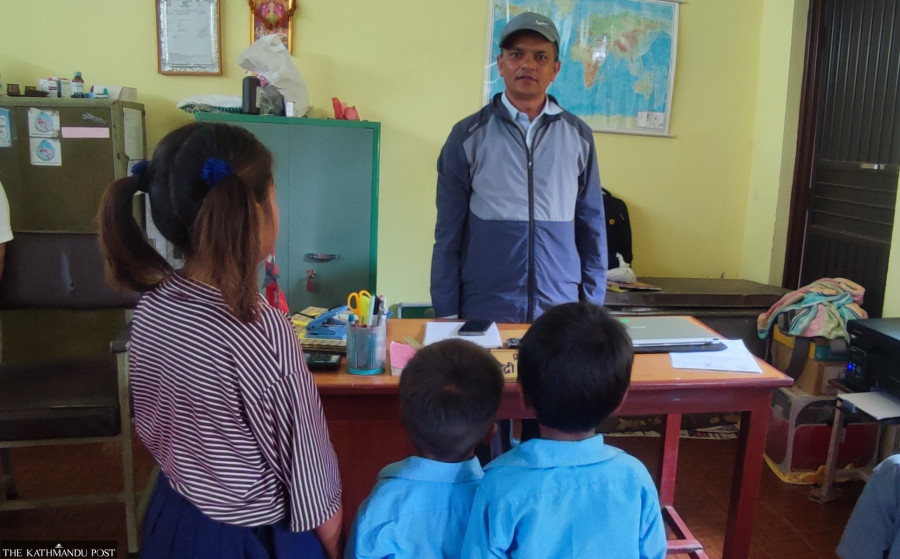
In a remote Chitwan village, an 11-year-old girl is stuck repeating a class she cleared—not because she failed, but because the next school is two hours away. Ayushma Chepang (left) with her two brothers and principal Badri Prasad Paudel. Ramesh Kumar Paudel/TKP
Ayushma Chepang, 11, who has completed Grade 5, has been forced to repeat the same class due to family responsibilities and the lack of a nearby higher school in her rural settlement of Kamalpur in ward 29 of Bharatpur Metropolitan City.
Ayushma is among four students currently studying in Grade 5 at the National Basic School in Kamalpur, which has classes only up to 5.
Although she has already passed the grade, she has had to remain in the same class. A secondary school offering education up to Grade 10 exists in Chaukidanda, but it is more than two hours away on foot through a forest trail that involves steep uphill and downhill walks, making daily travel unsafe and impractical for her.
“She could not be sent there because there were no other children from this village going to that school. The distance is long, and the forest route is risky for a child travelling alone,” said school principal Badri Prasad Paudel.
Because of these constraints, the school re-enrolled her in Grade 5 despite her passing. The Act Relating to Compulsory and Free Education, 2018, guarantees compulsory education up to Grade 8 and free education up to Grade 12. It also states that basic education facilities should be available within two kilometres of a child’s home, and that local authorities must ensure schools or alternative arrangements are available if none are accessible.
In Ayushma’s case, no nearby school meets this requirement.
Last academic year, there were four students in Grade 5 at the school, all of whom passed. While others were able to continue their studies in nearby areas such as Jugedi, Ayushma did not have that option.
“She is a good student. She passed Grade 5. But she has younger brothers, and she is responsible for taking care of them and bringing them to school,” Principal Paudel said.
Ayushma’s mother has left the family after remarrying, and her father is absent from the household. The children live with their elderly grandmother in a small settlement called Dui Ghare, located slightly below the school.
Ayushma’s younger brothers, Ayun and Ayush Chepang, now attend Early Childhood Development (ECD) and Grade 1, respectively. Their school attendance has become easier because of Ayushma’s presence, as she accompanies them daily.
“The children are given breakfast at school because of the long walk. Ayushma is the one who takes care of them,” the principal added.
Ayushma has been caring for her brothers since early childhood. Her grandmother, Phoolmati Chepang, said Ayun was only 15 months old when his mother left the family. He recently turned four.
“Their mother left. Their father lives away in Narayanghat and comes home only once or twice a year,” she said.
At 66, Phoolmati is the main caregiver for the children while their father works away from home.




 23.25°C Kathmandu
1.jpg)