Landless squatters question government’s commitment to resolving land issues
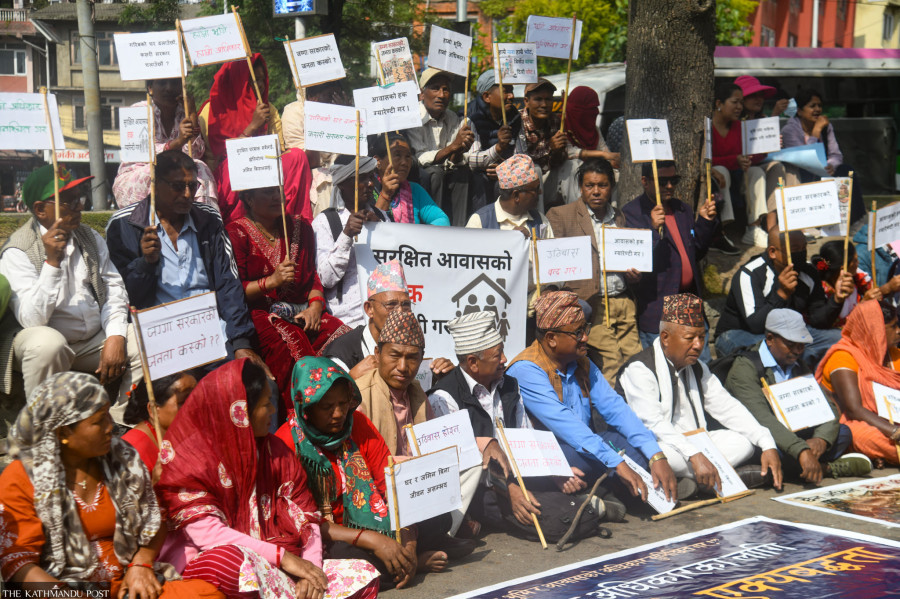
With only four provisions on land-related concerns in the government’s annual policy and programme, activists and informal settlers say key questions over land rights, housing security and evictions remain unanswered. Representatives from landless communities across 20 districts protest at Maitighar, Kathmandu last week. Deepak KC/TKP
Only four of the 100 points included in the government’s annual policy and programme, presented in Parliament, directly address land-related issues, prompting concerns among land rights activists and landless communities about the government’s commitment to resolving the longstanding issue.
Point 17 of the policy document mentions the concept of a land bank. The government says it will discourage the growing trend of leaving cultivable land barren and use a land bank system to bring unused farmland back into production. It has promised to ensure access to such land for young people, women, landless groups, and small and marginal farmers.
The policy also says farmers will be identified through official registration, identity cards and credit cards to improve access to concessional finance and technology. It further promises to encourage contract farming, cooperative farming and agroforestry systems.
The idea of a land bank was first included in Nepal’s National Land Policy, formulated after the promulgation of the constitution in 2015. However, the concept has yet to be implemented in practice.
In recent years, increasing urban migration, large-scale labour migration abroad, climate change impacts on agriculture, and inadequate irrigation facilities have contributed to a rise in abandoned farmland across Nepal. Although successive governments have repeatedly promised farmer registration systems and farmer identity cards linked to subsidies, implementation has remained weak.
The government’s plans to expand production through contract farming, cooperative farming and agroforestry appear ambitious on paper. However, questions remain over the model’s practicality and how the state intends to implement it. Land experts say that providing land access to landless agricultural labourers and small farmers through contract farming could help boost production and improve livelihoods, but the effectiveness of such policies can only be judged after implementation.
Point 18 of the policy and programme addresses land survey and land revenue administration. It states that cadastral and land revenue services will be integrated and gradually expanded to all local units. The government also plans to modernise land mapping and update land records using advanced technologies.
The policy further says that the state will seek a long-term solution for landless squatters and informal settlers living in insecure locations by arranging safe and appropriate housing.
Before coming to power, the Rastriya Swatantra Party (RSP) had pledged in its election manifesto to resolve the problems faced by landless squatters and informal settlers within 1,000 days by establishing a dedicated authority.
The same issue was included in the government’s 100-day roadmap announced shortly after Prime Minister Balendra Shah assumed office.
The government had instructed the then Land Problem Settlement Commission to complete data collection and verification of landless squatters and informal settlers within 60 days. However, no official progress report has yet been made public. Authorities have not disclosed how many families have been surveyed or verified.
Meanwhile, several major developments have significantly altered the land rights debate.
First, the government carried out eviction drives against landless and informal settlers in the Kathmandu Valley. Authorities used bulldozers to clear settlements and relocated residents to temporary holding centres. Rights groups estimate that around 20,000 people have been displaced.
Following directives to clear public and government land, eviction notices have also been issued in districts outside Kathmandu, including in Banke and Parsa.
Second, the government amended the Land Act 1964 through an ordinance.
Third, it dissolved the Land Problem Settlement Commission.
At the same time, the government has initiated a process to provide land administration services, including land revenue and cadastral services, through local units. After a public call for applications, 35 local units have been granted permission to begin providing these services in the first phase.
Point 69 of the policy and programme promises affordable and adequate housing schemes for homeless, marginalised, poor and disaster-affected communities. It also commits to identifying genuine landless people and ensuring them permanent housing and ownership rights.
The same commitment was included in the government’s 100-day roadmap.
However, critics argue that the government’s actions contradict its promises. Eviction campaigns against informal settlements have displaced many landless families, who are now living in holding centres for prolonged periods.
Rights groups say the displacement has severely affected livelihoods, food security and children’s education, triggering protests across the country. Landless and informal settler groups in several districts have launched demonstrations demanding housing security and land rights.
Point 70 of the policy document says the government will implement integrated settlement projects with land-use planning, infrastructure and community services to manage scattered and high-risk settlements.
Although Nepal introduced the Land Use Act in 2019, implementation has remained limited. Unmanaged settlements continue to grow, while many planned integrated settlements still lack basic infrastructure.
Nepal also faces mounting disaster risks due to settlements located in vulnerable areas.
According to Nepal’s Disaster Portal, 8,031 disaster-related incidents were recorded over the past year, killing 497 people and leaving 37 missing. Nearly 2,000 people were injured, and economic losses exceeded Rs2 billion.
Over the past decade, Nepal recorded 51,607 disaster-related incidents. The disasters killed 15,073 people, injured 39,210 and left 849 missing. Economic losses totalled around Rs34 billion. Officials say the frequency and severity of such incidents are increasing each year.
Land expert Jagat Deuja says the government’s policy remains vague regarding the rights of landless and informal settlers.
“The policy talks about safe and appropriate housing management, but it does not clearly define how the rights of landless and informal settlers over land they have occupied for decades will be recognised,” he said.
Deuja added that while the current government appears to prioritise agriculture overall, it has not clearly addressed critical issues such as agricultural land protection or the rights of tenant farmers cultivating guthi and private land.
He said the government now needs to prioritise comprehensive land records, effective land-use planning and secure land rights for landless people, informal settlers and small farmers.
As landless and squatter groups from across Nepal travelled to Kathmandu to voice their grievances, representatives of the National Land Rights Forum Nepal visited the RSP office in Banasthali on May 12. They submitted a memorandum through the party’s deputy parliamentary leader, Ganesh Parajuli.
Forum chair Lyam Bahadur Darji submitted a 12-point demand, urging the government not to displace landless and informal settlers and to pursue dialogue-based solutions.
During discussions with representatives, Parajuli said the RSP remained committed to managing settlements for landless squatters within 1,000 days and insisted that no one would be deprived of land rights.
Despite those assurances, many landless families and displaced settlers say they remain unconvinced, citing recent eviction campaigns and the lack of a clear roadmap for guaranteeing land ownership and long-term housing security.




 21.66°C Kathmandu